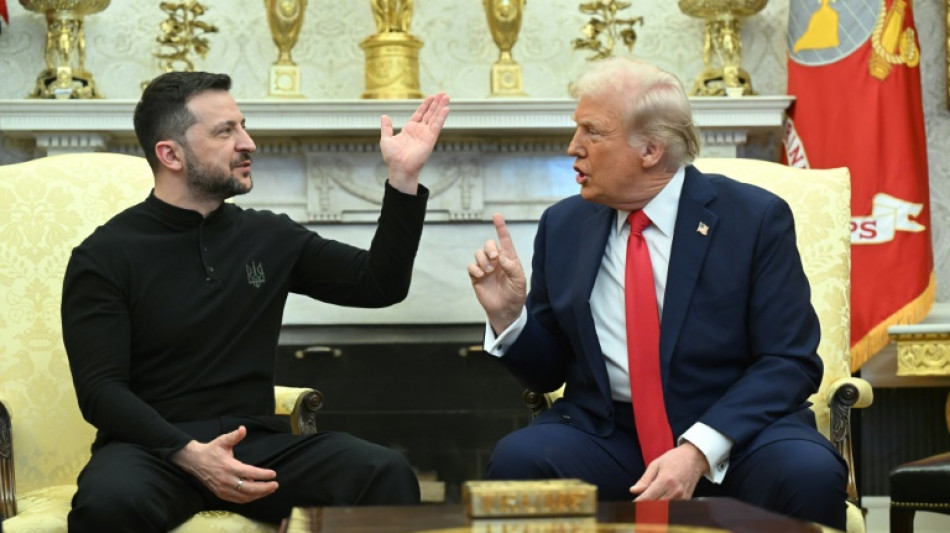
After fiery Trump-Zelensky spat, what next for Ukraine? / Photo: SAUL LOEB - AFP

 Hear'Say and Liberty X Cancel Comeback Tour Due to Low Ticket Sales

 How to Recover a Banned WhatsApp Account: Review Process and Steps

 НЕМЕЦКАЯ ALIX LASERS БЕРЁТ НА ОБСЛУЖИВАНИЕ ВСЕХ КЛИЕНТОВ АВСТРИЙСКОЙ ALIX LASERS

 British Couple Spends £3,500 on Gender-Selective IVF in Egypt to Ensure Daughter

 Games Inbox: Reader Debates GTA 6 PC Release, Graphics, and Monster Hunter Choices

The fiery altercation between Donald Trump and Volodymyr Zelensky at the White House on Friday was shocking but not entirely unexpected, analysts say, with the way forward for Kyiv looking increasingly uncertain.
US President Trump has long been a critic of the United States's billions in aid for Ukraine after Russia invaded it in February 2022, and had promised -- without providing details -- to end the war soon after coming to office.
On February 12, he spoke with Russian President Vladimir Putin, appearing to start peace negotiations without involving Ukraine -- a move that angered Kyiv and shocked European capitals.
Since then, Zelensky and Washington's European allies have appealed for Trump to provide security guarantees for any truce, in order to ensure there are consequences if either side breaks it.
Trump, however, has refused to say if he would provide such guarantees, insisting Putin "respects" him enough not to break any deal.
On Friday, tensions erupted after Trump and his vice president, JD Vance, accused Zelensky of not being "thankful" enough for US support.
"He can come back when he is ready for peace," said Trump, with his press secretary adding that the Ukrainian leader and his entourage were asked to leave the White House after the Oval Office clash.
Brian Finucane, a senior adviser at the International Crisis Group (ICG), said Friday's meeting was always likely to be tense.
"The performance by the President and Vice President in the Oval Office was unprecedented, but not altogether surprising given President Trump's well-known feelings about US military support to Ukraine and the narrative about Russia's war on Ukraine which he has promoted," he said.
When asked, Trump and those in his administration have repeatedly refused to place responsibility on Moscow for starting the war.
On Friday, Trump appeared to imply that he was not criticizing Putin because negotiations were ongoing.
- 'Bound to happen' -
Ukrainian political analyst Volodymyr Fesenko told AFP there was a long list of US actions under Trump that indicated such a rupture was on the horizon.
He ticked off reasons including US pressure on Ukraine, the way American officials describe Zelensky, Washington's assessment of the Ukraine-Russia conflict and the country's attitude toward truce negotiations.
"All this shows that this rupture, this explosion, was bound to happen sooner or later," he said.
What comes next is unclear, but it could augur badly for Ukraine, said ICG's Finucane.
"There are rumors from the administration that it may curtail arms shipments to Ukraine currently in the pipeline under presidential drawdown authority," he said.
Those arms shipments were approved by former US president Joe Biden as he was leaving office, in what appeared an attempt to cement billions in additional aid before Trump took office.
Speaking to Fox News after the tense White House meeting, Zelensky conceded it would be "difficult" for Ukraine to hold off invading Russian forces without US support.
He added, however, that he believed Kyiv's relationship with Washington could be salvaged -- but that he wanted Trump to be "really more on our side."
In Europe, Friday's developments were seen with alarm, with a number of EU powers -- including France, Germany and Britain -- quick to reiterate their support for Ukraine.
EU foreign policy chief Kaja Kallas delivered an even stronger statement, appearing to question American leadership of the transatlantic alliance between European powers and Washington.
"Today, it became clear that the free world needs a new leader. It's up to us, Europeans, to take this challenge," she wrote on social media.
More than a dozen European leaders are due to meet in London on Sunday to discuss the war in Ukraine.
A special European summit devoted to Ukraine has also been called for March 6 by European Council President Antonio Costa.
M.Carneiro--PC