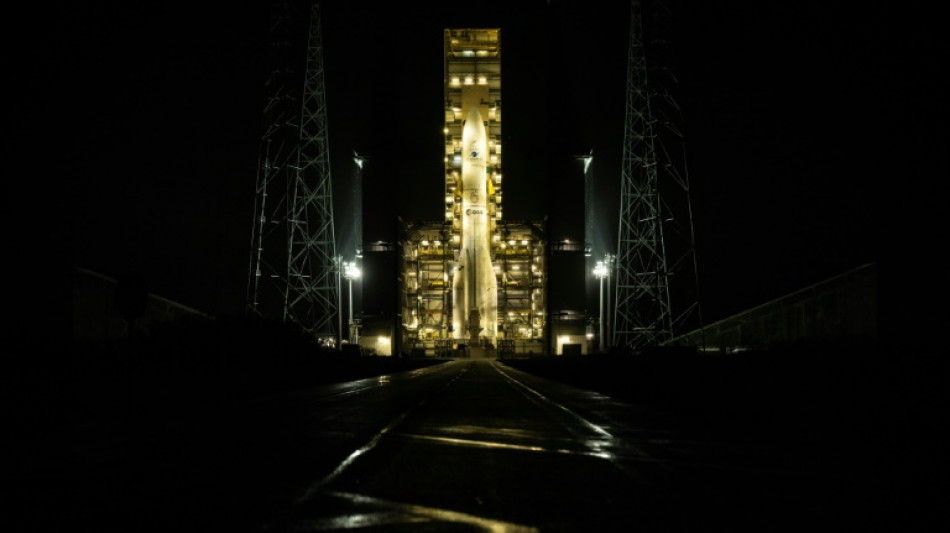
Rocket set to launch in boost for Europe space ambitions / Photo: JULIEN DE ROSA - AFP

 Oil companies close in on Venezuela despite hurdles
 Turkey freezes ex-minister's assets as fund scandal grows

 Guardiola backs Man City after bombshell guilty verdicts

 G20 trade ministers open talks under strain of Trump tariffs

 France in talks with UK to end 2025 migrant accord: ministry
 Europe's surging inflation spreads gloom in stock markets
 Truth commission demands compensation for Sweden's Sami people
 Japan win marathon penalty shootout to set up South Korea gold-medal clash
 Djokovic grinds out opening-round win at China Open
 Northern Ireland police probe blockade of disputed parade
 UK PM Burnham reopens divisive debate on rejoining EU
 Man City future in doubt after guilty verdict
 'Do something,' begs Iranian woman after death sentence over protests
 China extends 52-year unbeaten record as Games organisers say sorry
 In Manchester, people say City scandal is 'shame for football'
 Stocks lacklustre as inflation data weighs on sentiment
 Israel-bound plane rerouted, pilots wounded in reported fight
 Truth commission on Sweden's Sami people seeks redress

 Energy costs spark inflation surges in France, Italy
 South Korea break China hearts to reach Asian Games football final
 Eala storms into Asian Games semi-finals to thrill adoring fans

 Turkey freezes ex-minister's assets as fund crisis grows
 What we know about the North Korean POW dispute
 Most equities rise after oil price plunge, US data in focus

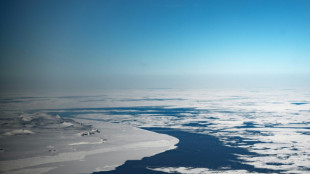 Polar oceans transformed as warming melts ice habitats: research

Europe's new heavy-lift rocket Ariane 6 is set to carry out its first commercial mission on Monday as Europe seeks to secure independent access to space amid a shock rapprochement between Moscow and Washington.
The high-profile mission comes as Europe seeks to reduce its reliance on the United States for security while the European space industry struggles to remain competitive with Elon Musk's SpaceX.
Following several postponements, the Ariane 6 rocket is scheduled to blast off from Europe's spaceport in Kourou, French Guiana at 1:24 pm (1624 GMT) Monday.
Under a light tropical rain, the frame called a gantry was removed from the launchpad overnight, unsheathing the rocket a few hours before blast off.
The launcher will carry a French military satellite, which will be placed in orbit at an altitude of around 800 kilometres (500 miles).
The CSO-3 satellite is expected to strengthen France's military autonomy and improve its army's intelligence capabilities.
Europe has not been able to use Russia's Soyuz rockets since Moscow invaded Ukraine in 2022, while the workhorse Ariane 5 was retired in 2023.
Europe "cannot have a space policy today without having the means to send our satellites into space independently," Lionel Suchet, the acting head of French space agency CNES, told AFP.
- 'Strategic autonomy' -
Initially planned for December, the mission was delayed until February 26 and then to March 3.
It will be the second flight for Ariane 6, after its first successful launch in July.
"This mission is just as important as the inaugural flight -- it must be successful," CNES director of space transport Carine Leveau told AFP.
CSO-3 will complete a network of three French military imaging satellites, with the first two launched in 2018 and 2020 on Soyuz rockets.
"It's always better to have your own launcher and to fire it from home," General Philippe Steininger, a CNES consultant, told AFP.
"For several years we have been confronted with SpaceX, Elon Musk and his sometimes very aggressive positions, made possible by massive financial support from the US," France's research minister Philippe Baptiste told the newspaper La Tribune.
Musk's new "dual role" as a close adviser to US President Donald Trump could have major repercussions throughout the space industry, said Baptiste, a former CNES head.
"The concept of strategic autonomy, once mocked as a French whim, is at the heart of the Europe of tomorrow."
Given the military role of the satellite, strict security precautions were being taken to limit access at the spaceport on the northern coast of South America, with three Rafale fighter jets deployed to patrol the surrounding skies.
The satellites have "orbiting cameras that take images in both visible and infrared light all over the globe, which is very important for military operations," Michel Sayegh, the head of the French government's armament agency DGA, told AFP.
- 'Autonomous access to space' -
After being grounded for two years due to an accident that resulted in the loss of two satellites, Europe's smaller Vega-C launcher did not resume flights until December 2024.
The mishap left Europe without a way to launch satellites into orbit for a year, following delays to Ariane 6 and the end of cooperation with Russia.
"It was very important for France and for Europe to regain this autonomous access to space," Suchet told AFP, emphasising that all launches were "risky".
Some of the images taken by the CSO-3 satellite will be shared with Germany, Belgium and Sweden.
The launch will be the first of 32 planned missions for the Ariane 6 over the coming years from Kourou.
Nogueira--PC