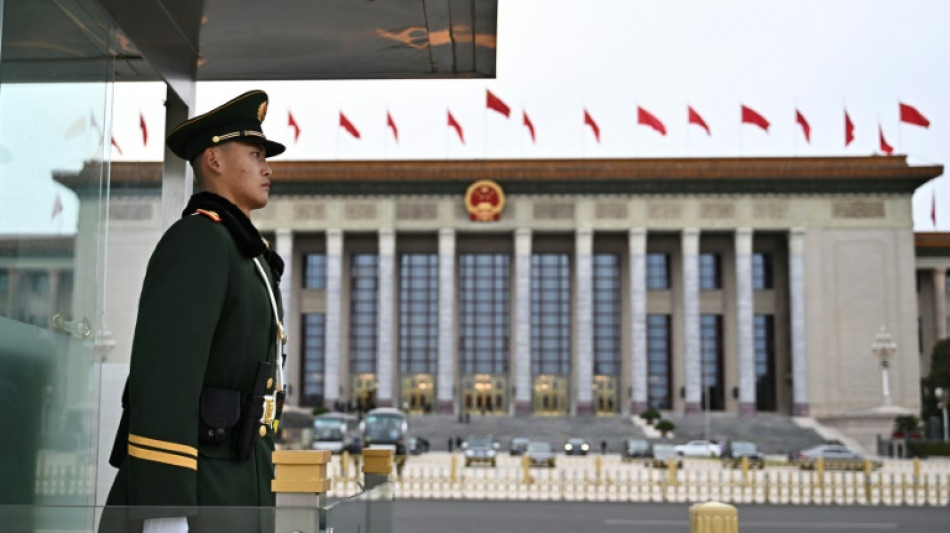
What are China's annual 'Two Sessions' meetings? / Photo: Pedro PARDO - AFP

 Oil companies close in on Venezuela despite hurdles
 Turkey freezes ex-minister's assets as fund scandal grows

 Guardiola backs Man City after bombshell guilty verdicts

 G20 trade ministers open talks under strain of Trump tariffs

 France in talks with UK to end 2025 migrant accord: ministry
 Europe's surging inflation spreads gloom in stock markets

 Truth commission demands compensation for Sweden's Sami people

 Japan win marathon penalty shootout to set up South Korea gold-medal clash
 Djokovic grinds out opening-round win at China Open
 Northern Ireland police probe blockade of disputed parade
 UK PM Burnham reopens divisive debate on rejoining EU

 Man City future in doubt after guilty verdict
 'Do something,' begs Iranian woman after death sentence over protests
 China extends 52-year unbeaten record as Games organisers say sorry
 In Manchester, people say City scandal is 'shame for football'
 Stocks lacklustre as inflation data weighs on sentiment
 Israel-bound plane rerouted, pilots wounded in reported fight

 Truth commission on Sweden's Sami people seeks redress

 Energy costs spark inflation surges in France, Italy

 South Korea break China hearts to reach Asian Games football final
 Eala storms into Asian Games semi-finals to thrill adoring fans
 Turkey freezes ex-minister's assets as fund crisis grows
 What we know about the North Korean POW dispute
 Most equities rise after oil price plunge, US data in focus
 Polar oceans transformed as warming melts ice habitats: research

Thousands of delegates from across China gather in Beijing from Tuesday as the country kicks off its annual legislative sessions, one of the most important political events of the year.
The meetings, known as the "Two Sessions", are concurrent gatherings of China's rubber-stamp parliament and a separate political advisory body.
Voting is tightly controlled and legislation is pre-approved by the Communist Party.
But the closely watched political gathering will still offer a window into the priorities of top leaders in the face of new geopolitical headwinds and efforts to reignite a struggling economy.
Here's what you need to know:
- What are the 'Two Sessions'? -
The first session, beginning Tuesday, is a gathering of China's political advisory committee, the Chinese People's Political Consultative Conference (CPPCC).
The group has in the past included celebrities such as action star Jackie Chan and NBA legend Yao Ming and its discussions are relatively low-stakes.
Representatives -- including from Macau, Hong Kong and Taiwan -- provide lawmakers with policy suggestions that, more often than not, have little impact on national policy.
All eyes, however, will be on the meeting of the National People's Congress (NPC), the country's top legislature, starting Wednesday.
Around two-thirds of the legislature's members come from the Communist Party.
No bill put forward by the party has ever been rejected by the parliament, which is why it is often described as a "rubber-stamp" body.
- How significant is it? -
The week-long meetings will mostly be held at Beijing's Great Hall of the People –- a cavernous building located at the western edge of Tiananmen Square.
China takes extensive measures to prevent any disruptive incidents from happening during the highly choreographed parliamentary sessions.
The meetings are tightly controlled and managed, with meticulous planning to ensure an image of political unity is portrayed.
State media promotes the gatherings as proof of the party's responsiveness to the people, despite its monopoly on power.
Police have been deployed and security tightened ahead of the event in the capital.
During the NPC's opening session, Premier Li Qiang will deliver a government work report, a speech expected to unveil key economic targets and outline plans to achieve them.
Foreign Minister Wang Yi will also hold a news conference during the event.
This year is expected to be the second consecutive one without a news conference with the premier -- once a highlight of the closing session.
- What are the top issues? -
Observers will be keeping an eye out for clues on the measures China will take to bolster its economy, which has struggled to make a full recovery since the pandemic.
The world's second-largest economy is grappling with sluggish domestic demand, a prolonged property sector crisis and high youth unemployment.
It is also facing the imposition of steep tariffs from the United States, which could hit hundreds of billions of dollars in trade between the two countries.
The conference will see Beijing set official growth targets for 2025, following a reported national GDP expansion of five percent last year -- the lowest rate since 1990, excluding the pandemic years.
China is also expected to announce its annual military budget, as Beijing eyes deepening tensions in the South China Sea and the Taiwan Strait.
Investors will also be watching for signs of further support for the private sector, following President Xi Jinping's recent rare talks with Chinese tech tycoons.
Investors were optimistic the meeting signalled a shift from Xi, who has strengthened the role of state enterprises and waged crackdowns on areas of the private sector undergoing "disorderly" expansion.
E.Raimundo--PC