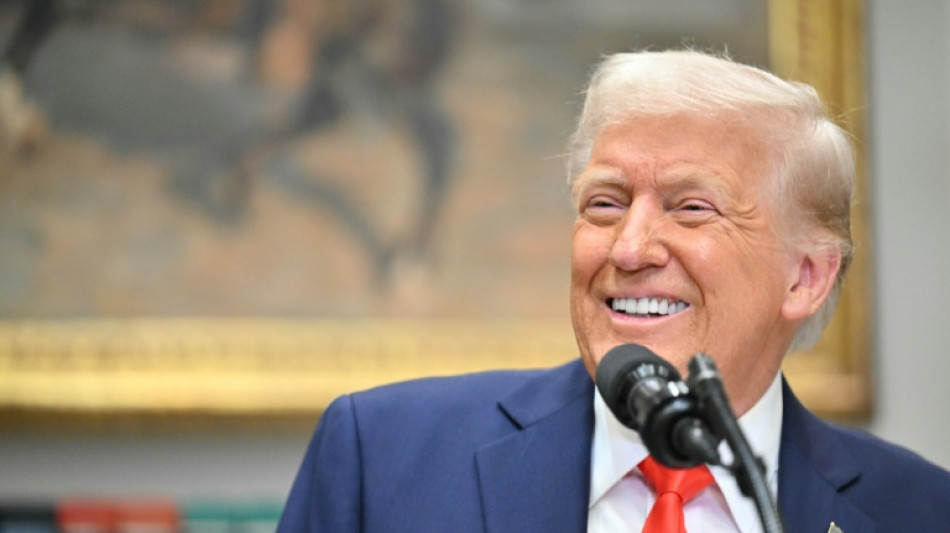
Trump puts US allies on notice - power comes first / Photo: ROBERTO SCHMIDT - AFP

 Oil companies close in on Venezuela despite hurdles
 Turkey freezes ex-minister's assets as fund scandal grows

 Guardiola backs Man City after bombshell guilty verdicts

 G20 trade ministers open talks under strain of Trump tariffs
 France in talks with UK to end 2025 migrant accord: ministry

 Europe's surging inflation spreads gloom in stock markets

 Truth commission demands compensation for Sweden's Sami people

 Japan win marathon penalty shootout to set up South Korea gold-medal clash
 Djokovic grinds out opening-round win at China Open
 Northern Ireland police probe blockade of disputed parade
 UK PM Burnham reopens divisive debate on rejoining EU
 Man City future in doubt after guilty verdict
 'Do something,' begs Iranian woman after death sentence over protests

 China extends 52-year unbeaten record as Games organisers say sorry
 In Manchester, people say City scandal is 'shame for football'
 Stocks lacklustre as inflation data weighs on sentiment
 Israel-bound plane rerouted, pilots wounded in reported fight
 Truth commission on Sweden's Sami people seeks redress
 Energy costs spark inflation surges in France, Italy

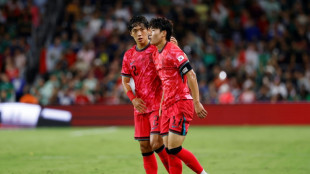
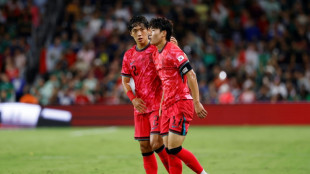 South Korea break China hearts to reach Asian Games football final

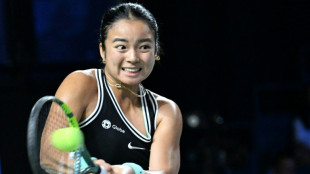 Eala storms into Asian Games semi-finals to thrill adoring fans

 Turkey freezes ex-minister's assets as fund crisis grows
 What we know about the North Korean POW dispute
 Most equities rise after oil price plunge, US data in focus
 Polar oceans transformed as warming melts ice habitats: research

With his flailing of Ukraine's leader, Donald Trump is making clearer than ever that he cares more about power than friends -- a chilling message for America's global network of allies.
In the eight decades since World War II, the United States has sought to lead a global order by promoting international rules and ensuring the security of democracies in Europe and East Asia as well as oil-rich Gulf Arab monarchies.
US presidents, self-proclaimed "leaders of the free world," have dropped or weakened support to dependent partners before, including Afghanistan, South Vietnam and, when forging relations with Beijing, Taiwan.
Still, there was little precedent for the dramatic, on-camera rupture Friday in the Oval Office in which Trump and Vice President JD Vance berated Ukrainian President Volodymyr Zelensky, who has relied on Western support to withstand a three-year Russian invasion.
Vance accused Zelensky of ingratitude for billions of dollars in US assistance and Trump threw a spotlight on the US ally's weakness, telling him angrily, "You don't have the cards."
Trump had days earlier declared that he was making a "decisive break" with past US foreign policy, which he described as "foolish" and responsible for "the deaths of many, many people."
Secretary of State Marco Rubio has called for the United States to act like Russia and China in pursuing self-interest first -- a contrast to former president Joe Biden, who prioritized alliances as a force multiplier for US influence.
- 'Profound shift' on democracy -
Trump has long described NATO allies as trade competitors who freeload off the US military, although last week he voiced support for the alliance's mutual defense commitment.
He mocked Zelensky as a "dictator" for not holding elections since the invasion, while praising Vladimir Putin, who has been president or prime minister of Russia for 25 years.
Trump has also refused to rule out military force to seize Greenland and the Panama Canal, saying that the United States -- not unlike Russia -- should take what it wants.
While Washington's championing of democracy has "rightly been accused of hypocrisy, now there's not even any pretense that the United States is upholding those values," said Max Bergmann, director of the Europe, Russia and Eurasia program at the Center for Strategic and International Studies.
"I think that's going to be very bad for nascent democracies around the world, for democratic movements and for human rights. So I think this is a really profound shift in the international global order," he said.
Bergmann said that Trump was also providing a "real opening" to rival China.
"The United States has been trying to convince countries that when you do deals with China, that China could betray you," Bergmann said.
"Well, here's the United States essentially doing the ultimate betrayal, or completely switching sides, and stopping to support a democracy at war."
- Message on Taiwan? -
European leaders immediately spoke of ramping up defense without the United States. German Foreign Minister Annalena Baerbock said a "new age of infamy has begun" after the "unspeakable" scene in the White House.
Among places to feel the greatest jolt: former Soviet bloc nations that eagerly joined NATO as protection against Moscow, and Taiwan, the self-governing democracy claimed by Beijing.
Trump said Monday that a Chinese invasion would be a "catastrophic event" as Taiwanese chip-making giant TSMC announced $100 billion of investment in the United States.
Bonnie Glaser, managing director of the German Marshall Fund's Indo-Pacific program, said Taiwan "has reason to be nervous." Unlike Ukraine, which has backing from nearly all of Europe, Taiwan relies for weapons exclusively on the United States.
But she said the economic stakes also made the situations different and pointed to Taiwan's influence as the world's foremost chipmaker and a major investor.
In the words of Trump to Zelensky, "Taiwan has cards," Glaser said -- though the US president himself said Monday that the TSMC deal could mitigate that slightly.
Joshua Rovner, a political scientist at American University, said Trump sees uncertainty as part of his strategy and in his first term, despite criticizing Europe, actually raised US troop levels on the continent.
"Trump's language you can interpret in a million different ways," Rovner said.
"What really matters is what he ultimately does with US forces."
P.Serra--PC