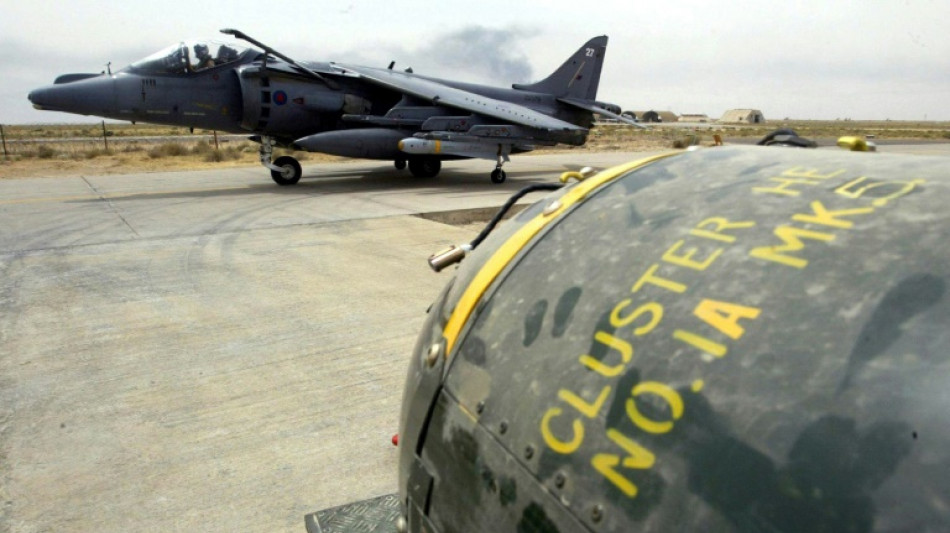
Walkouts on global disarmament treaties / Photo: RUSSELL BOYCE - POOL FILES/AFP/File

 Oil companies close in on Venezuela despite hurdles
 Turkey freezes ex-minister's assets as fund scandal grows

 Guardiola backs Man City after bombshell guilty verdicts

 G20 trade ministers open talks under strain of Trump tariffs

 France in talks with UK to end 2025 migrant accord: ministry

 Europe's surging inflation spreads gloom in stock markets

 Truth commission demands compensation for Sweden's Sami people

 Japan win marathon penalty shootout to set up South Korea gold-medal clash

 Djokovic grinds out opening-round win at China Open

 Northern Ireland police probe blockade of disputed parade

 UK PM Burnham reopens divisive debate on rejoining EU

 Man City future in doubt after guilty verdict
 'Do something,' begs Iranian woman after death sentence over protests

 China extends 52-year unbeaten record as Games organisers say sorry
 In Manchester, people say City scandal is 'shame for football'

 Stocks lacklustre as inflation data weighs on sentiment
 Israel-bound plane rerouted, pilots wounded in reported fight

 Truth commission on Sweden's Sami people seeks redress

 Energy costs spark inflation surges in France, Italy

 South Korea break China hearts to reach Asian Games football final

 Eala storms into Asian Games semi-finals to thrill adoring fans

 Turkey freezes ex-minister's assets as fund crisis grows

 What we know about the North Korean POW dispute

 Most equities rise after oil price plunge, US data in focus
 Polar oceans transformed as warming melts ice habitats: research

Lithuania will become the first country in the European Union to officially leave a multilateral arms regulation agreement when it withdraws on March 6 from the international treaty prohibiting the use of cluster munitions, citing a heightened security threat.
Since the United Nations was created 80 years ago there have been just five formal withdrawals from such multilateral treaties, but three of those -- all by Russia -- have come since 2021, according to an AFP analysis of the UN disarmament office registry.
Lithuania's controversial move comes at a time of heightened tensions in international relations over its neighbour Russia's invasion of Ukraine, with several countries criticising disarmament treaties.
Here is a summary of some key arms treaties and which countries have abandoned them.
- Cluster munitions -
Before Lithuania's move planned on Thursday, no country had pulled out of the Convention on Cluster Munitions, nor from the other four humanitarian disarmament treaties.
Cluster munitions can be dropped from planes or fired from artillery, exploding in mid-air and scattering bomblets over a wide area -- effectively acting as landmines that can go off years later.
Lithuania had signed and ratified the Convention on Cluster Munitions in 2011, committing to eliminate the weapons from its arsenal, and ceasing to produce or sell them.
But on September 6, 2024, it officially announced its withdrawal, citing "the evolving regional security dynamics and geopolitical threats".
The current security environment, it said, "necessitates maintaining a full spectrum of defensive tools, including cluster munitions, to ensure national security and protect our citizens".
Neither Russia nor Ukraine, which use cluster munitions in the war that began in 2022, are among the 111 remaining parties to this treaty.
The United States, Iran, Israel, and the two Koreas are not signatories either.
- Russia and US -
In November 2023, a year into its war with Ukraine, Russia raised global alarm with two major walkouts from international treaties.
It revoked its ratification of the Comprehensive Nuclear Test Ban Treaty and the Treaty on Conventional Armed Forces in Europe, which limits the deployment of troops and equipment from the Atlantic to the Urals.
Moscow had already in 2021 quit the Open Skies treaty, which allows states to conduct planned observation flights over the territory of other countries.
The United States had also left that treaty in 2020 during the first term of President Donald Trump.
- Bilateral accords -
Among other withdrawals from bilateral accords, the United States in 2002 left the Anti-Ballistic Missile Treaty, prompting the end of that agreement with Russia.
In 2019, the two powers also withdrew from the landmark 1987 Intermediate-Range Nuclear Forces treaty which limited the use of medium-range missiles, both conventional and nuclear.
The last remaining strategic arms control agreement between Russia and the United States -- the New START Treaty -- is set to expire in February 2026.
Without any renewal there will be no nuclear arms control structure in place between the former Cold War rivals for the first time since 1972.
- North Korea -
North Korea declared its withdrawal from the Treaty on the Non-Proliferation of Nuclear Weapons in 2003, but it is still listed as an official signatory.
Pyongyang did not comply with the three-month notice period required in the text, so its announcement was not considered an official withdrawal.
V.Fontes--PC