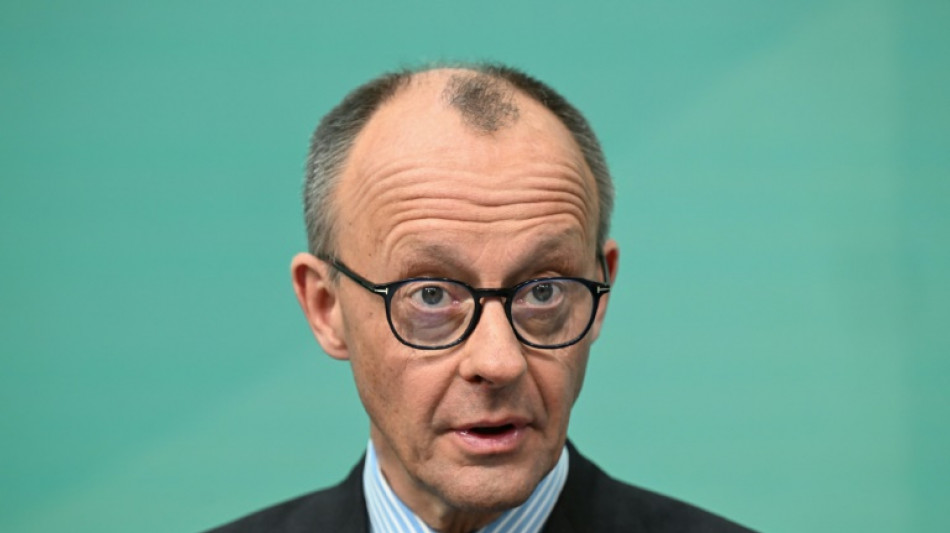
Germany's Merz vows billions for defence, economy / Photo: RALF HIRSCHBERGER - AFP

 Oil companies close in on Venezuela despite hurdles
 Turkey freezes ex-minister's assets as fund scandal grows

 Guardiola backs Man City after bombshell guilty verdicts

 G20 trade ministers open talks under strain of Trump tariffs
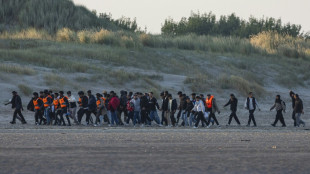 France in talks with UK to end 2025 migrant accord: ministry

 Europe's surging inflation spreads gloom in stock markets
 Truth commission demands compensation for Sweden's Sami people

 Japan win marathon penalty shootout to set up South Korea gold-medal clash

 Djokovic grinds out opening-round win at China Open
 Northern Ireland police probe blockade of disputed parade
 UK PM Burnham reopens divisive debate on rejoining EU
 Man City future in doubt after guilty verdict
 'Do something,' begs Iranian woman after death sentence over protests

 China extends 52-year unbeaten record as Games organisers say sorry
 In Manchester, people say City scandal is 'shame for football'
 Stocks lacklustre as inflation data weighs on sentiment
 Israel-bound plane rerouted, pilots wounded in reported fight
 Truth commission on Sweden's Sami people seeks redress

 Energy costs spark inflation surges in France, Italy

 South Korea break China hearts to reach Asian Games football final
 Eala storms into Asian Games semi-finals to thrill adoring fans

 Turkey freezes ex-minister's assets as fund crisis grows
 What we know about the North Korean POW dispute

 Most equities rise after oil price plunge, US data in focus
 Polar oceans transformed as warming melts ice habitats: research

Germany's likely next chancellor Friedrich Merz said Tuesday that his centre-right CDU/CSU and the centre-left Social Democrats (SPD) would propose an unprecedented package of billions of euros in extra spending on defence and infrastructure.
The two parties are in talks on forming a coalition government after last month's general election, which have been given new urgency by US President Donald Trump's clash with Ukrainian President Volodymyr Zelensky and the freezing of American military aid to Kyiv.
Merz said at a press conference that the two parties would bring proposals to parliament in the next week to exempt more defence spending from Germany's constitutionally enshrined "debt brake".
He vowed to do "whatever it takes" when it comes to defence "in light of threats to our freedom and peace on our continent".
It would be a dramatic departure for a country that has spent decades under the American security umbrella, and historically averse to large public debts.
The proposals unveiled Tuesday would mean defence spending would be exempted from the debt brake if it exceeds one percent of GDP -- or 45 billion euros ($47.7 billion) when applied to the current size of Germany's economy.
Merz also said the two parties wanted to bring in "a special fund of 500 billion euros for the next 10 years" for investment in infrastructure, something the SPD has been pushing for.
The fund would be aimed at kick-starting Germany's moribund economy, which is threatened with a third straight year of recession.
Merz said he wanted to get immediate approval for a three-billion-euro aid package for Ukraine that has been held up for weeks.
He said he would meet outgoing Chancellor Olaf Scholz on Wednesday "to speak about the urgent help needed for Ukraine, around 3.0 or 3.5 billion euros, which... can be approved now as off-budget expenditure".
Speaking alongside Merz, CSU leader Markus Soeder said the parties were "sending a message to our enemies and our friends: Germany is here and is not pulling back".
"We will do everything necessary to protect and strengthen Germany and to bring Europe forward," Soeder said.
He said "old certainties had been recast" in recent weeks and "many of us have had our basic trust in America deeply shaken", even those like himself who had "believed in the US's moral leadership role since I was a child".
- Clock is ticking -
Merz's promise of "whatever it takes" recalled the pledge made in 2012 by the then president of the European Central Bank (ECB) Mario Draghi when it came to saving the euro during the sovereign debt crisis.
The ECB's interventions were at the time described as a "bazooka", a term which is once again being used to describe the spending needed to ensure Germany's defence.
The CDU/CSU and SPD are at pains to rush the new financing though the outgoing parliament, where they have the necessary two-thirds majority together with the Greens.
While the Greens are not likely to be in the next government, they are staunch supporters of Ukraine and of greater infrastructure spending, so could be brought on board.
The clock is ticking: At the end of the month the new parliament will convene in which the far-right Alternative for Germany (AfD) and the far-left Linke will together be able to veto such sweeping changes.
When it comes to defence spending, German media reports suggest that 200 billion to 400 billion euros would be needed to bring Germany's threadbare armed forces up to scratch.
Soeder said that the future government was ready to do "everything necessary to make the German army fit for purpose".
"We are rearming -- militarily but also economically and technologically," he said.
While the CDU/CSU alliance has emphasised the need to boost Germany's defence, the Social Democrats also emphasise the need to pay for investment and social services.
SPD leader Lars Klingbeil spoke of the need for massive investment in a country whose infrastructure had been degraded by years of "wear and tear".
He pledged that his party, which traditionally fights for the working class, would push for stable pensions in the rapidly ageing country, and a fair tax system.
E.Raimundo--PC