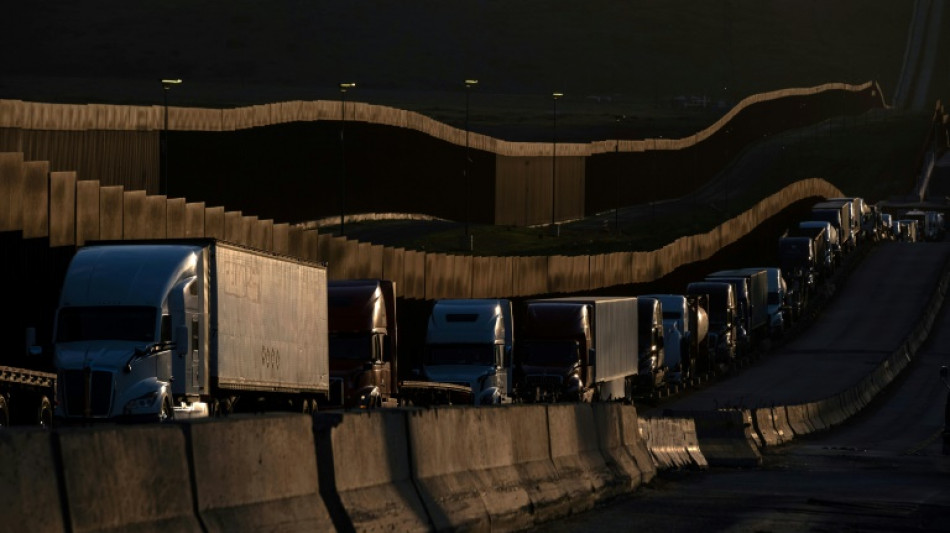
Trump tariff uncertainty overshadows growth promises: analysts / Photo: Guillermo Arias - AFP

 Oil companies close in on Venezuela despite hurdles

 Turkey freezes ex-minister's assets as fund scandal grows

 Guardiola backs Man City after bombshell guilty verdicts

 G20 trade ministers open talks under strain of Trump tariffs

 France in talks with UK to end 2025 migrant accord: ministry

 Europe's surging inflation spreads gloom in stock markets

 Truth commission demands compensation for Sweden's Sami people

 Japan win marathon penalty shootout to set up South Korea gold-medal clash
 Djokovic grinds out opening-round win at China Open

 Northern Ireland police probe blockade of disputed parade

 UK PM Burnham reopens divisive debate on rejoining EU

 Man City future in doubt after guilty verdict

 'Do something,' begs Iranian woman after death sentence over protests

 China extends 52-year unbeaten record as Games organisers say sorry

 In Manchester, people say City scandal is 'shame for football'
 Stocks lacklustre as inflation data weighs on sentiment

 Israel-bound plane rerouted, pilots wounded in reported fight

 Truth commission on Sweden's Sami people seeks redress

 Energy costs spark inflation surges in France, Italy

 South Korea break China hearts to reach Asian Games football final

 Eala storms into Asian Games semi-finals to thrill adoring fans

 Turkey freezes ex-minister's assets as fund crisis grows

 What we know about the North Korean POW dispute

 Most equities rise after oil price plunge, US data in focus
 Polar oceans transformed as warming melts ice habitats: research

President Donald Trump's tariffs and the retaliation they attracted will likely weigh on US growth and boost inflation, according to analysts, but, beyond that, uncertainty surrounding the levies threatens to overshadow optimism about his future policies.
Trump reignited trade wars this week with hefty duties on Canadian, Mexican and Chinese imports, drawing sharp retaliation from Ottawa and Beijing, including new tariffs on key American farm products.
Collectively, these could dent US GDP growth by one percentage point and hike inflation by 0.6 points if kept in place for the year, said Nationwide chief economist Kathy Bostjancic.
"Tariffs represent a negative supply shock. It hurts production, raises prices," she told AFP, warning that business and consumer confidence also take a hit from levies.
And the unpredictability of Trump's tariff plans stand to offset positivity about the president's promises of deregulation and tax cuts, which are seen as pro-growth, she said.
"That hope and excitement right now is overwhelmed by the uncertainty of what's going to play out," she added.
It also remains unclear if new tariffs will be long-lasting, and they come atop cost-cutting measures in the federal government which are being challenged in courts, KPMG chief economist Diane Swonk said.
The fallout from these efforts can undermine demand.
Trump has not only quickened the pace of tariff hikes in his second term by tapping emergency economic powers to impose them without an investigation period, but his levies cover a larger value of goods.
Trump's first-term tariffs hit $380 billion worth of US imports over 2018-2019, mainly from China, said Erica York of the Tax Foundation.
But his latest duties introduced over a month impact $1.4 trillion of imports, mostly from allies, she added.
"Because of the faster implementation and the larger magnitude, the new tariffs will be much more disruptive to the US economy than Trump's first trade war," York said.
- Prices, jobs -
While the situation is fluid, Bostjancic said prices of products like motor vehicle parts could rise by 10 percent within months, given how integrated North American supply chains are.
This could inflate consumer costs for big ticket items. Used car prices could increase if producing new vehicles became pricey, analysts said.
New homes stand to become more expensive too, potentially making property owners reluctant to move and weighing on the housing market, said Jessica Lautz at the National Association of Realtors.
Trump's latest 25 percent tariff on Canadian goods hits lumber imports, which are important to homebuilders.
With the breadth of Trump's current tariff plans, "some companies may not be able to maintain the same level of employment," Swonk of KPMG warned.
During Trump's first term, despite an initial uptick in steel industry employment when he imposed tariffs on imports of the metal, these were more than offset by higher input costs and layoffs elsewhere, she noted.
- 'Choke points' -
Other near-term effects include countries' readiness to to hit US "choke points" following experiences from his first administration, said Swonk.
"They're going to look for the places that are the biggest pinch points for the president's party and that's the Republican Party," she told AFP.
This means taking aim at Republican-dominated states.
When the world's biggest economy takes action like sweeping tariffs other countries tend respond strategically, targeting countermeasures at areas which likely have more political sway over the administration, she said.
Farm and food products are often primary targets of retaliation, said Wendong Zhang of Cornell University. This could spark the need for federal aid to farmers subsequently.
Already, China said it would impose 10 percent and 15 percent levies on various US agricultural exports including soybeans.
In Trump's first term, retaliatory tariffs on the United States caused more than $27 billion in US agricultural export losses from mid-2018 to late-2019.
Economists say the hit to growth and inflation in 2025 could be somewhat counterbalanced by aggressive deregulation efforts next year, as Trump's government seeks to rein in the budget deficit and make certain tax cuts permanent.
For now, the "uncertainty effect," serves as a tax of its own, Swonk said.
A.F.Rosado--PC