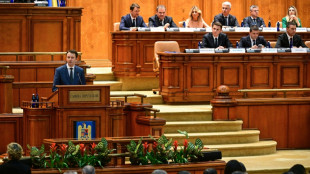
Germany set for massive rearmament as divide with US widens / Photo: RALF HIRSCHBERGER - AFP

 Japan win marathon penalty shootout to set up South Korea gold-medal clash

 Djokovic grinds out opening-round win at China Open
 Northern Ireland police probe blockade of disputed parade
 UK PM Burnham reopens divisive debate on rejoining EU
 Man City future in doubt after guilty verdict
 'Do something,' begs Iranian woman after death sentence over protests

 China extends 52-year unbeaten record as Games organisers say sorry
 In Manchester, people say City scandal is 'shame for football'
 Stocks lacklustre as inflation data weighs on sentiment
 Israel-bound plane rerouted, pilots wounded in reported fight
 Truth commission on Sweden's Sami people seeks redress

 Energy costs spark inflation surges in France, Italy

 South Korea break China hearts to reach Asian Games football final
 Eala storms into Asian Games semi-finals to thrill adoring fans

 Turkey freezes ex-minister's assets as fund crisis grows
 What we know about the North Korean POW dispute

 Most equities rise after oil price plunge, US data in focus
 Polar oceans transformed as warming melts ice habitats: research

 Lost shark becomes viral star in South Korea

 Dangote to launch $16bn refinery in Kenya
 North Korean leader 'extremely obese': Seoul spy agency
 Yankees and pope-backed White Sox start MLB playoffs with wins

 Malaysia's ex-PM Mahathir in hospital for observation

 'No limits': Marathon world record holder Sawe chasing history
 Countdown begins to biggest-ever Rugby World Cup

Germany is set to rearm in a way not seen since World War II after the likely next chancellor Friedrich Merz said his government would vastly increase defence spending.
The announcement means Germany will effectively have to override its constitutionally enshrined "debt brake" so it can up its defence budget by 100 billion euros ($107 billion) a year as Europe braces for a weakening of the US defence umbrella.
"There are moments in which the history of a country takes an unexpected turn," the Zeit newspaper said on Wednesday, adding that Merz's plans "may turn out to be one such moment".
The plans were unveiled Tuesday as part of speeded-up talks between Merz's centre-right CDU/CSU alliance and the centre-left Social Democrats (SPD) on a possible coalition after last month's general election.
Their tempo was stepped up further after Friday's televised row between US President Donald Trump and his Ukrainian counterpart Volodymyr Zelensky, with the White House then freezing aid to Kyiv.
Merz, a longtime Atlanticist who had previously baulked at financing public spending through large-scale debt, has quickly changed his tune given the head-spinning pace of events.
Germany's EU partners, who are gathering for a key summit on Thursday to discuss Ukraine and defence, had been waiting for action from Berlin after months of political paralysis since the collapse of Chancellor Olaf Scholz's government in November.
Alongside the huge boost in defence spending, Merz wants to set up a 500-billion-euro fund to upgrade Germany's creaking infrastructure and help drag it out of two straight years of recession.
If the plans succeed, they could be a "real game changer" and also "quickly overcome Germany's economic stagnation", said Sebastian Dullien, director of the IMK economic research institute.
- Germany's 'duty' -
Current German Defence Minister Boris Pistorius has described the plans as "a historic day for the army and for Germany", a country which has been wary of projecting military might since the horrors it perpetrated under Nazism.
As the Spiegel newspaper pointed out, it is also a far cry from Merz's stance on the campaign trail, where he stuck to the CDU's traditionally strait-laced image on fiscal policy.
"Nevertheless, it's good that Merz is breaking his campaign pledges," the paper said.
Given the possibility of the US turning "openly hostile" to Europe, it was now Germany's "duty as the most populous, most economically powerful country on the continent... to bring Europeans together, to lead them and spur them on in ensuring their own security," it added.
But the plans need to be quickly shepherded through the outgoing parliament, where they will need a two-thirds majority to modify the debt brake, most likely with the help of the Greens.
Then the CDU/CSU and SPD will have to hammer out the rest of the coalition agreement before they can take office and spend the eye-watering sums.
- Potential conflict -
Jacob Ross of the German Council on Foreign Relations said the importance of Tuesday's plans has "a lot to do with psychology and the signals that such announcements send".
As for how such enormous amounts could be spent in practice, Ross told AFP that many questions remain unanswered.
"Who is going to build the necessary weapons? Does Europe have access to the necessary raw materials? What will happen to inflation when such sums are pumped into the economy?" he asked.
There is also the question of coordination with other EU states and with Brussels, where EU chief Ursula von der Leyen also presented a plan on Tuesday to mobilise some 800 billion euros for Europe's defence and support for Ukraine.
"I do think there's a potential for conflict, particularly with Paris," Ross said.
He recalled the reaction to the 100-billion special fund announced by Scholz in the wake of Russia's invasion of Ukraine in 2022, which was quickly used up.
"Back then (French President) Macron was caught unawares and warned that Germany could be 'isolating' itself," Ross said.
"Now we're talking about more than twice the amount of money and naturally European partners will ask what this will mean for their own economies, for the eurozone and for the balance of power in Europe."
M.Carneiro--PC