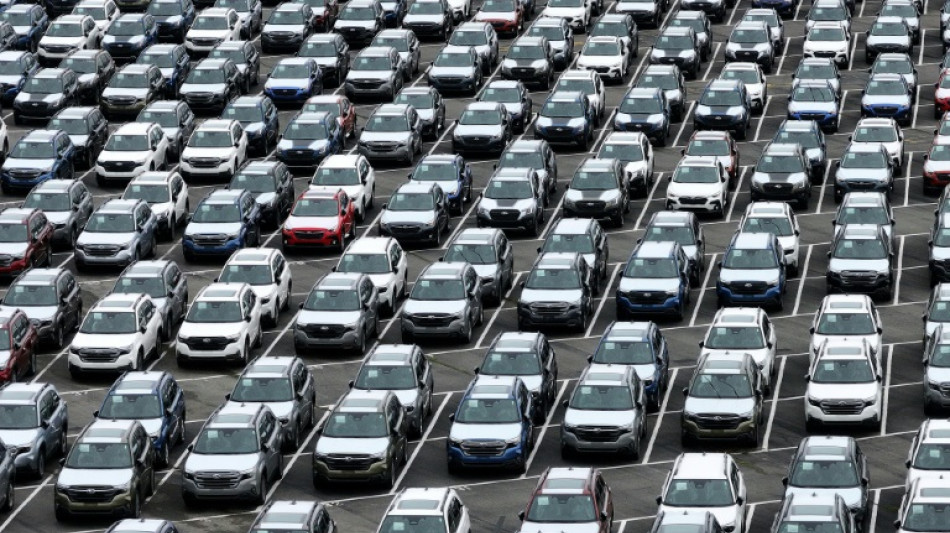
Trump car tariff pivot and Detroit's 'Big Three' / Photo: JUSTIN SULLIVAN - GETTY IMAGES NORTH AMERICA/AFP/File

 Japan win marathon penalty shootout to set up South Korea gold-medal clash
 Djokovic grinds out opening-round win at China Open

 Northern Ireland police probe blockade of disputed parade

 UK PM Burnham reopens divisive debate on rejoining EU

 Man City future in doubt after guilty verdict

 'Do something,' begs Iranian woman after death sentence over protests

 China extends 52-year unbeaten record as Games organisers say sorry

 In Manchester, people say City scandal is 'shame for football'
 Stocks lacklustre as inflation data weighs on sentiment

 Israel-bound plane rerouted, pilots wounded in reported fight

 Truth commission on Sweden's Sami people seeks redress

 Energy costs spark inflation surges in France, Italy

 South Korea break China hearts to reach Asian Games football final
 Eala storms into Asian Games semi-finals to thrill adoring fans

 Turkey freezes ex-minister's assets as fund crisis grows

 What we know about the North Korean POW dispute

 Most equities rise after oil price plunge, US data in focus
 Polar oceans transformed as warming melts ice habitats: research

 Lost shark becomes viral star in South Korea

 Dangote to launch $16bn refinery in Kenya

 North Korean leader 'extremely obese': Seoul spy agency

 Yankees and pope-backed White Sox start MLB playoffs with wins

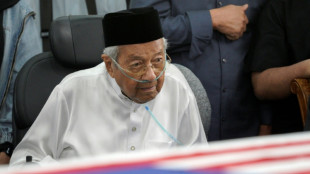 Malaysia's ex-PM Mahathir in hospital for observation

 'No limits': Marathon world record holder Sawe chasing history

 Countdown begins to biggest-ever Rugby World Cup

After an outcry from Detroit, President Donald Trump has granted one-month tariff exemptions on most auto imports from Canada and Mexico, underscoring the continued clout of US carmakers.
The "Big Three" automakers -- Ford, General Motors and Chrysler-owner Stellantis -- operate their businesses on an integrated basis throughout North America, leaving them badly exposed to the proposed tariffs.
Trump, who won hotly-contested Michigan during the 2024 presidential campaign, halted the auto tariffs on Wednesday, just a day after they took effect. The announcement represents relief "but not a cure" since the same tariffs could kick in next month, said Bank of America.
- Diminished 'Big 3' still a force -
While much diminished from their heyday, General Motors, Ford and Stellantis remain giant players in the United States in terms of jobs and economic impact.
Automakers in the United States employ 436,000 workers, with the Big Three accounting for about 55 percent of that number.
The trio also accounts for half of the US assembly plants and nearly half of the 10 million vehicles assembled annually in the United States, according to a report by the American Automotive Policy Council (AAPC).
By comparison, foreign automakers like Honda, BMW and Nissan each account for five percent or less of total US auto jobs, while electric vehicle maker Tesla -- led by close Trump ally Elon Musk -- accounts for 14 percent, according to the AAPC.
- Integrated throughout North America -
The Big Three also produce cars in overseas factories, but most of their imports come from Mexico and Canada under the terms of a free trade pact inked during Trump's first term, the United States-Mexico-Canada Agreement (USMCA).
Popular vehicles imported from Mexico in 2024 included the Chevrolet Silverado and the Ford Maverick, while the Chrysler Pacifica and the Lincoln Nautilus were imported from Canada, according to figures from GlobalData.
Foreign automakers like Toyota and Honda also make use of the USMCA to produce cars in Canada and Mexico sold in the United States, and in organizing sophisticated supply chains in which parts and technology move seamlessly throughout the region.
The auto supply industry employs 932,000 people across the 50 US states, according to MEMA, the Vehicle Suppliers Association. The US industry producers about 27 percent of its manufacturing sourcing from Mexico and 10 percent from Canada, according to MEMA.
- Other car tariffs coming -
The auto industry's regional integration has made it among the sectors most exposed to Trump's hefty 25 percent tariffs on Mexico and Canada.
Ford CEO Jim Farley warned in February that enactment of the tariffs "would blow a hole in the US industry that we have never seen."
While greeting Trump's tariff reprieve for USMCA-covered auto imports, automakers recognized the pause is only for one month.
The Trump administration has depicted the tariffs as a tool to encourage more manufacturing capacity in the United States, but such decisions are not taken overnight.
"The reality is that a month is nowhere near enough time for automakers to relocate factories or reconfigure supply chains," said Jessica Caldwell, head of insights at Edmunds.
"In the short term, manufacturers may need to ramp up production and stockpile inventory as a hedge against potential tariffs —- an expensive and risky move that could lead to bloated inventories if the tariffs don't take effect."
Trump has broadly discussed a desire for 25 percent tariffs on imported cars but has offered few details.
If the administration maintains protection for USMCA imports, automakers from Germany, Japan and South Korea that import to the United States would seem to be the most exposed to such a policy.
About 50 percent of the cars sold in the United States are manufactured within the country. Among imports, about half come from Mexico and Canada, with Japan, South Korea and Germany, also major suppliers.
H.Silva--PC