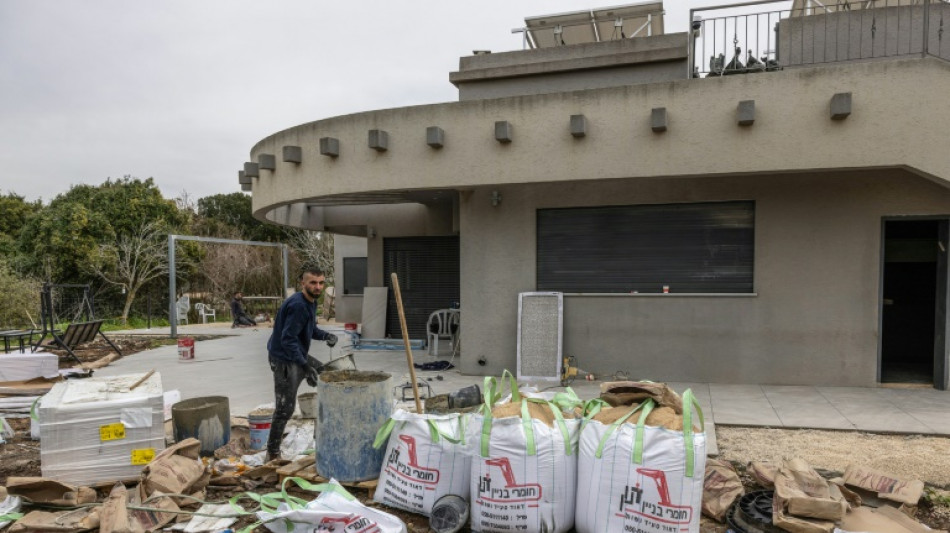
Residents of Israel's north slowly returning home after Hezbollah truce
/ Photo: Menahem KAHANA - AFP

 Japan win marathon penalty shootout to set up South Korea gold-medal clash

 Djokovic grinds out opening-round win at China Open

 Northern Ireland police probe blockade of disputed parade

 UK PM Burnham reopens divisive debate on rejoining EU

 Man City future in doubt after guilty verdict

 'Do something,' begs Iranian woman after death sentence over protests
 China extends 52-year unbeaten record as Games organisers say sorry
 In Manchester, people say City scandal is 'shame for football'

 Stocks lacklustre as inflation data weighs on sentiment

 Israel-bound plane rerouted, pilots wounded in reported fight

 Truth commission on Sweden's Sami people seeks redress

 Energy costs spark inflation surges in France, Italy

 South Korea break China hearts to reach Asian Games football final
 Eala storms into Asian Games semi-finals to thrill adoring fans

 Turkey freezes ex-minister's assets as fund crisis grows

 What we know about the North Korean POW dispute

 Most equities rise after oil price plunge, US data in focus

 Polar oceans transformed as warming melts ice habitats: research

 Lost shark becomes viral star in South Korea
 Dangote to launch $16bn refinery in Kenya
 North Korean leader 'extremely obese': Seoul spy agency
 Yankees and pope-backed White Sox start MLB playoffs with wins

 Malaysia's ex-PM Mahathir in hospital for observation

 'No limits': Marathon world record holder Sawe chasing history

 Countdown begins to biggest-ever Rugby World Cup

On a lush green hilltop on Israel's northern border with Lebanon, Carmela Keren Yakuti proudly shows off her home in Dovev, which she fled more than 16 months ago over fears of a Hezbollah attack.
"Now that everyone is back, it's an amazing feeling," said Yakuti, 40, standing on her freshly washed patio and breathing in the crisp country air.
"It's great here. We have a beautiful moshav, a beautiful view," she added, referring to what Israelis call a small agricultural community. "It's simply great to be back home."
On October 8, 2023, a day after Hamas's unprecedented attack on southern Israel triggered war in Gaza, Lebanon's Hezbollah group declared its support for the Palestinian militants and began firing rockets into northern Israel.
For their own protection, the Israeli military ordered Yakuti, her family, friends and neighbours to leave Dovev, and they were sent to live in a hotel in the city of Tiberius, further south.
In total, the hostilities with Iran-backed Hezbollah displaced around 60,000 residents of northern towns and villages, according to official data.
Half are yet to return home.
On the Lebanese side, more than one million people fled the south of the country, around 100,000 of whom are still displaced, according to the United Nations.
On November 27, 2024, after more than a year of hostilities, including two months of all-out war during which Israel sent ground troops into Lebanon, a truce agreement came into force.
Israeli authorities have said residents of northern border communities could return home from March 1.
Yakuti, who retrained as a beautician during the time she was displaced, said she immediately packed up her belongings, bid farewell to the "kind" hotel staff and moved back into her two-storey home.
From her living room and patio, she has a clear view of a Lebanese village that was emptied of its residents following evacuation calls issued by the Israeli army in September ahead of its ground offensive.
"I'm not afraid and not shaking. The army did its job and carried out its work," the mother of three said, adding: "I'm at peace with my decision to return here, and I wouldn't give up my home and my moshav even if the war continued."
- Rockets, mortars -
While many of Dovev's residents were returning this week, the scene was not so joyous in other communities along Israel's northern border.
In the kibbutz community of Hanita, Or Ben Barak estimated that only about 20 or 30 families out of around 300 had come back.
"At first, there was this kind of euphoria when they announced that we could return," said Ben Barak, who counts his grandparents among the founders of the 97-year-old kibbutz.
"But now people are also seeing that the place isn't quite ready for living yet."
Ben Barak, 49, pointed out the multiple places where rockets and mortars had fallen, as well as the damage done by the heavy Israeli military vehicles such as tanks that passed through on their way into Lebanon.
Asked if he was concerned about security now the war was over, Ben Barak said that what worried him more was "what will happen with the community. Who will come back, how they will come back, and how many will come back?"
"I believe that in Lebanon, the army fought very hard and did everything it needed to do, but the real question is how to maintain this quiet," he said.
"That's the challenge -- how to guarantee a peaceful life for the next 20 to 30 years. That's the challenge for the state, and that will also determine whether people stay here."
Just down the hill from the still abandoned streets of Hanita, the town of Shlomi appeared to be returning to life.
At Baleli Falafel, Yonatan Baleli stuffed pita with salad and tahini as a long line of hungry customers waited to blaring trance music.
"I feel much safer than before, but do I feel 100 percent safe? No," said Ronit Fire, 54.
"It's not pleasant to say this, but it feels like it's just a matter of time," she said, adding that she believed there would be another war in the future.
"The next time will come again at some point," said Fire.
F.Carias--PC