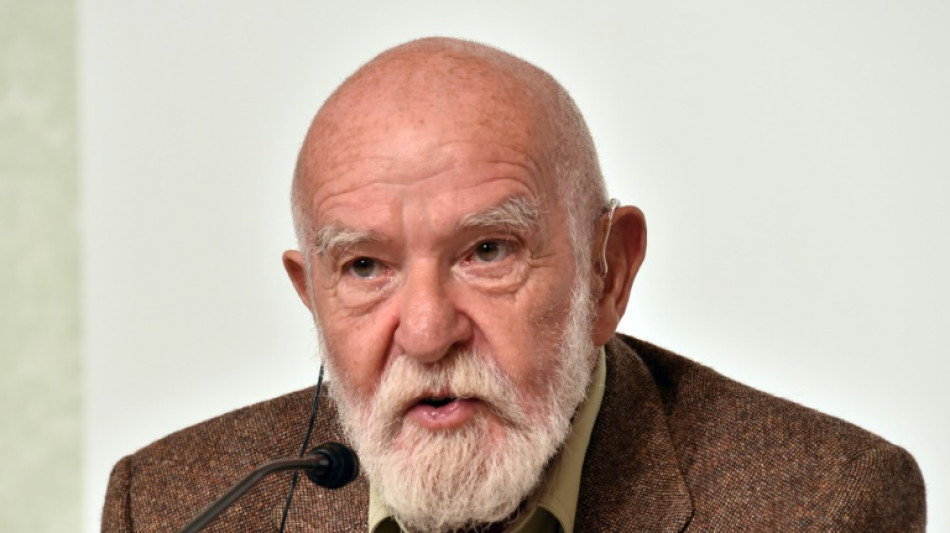
South Africa's taboo-breaking playwright Athol Fugard / Photo: YOSHIKAZU TSUNO - AFP

 In Manchester, people say City scandal is 'shame for football'

 Stocks lacklustre as inflation data weighs on sentiment
 Israel-bound plane rerouted, pilots wounded in reported fight

 Truth commission on Sweden's Sami people seeks redress

 Energy costs spark inflation surges in France, Italy

 South Korea break China hearts to reach Asian Games football final

 Eala storms into Asian Games semi-finals to thrill adoring fans

 Turkey freezes ex-minister's assets as fund crisis grows

 What we know about the North Korean POW dispute

 Most equities rise after oil price plunge, US data in focus

 Polar oceans transformed as warming melts ice habitats: research

 Lost shark becomes viral star in South Korea
 Dangote to launch $16bn refinery in Kenya
 North Korean leader 'extremely obese': Seoul spy agency
 Yankees and pope-backed White Sox start MLB playoffs with wins
 Malaysia's ex-PM Mahathir in hospital for observation

 'No limits': Marathon world record holder Sawe chasing history

 Countdown begins to biggest-ever Rugby World Cup

 Bangladesh women lose ground after quota reform
 Vietnam admits 'differing opinions' on Hanoi development
 Stocks temper gains as oil pares heavy losses, US data in focus

 New Zealand denies breaching climate commitments to EU

 Albert becomes youngest US scorer in 4-2 win over Chile

 Pirate island's plunging population shows Greece's demographic decline

 With elections ahead, Latvia's Russian-speakers reject Moscow's help
South African writer and theatre director Athol Fugard was acclaimed at home and abroad for plays that exposed the injustices of the apartheid system and challenged its racist taboos, including by putting black and white actors on stage together.
Fugard, who died on March 8, aged 92, wrote more than 30 plays over seven decades, his most important in the darkest days of apartheid, touching on the raw themes of the cruel and dehumanising regime that ended in 1994.
"His work helped expose the inhumanity, injustice and blind stupidity of the system to audiences around the world," The Guardian newspaper wrote in 2012 of the "fearless, flinty, obdurate Afrikaner".
In 2006 the film "Tsotsi", based on a novel he completed in 1961 and published in 1980, won the first Best Foreign Language Film Oscar for a South African production.
Mourning him in a statement on Sunday, the mayor's office in Cape Town called him "a true patriot whose legacy will continue to inspire generations".
"Beyond his literary achievements, Fugard's commitment to justice and equality made him a pivotal figure in South Africa's cultural and political spheres," it said.
"Athol Fugard was not just a luminary in the world of theatre; he was a teller of profound stories of hope and resilience about South Africa."
- Staging segregation -
Fugard was born in 1932 in the small Eastern Cape town of Middelburg. He grew up as laws were being assembled to keep the races apart and bar black South Africans from free movement, decent education, and other rights.
His first major play was "The Blood Knot", a story of two mixed-race brothers which premiered in 1961 with a white actor -- Fugard himself -- and a black actor on stage together and in front of a multiracial audience.
It was a first under the apartheid system and was followed by laws prohibiting mixed casts and audiences.
"You could use the stage to talk about things that would have landed you in trouble if you talked about them openly and publicly in any other context," Fugard said in a 2014 interview with the American Academy of Achievement network.
He went on to work with the Serpent Players, a group of black actors, resisting official harassment to put South African stories on stage at a time when many still thought only European classics were worthy.
Among his best known was "Boesman and Lena", about the difficult circumstances of a mixed-race couple, which premiered in 1969 and was made into a film in 2000 starring Danny Glover and Angela Bassett.
The semi-autobiographical "'Master Harold'... and the Boys", set in 1950, looks at prejudice through the interaction between a white adolescent and two black men working for his family.
The prevalent theme of resistance in his most celebrated plays including "Sizwe Banzi Is Dead" and "The Island", which he co-wrote with the actors John Kani and Winston Ntshona, solidified Fugard's place in protest theatre.
Fugard "mirrors both the trauma and triumph of human striving in South Africa," The Christian Science Monitor wrote in 1992, calling him "The Face of South Africa's Conscience".
- A life's work -
"Apartheid defined me, that is true... But I am proud of the work that came out of it, that carries my name," Fugard told AFP in 1995.
His pieces were regularly revived after the first all-race election in South Africa in 1994, although Fugard feared the end of the system could make his writing redundant.
But the messy legacy of apartheid provided new material and he continued to write into old age, with "The Painted Rocks at Revolver Creek" debuting in New York in 2015 when he was in his 80s.
He told NPR at the time that "possibly, at this moment in our history, the stories that need telling are more urgent than any of the stories that needed telling during the apartheid years."
Fugard, who married twice, won several awards for his work, notably a 2011 Tony for a lifetime's achievement in theatre.
H.Silva--PC