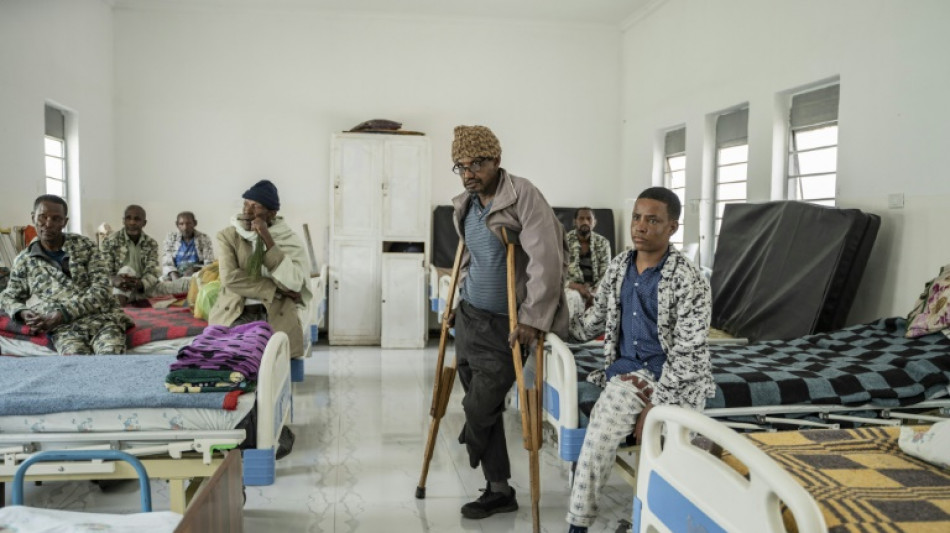
Patients with leprosy face lasting stigma in Ethiopia / Photo: Amanuel Sileshi - AFP

 8.3 mn refugees at risk due to 'severe' funding cuts: UN

 Stocks drop and oil rises as Hormuz hopes fade
 OpenAI cancels release of newest model due to safety concerns

 AI bosses head to White House as safety pressure builds

 Batista sacked as Costa Rica coach after six months

 Flooding, power cuts and evacuations as Hurricane Polo slams Mexico

 Dodgers eye three-peat, Red Sox face Yankees as MLB playoffs begin

 Certification of Boeing 737 MAX delayed by software bug
 Celine Dion wows Paris Fashion Week with surprise gig

 AMD buys firm founded by AI 'godmother' Fei-Fei Li

 Italy rebound in Turkey as France win late in Belgium

 Pope says concerns about AI 'should be taken seriously'

 Hurricanes to hoist title banner as NHL season begins

 Justice Alito steps aside from major US climate case

 Willis happy with England exile after retains Top 14 player award

 Spain housing protests keep heat on government as PM seeks new law

 Wissa spoils Zimbabwe homecoming as DR Congo win AFCON qualifier
 UK police release on bail five men held over airbase incident

 Ex-All Black Plummer 'sure' New Zealand will find Super Rugby solution

 Shein sees 1% revenue growth in first half of 2026

 Netherlands regrets Israel retaliation in settlements row

 Moscow seizes Russian assets of German food retailer Metro

 Bulgarian spirits inflamed by new rakia rules

 Documentary turns camera on architect Peter Zumthor

 UK police say releasing on bail five men held over airbase incident

Tilahun Wale not only lost his right foot to leprosy -- a disease that still affects thousands in Ethiopia -- he also lost his family.
"My family abandoned me. They blocked my number and refused to speak to me," said Tilahun, 46, a farmer in Ethiopia's populous Oromia region, who contracted leprosy around 10 years ago.
Ethiopia, a country of some 130 million people in northeastern Africa, officially eliminated leprosy as a public health problem in 1999, after case numbers dropped below one in 10,000.
But some 2,500 infections are still recorded there each year, according to the United Nations World Health Organization (WHO), which lists leprosy as one of the 20 "neglected" tropical diseases.
In Ethiopia, a highly religious country, leprosy is often perceived as a divine punishment.
Caused by the bacteria Mycobacterium leprae, the contagious infection attacks the skin and peripheral nerves, with potentially serious after-effects, including physical deformities.
The disease was declared eliminated as a health problem globally in 2000, according to the WHO.
But leprosy is still present in more than 120 countries worldwide, with nearly 200,000 cases reported each year, despite being curable and with treatments that can prevent disability if applied early.
Haile Kairos developed the disease as a child.
"I noticed the appearance of lumps on certain parts of my body," said the 35-year-old, hiding the effects of leprosy on his legs with a blanket.
There is still a stigma, he said, recalling the disgust and avoidance he has faced.
Ethiopian society "doesn't have enough information about the disease", he said.
The Alert Hospital in the capital Addis Ababa specialises in leprosy and treats dozens of patients at a time.
It was originally founded as a leper colony in 1934 away from residential areas, but the city has expanded to surround it.
- 'Stigma has diminished' -
Perceptions of the disease are only slowly evolving, said Solomon Getahun, project manager at International Leprosy Mission, an NGO that provides medical assistance to patients and raises awareness.
It organises discussions in communities across Ethiopia, bringing together people with the disease to explain the challenges they face.
The NGO also offers microcredit to patients, most of whom struggle to find employment.
Atale Mekuriyaw, 70, works at a centre where a dozen people with the disease, mostly women, make rugs, traditional clothing and jewellery.
The modest salary "helps us provide for our families", she said.
For every kilo of raw cotton she weaves, she earns between 100 and 150 birr (around 75 cents to $1.15).
"Coming here and spending time like this is important to us. It's better than staying at home," added Atale, who has suffered from leprosy since childhood and says she feels less discriminated against today.
"In the past, people used to say: 'Don't go near her!' But today, thanks to access to medication, the stigma has diminished," she said.
The WHO has praised Ethiopia's progress in treatment and care.
But the recent drastic cuts in aid announced by the United States and other Western countries could undermine the efforts.
The WHO said last month it was cutting its budget by a fifth after the United States -- previously its biggest source of funds -- said it would no longer contribute.
That is a potential problem for Alert Hospital, where preventative medicines have been supplied by the WHO.
Shimelis Gezahegn, the hospital's director, said the Ethiopian authorities had promised "a backup plan".
He added that it was vital they step in to continue work on treatment and eventual eradication of the disease.
But "there could be some problems," he said.
T.Vitorino--PC