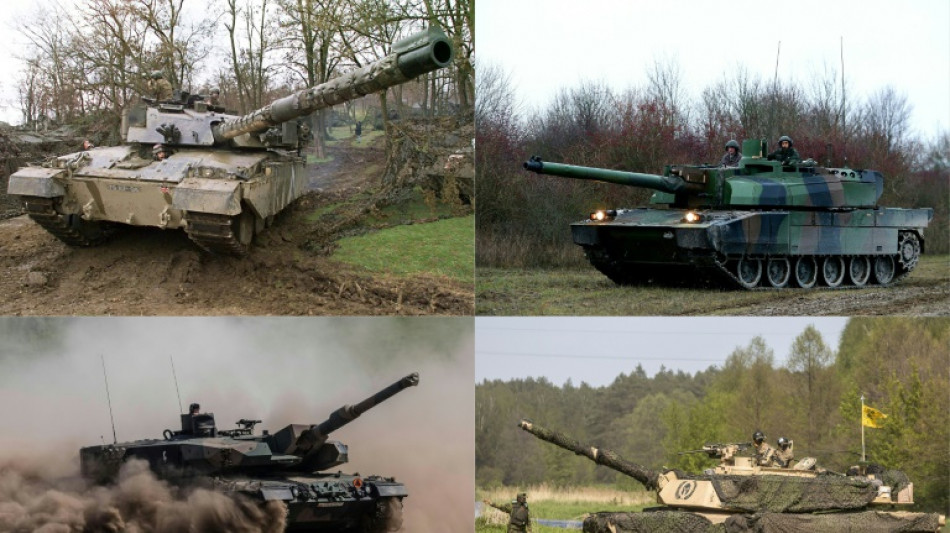
Conflicts spur 'unprecedented' rise in military spending / Photo: Eric Feferberg, FRANCOIS NASCIMBENI, Wojtek RADWANSKI - AFP/File

 NFL Giants obtain QB McCarthy from Vikings

 Deal for evicted Spanish pensioner as PM seeks new housing law

 Clippers apologize, warn fans of 'challenges' after Leonard scandal

 Turkish comedian convicted for Erdogan 'insult' freed pending appeal

 Trump announces 'biggest' US steel plant in battleground Iowa

 Olise wonder strike gives Zidane's France win in Belgium
 US stocks fall, bond yields rise as Middle East war drags on

 Trump denies offering to sell arms to China's Xi

 Wemby ready for NBA Spurs to move rivals in climb to top

 Ukraine to postpone some spending amid delays in aid: PM

 Tuchel says Czech Republic game 'not yet a must-win'
 MaXhosa puts South Africa on the Paris fashion map
 Rose, Scott among 2027 World Golf Hall of Fame finalists

 Brunson says NBA champion Knicks can't get satisfaction

 France puts out largest wildfire since 1949
 Real Madrid's Perez summoned over Barcelona referee payments comments

 Oil takes off again, Wall Street dips after Trump rejects Iran truce offer

 AlgoQuant Asset Management Selects Liquid Mercury to Enhance Digital Asset Trading Infrastructure
 UK to reopen refugee resettlement scheme to push 'safe' migration
 Pope urges Europe to help combat 'lies and deceit' in world affairs

 Iranian lawyer Nasrin Sotoudeh wins Council of Europe's rights prize
 French far-right's Bardella denies alleged 2013 antisemitic comments
 Oil up, Wall Street dips after Trump rejects Iran truce offer

 Gakpo withdraws from Netherlands squad

 SpaceX puts Starship megarocket in orbit for first time
Worldwide military expenditure saw its steepest rise in 2024 since the end of the Cold War, reaching $2.7 trillion as wars and rising tensions drove up spending, researchers said Monday.
Military spending rose worldwide with particularly large increases in Europe and the Middle East, according to a new report by the Stockholm International Peace Research Institute (SIPRI).
Several European countries had seen "unprecedented" rises in their military spending, the report noted.
In real terms, spending rose by 9.4 percent globally compared to 2023, with 2024 marking the 10th year of consecutive spending increases.
"This was really unprecedented," Xiao Liang, a researcher with the SIPRI Military Expenditure and Arms Production Programme, told AFP.
"It was the highest year-on-year increase since the end of the Cold War."
While there may have been steeper increases during the Cold War, data for the Soviet Union is not available, Liang added.
More than 100 countries, including all of the 15 largest spenders, increased their military budgets last year, said the report.
- Profound impact -
"This really speaks to the heightened geopolitical tensions," Liang said. The spending increase was likely to have "a very profound socio-economic and political impact", he added.
"Countries have to make trade-offs in their budgetary decisions," he said.
"For example, we've seen many European countries cutting other spending like international aid to fund the increase in military spending, and... trying to raise taxes or rely on loans or debt to fund the spending," Liang said.
The main contributor to the rise in expenditure was the European region including Russia, where spending rose by 17 percent to $693 billion.
All European countries, except Malta, expanded their budgets, "pushing European military spending beyond the level recorded at the end of the Cold War," SIPRI said.
Russia's military expenditure reached $149 billion in 2024: a 38-percent increase on the previous year and a doubling since 2015.
Ukraine's military spending grew by 2.9 percent to reach $64.7 billion.
While that sum only corresponds to 43 percent of Russia's arms spending, for Ukraine it is the equivalent of 34 percent of its GDP. That means it is carrying the highest military burden of any country.
- Germany rearming -
Germany's spending increased by 28 percent, reaching $88.5 billion, overtaking India as the fourth largest in the world.
"Germany became the biggest spender in Central and Western Europe for the first time since its reunification," Liang noted.
The world's largest spender, the United States, increased expenditure by 5.7 percent, reaching $997 billion. That alone accounts for 37 percent of worldwide spending and 66 percent of the military spending among NATO countries.
Total military spending by the 32 members of the US-led alliance rose to 1.5 trillion as all members increased their spending.
"We've seen in 2024 that 18 out of the 32 NATO countries reached the two-percent GDP spending target, which is the highest since the founding of the alliance," Liang said.
While some of the increases have been a result of European military aid to Ukraine, it has also been fuelled by concerns of potential US disengagement with the alliance.
"There has really been a shift in European defence policies, where we will see large-scale procurement plans into the arms industry in the years to come," Liang explained.
Military budgets also drastically grew in the Middle East to an estimated $243 billion, an increase of 15 percent from 2023.
As Israel continued its offensive in Gaza, its military expenditure surged by 65 percent to $46.5 billion in 2024. SIPRI noted that this represented "the steepest annual increase since the Six-Day War in 1967".
In contrast, Iran's fell by 10 percent to $7.9 billion in 2024, "despite its involvement in regional conflicts and its support for regional proxies", the report added.
"The impact of sanctions on Iran severely limited its capacity to increase spending," said SIPRI.
The world's second-largest spender, China, increased its military budget by 7.0 percent to an estimated $314 billion, "marking three decades of consecutive growth".
China -- which has been investing in modernising its military and expansion of cyberwarfare capabilities and nuclear arsenal -- accounted for half of all military spending in Asia and Oceania.
F.Cardoso--PC