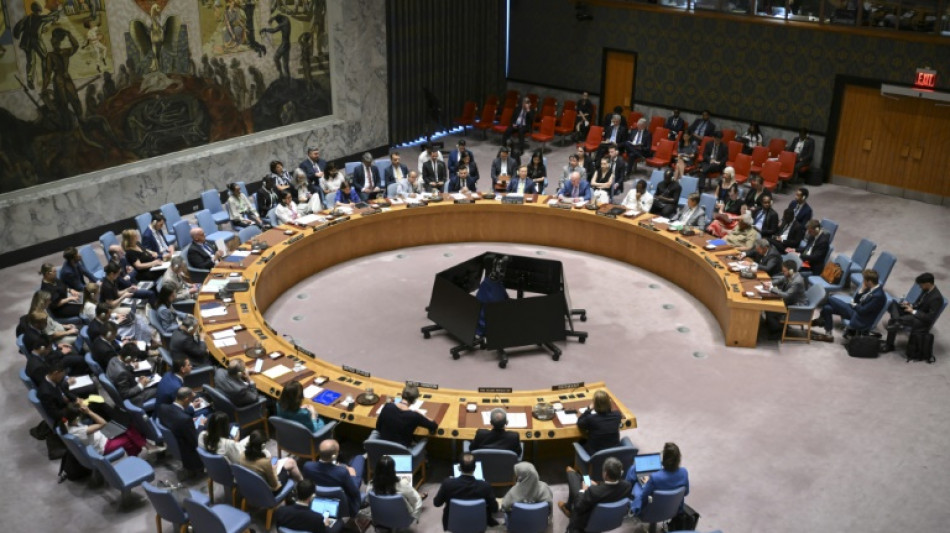
UN Charter: a founding document violated and ignored / Photo: ANGELA WEISS - AFP

 Alex Bodi and Prof. Dr Dieter Lazik sign a contract for ALPHA WHEY and BODI Energy Drink

 Swiss reject plan to toughen neutrality: projection
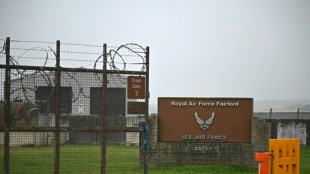 UK police call in bomb disposal team near air force base

 Bangkok floods send thousands into shelters after days of rain

 Assefa just misses women's world record at Berlin Marathon

 Dramatic winners Zimbabwe to end five-year exile by tackling DR Congo

 Pope to meet victims of clerical sex abuse on France trip

 How young is too young as child prodigies win big at Asian Games
 UK Labour party meets buoyed by Burnham but eager for concrete plans
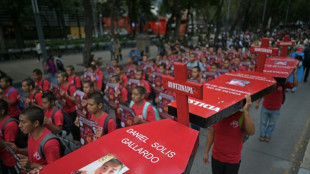 Thousands protest ahead of Mexican president's report on missing students
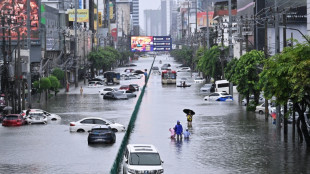 Bangkok floods force thousands into shelters
 AI startup urges optimism from Europe despite safety fears

 'Godlike, invincible': Japan hails 11-year-old Games history-maker

 Nepal's hydropower ambitions face climate reality check

 Power cuts, rubble: millions come home to find Sudan's capital unlivable

 Internationals keep Presidents Cup lead with late fightbacks

 Tuchel to 'keep pushing' England to reach Spain's level

 Alcaraz saves match points to keep Europe ahead in Laver Cup
 Spain success driven by hunger to improve, says De La Fuente

 Lyon collapse at Stade Francais to suffer first Top 14 loss
 Oyarzabal and Spain sink England again as Modric shines for Croatia
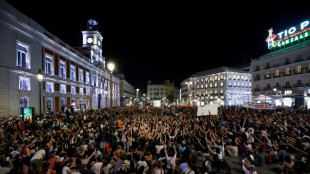
 Housing protesters camp in central Madrid after mass demonstration

 Louise Trotter expands her palette at Bottega Veneta
 Pope prays at Lourdes after huge Paris mass

 USA trims International lead after Presidents Cup four-balls

Eighty years ago Thursday, 50 countries came together in the ashes of World War II to sign the United Nations' founding charter in order "to save succeeding generations from the scourge of war."
UN Secretary-General Antonio Guterres insisted this week the Charter "is a promise of peace, dignity and cooperation among nations."
But critics say the organization has been utterly helpless in stopping the countless conflicts that have broken out since and continue around the globe today.
Here is a look at the UN Charter's history.
- Main principles -
Conceived in the early years of World War II and signed on June 26, 1945 in San Francisco, the charter paved the way for the creation of the United Nations on October 24, 1945.
In 19 chapters and 111 articles, the Charter lays out the principles of international relations, including the peaceful settlement of disputes, sovereignty and equality between states, humanitarian cooperation, and respect for human rights.
If there is a threat to global peace, Chapter VII gives the UN Security Council the power to impose sanctions to enforce its decisions or even deploy military force.
The Charter, which is very difficult to amend, also establishes the Security Council, with its five veto-wielding permanent members, the General Assembly and the Secretariat, as well as the International Court of Justice.
The United Nations currently has 193 member states.
- 'Impunity reigns' -
But for all the good words, the Charter's principles have been continually violated across the planet for eight decades.
Member states rarely agree whether self-determination trumps non-interference in a state's internal affairs, or if the right to self-defense can justify acts of aggression.
In the most recent example, Tehran, backed by veto-wielding China, accused Washington of violating the UN Charter by striking Iranian nuclear sites over the weekend, an act the United States justified by the right to "collective self-defense."
And the international community has never really addressed the "crime of aggression," said Gissou Nia, a fellow with the Atlantic Council think tank, be it Russia's war against Ukraine or the US invasion of Iraq.
"And once impunity reigns on one set of violations, one that's never dealt with, it continues, and countries use it as justification for the actions that they take," Nia told AFP.
She added: "For self-defense, you really have to show evidence of an imminent attack. I think that it's one of the more contentious issues that involve the UN Charter and the narrative has really gotten away from us."
Russia's invasion of Ukraine in February 2022 was denounced as a clear violation of the Charter by Guterres and the General Assembly, but not by the Security Council, where Russia has a veto.
And even though the Charter allows for persistent violators to be expelled from the UN, that has never happened.
In 1974, the UN did, however, suspend South Africa from the General Assembly over the crimes of apartheid, a ban that lasted two decades.
F.Moura--PC