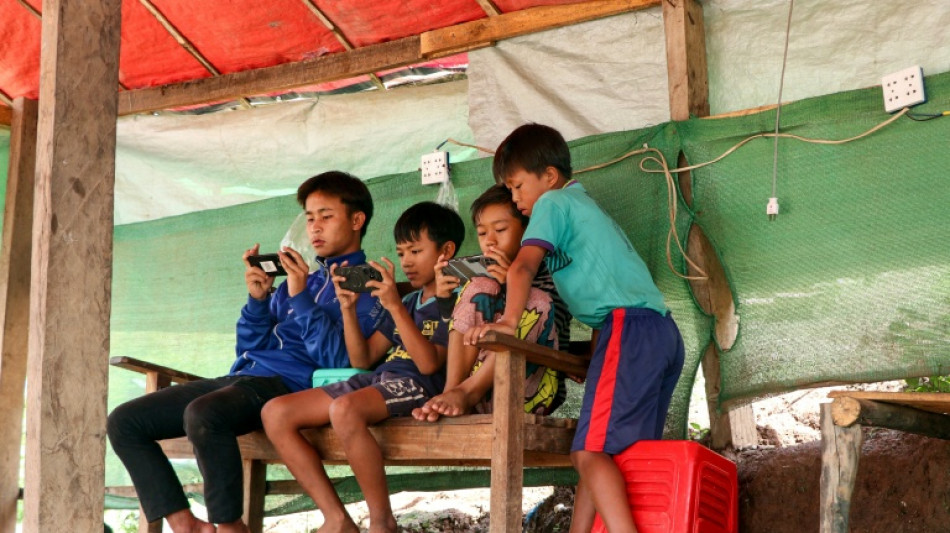
Making connections in Myanmar's fractured state / Photo: STR - AFP

 Thousands seek to thwart disputed N.Ireland flashpoint parade

 Swiss vote on what it means to be neutral

 Pope to meet with victims of clerical sex abuse during France trip

 Iran stands firm on Hormuz plan after US rejection
 Madrid protest camp grows after eviction outrage

 Italy winemakers hail bumper harvest but cut output

 Kyiv shoppers feel the pinch from Russian strikes
 Japanese anime actor fights TikTok over AI voice cloning
 Curtain falls on the romance of India's single-screen cinemas

 Smells like teen spirit as US thrash Peru 4-1

 Cavy chaos: Hundreds attend New Zealand's biggest guinea pig show

 Venezuela releases more political prisoners after opposition talks

 England's best 'for a long time' despite Spain defeat, says Kane

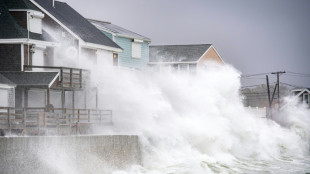 Powerful storm pummels northeast US with rain, high winds

 Filmmaker Mike Leigh wins top prize at Spain festival with 'last film'

 Spain beat England in Nations League to extend unbeaten run

 Ireland squad vote to play Israel tie despite Gaza unease

 Gutsy Vollering wins cycling road race world title

 Vollering wins cycling road race world title
 Man City's meteoric rise clouded by dark shadow

 Mbappe out for two weeks or more with knee injury say Real

 Lyon collapse away to Stade and suffer first Top 14 loss

 Russia accuses Europe of seeking to thwart Ukraine talks

 Man City chairman defiant over reported Premier League charges

 Germany ready to 'walk through fire' for Klopp, says Tah

In a riverine battleground in western Myanmar, an entrepreneur hunts for reception using a makeshift bamboo antenna, his payphone kiosk providing locals a lifeline to connect with their loved ones.
In commercial capital Yangon, a student flicks through apps that cloak his online identity so he can skirt social media bans that accompanied the 2021 coup.
And in the mountainous east, customers at an internet cafe feverishly scroll for news from the outside, dependent on Elon Musk-owned satellites.
Four years of civil war between Myanmar's military and its myriad opponents have shattered communications networks.
In response, people have resorted to methods ranging from the old-fashioned to the ingenious to the hyper-modern.
"I don't want to be cut off from the world," Hnin Sandar Soe, 20, said at an internet cafe in eastern Karenni state where she reads headlines, studies online and reaches out to friends and family.
"It always brings a warm and comforting feeling to keep in touch with them."
- Payphone lifeline -
Myanmar has been under military rule for most of its post-independence history, but a decade-long democratic thaw starting in 2010 was accompanied by an astronomical growth in connectivity.
That year, SIM cards cost $1,000 and fewer than five percent of the population owned a mobile phone, according to World Bank figures.
Seven years later, that figure was 82 percent, as citizens seized on the rapidly developing cellular networks and novelty of free speech.
But since the military toppled the civilian government and ignited the war, there has been a slide back into digital darkness.
The junta has banned a slew of apps, conflict has eviscerated infrastructure and blackouts are weaponised by all sides.
In western Rakhine state, where civil war has intensified long-running conflict, reliable communications are now a dim memory.
Witnessing his neighbours hiking hills for mobile signal, Saw Thein Maung founded an old-fashioned payphone business six months ago.
Today, he operates three phones wired to antennas on 10-metre (33-foot) poles that wobble in the wind above the delta town of Ponnagyun.
The business earns him a relative fortune of up to $23 a day as customers clamour to dial out.
"They don't want to stop speaking with their children elsewhere. They don't care how much they have to pay," Saw Thein Maung said.
Customer Tun Lin, 27, uses the payphone to ring city-dwelling contacts to enquire about job openings.
"Making phone calls is the only way," the unemployed former NGO worker said.
- Satellite solutions -
Activist group the Myanmar Internet Project (MIP) says there have been nearly 400 regional internet shutdowns since the junta takeover.
What it calls a "digital coup" has slowed emergency responses, hampered education and hobbled the economy.
"The public is experiencing hardship as a result of this insult added to injury," said MIP spokesman Han, who goes by one name. "They are looking for all kinds of ways to resist."
In Karenni state, an internet cafe with a glowing blue router offers an oasis of connectivity, bypassing restrictions by tethering to Musk's Starlink satellite system.
The junta has not licensed the technology, meaning it is illegal to operate.
Cafe owner Marino had it smuggled over the border to his shop, where the cutting-edge web link contrasts with the corrugated roof and tarpaulin walls.
"We need the internet to know what is happening in our country or the world and if our friends are doing well or not," he said.
Nearby, an elderly woman chatted on her phone and a gaggle of teens played online games.
- Dodging disconnection -
Major cities under junta control retain reliable internet, but Facebook, Instagram, X and WhatsApp -- where opposition groups have typically organised -- are all banned.
In Yangon, virtual private networks (VPNs) provide a way to dodge the bans.
After the junta started blocking VPNs last year, a whisper network rippled through the city, with people sharing free options that still function.
One week the best is 1.1.1.1, before JumpJumpVPN emerges as more popular, and then everyone moves to Now VPN.
But the junta security forces now conduct spot checks for VPNs, said one 23-year-old student, speaking on condition of anonymity because he uses the outlawed apps.
"Other countries have internet freedom and young people can learn freely," he said. "It is different in our country where everything is restricted. I feel our rights are blocked."
He remains undeterred. "We young people have a mindset that we will overcome any restrictions."
F.Carias--PC