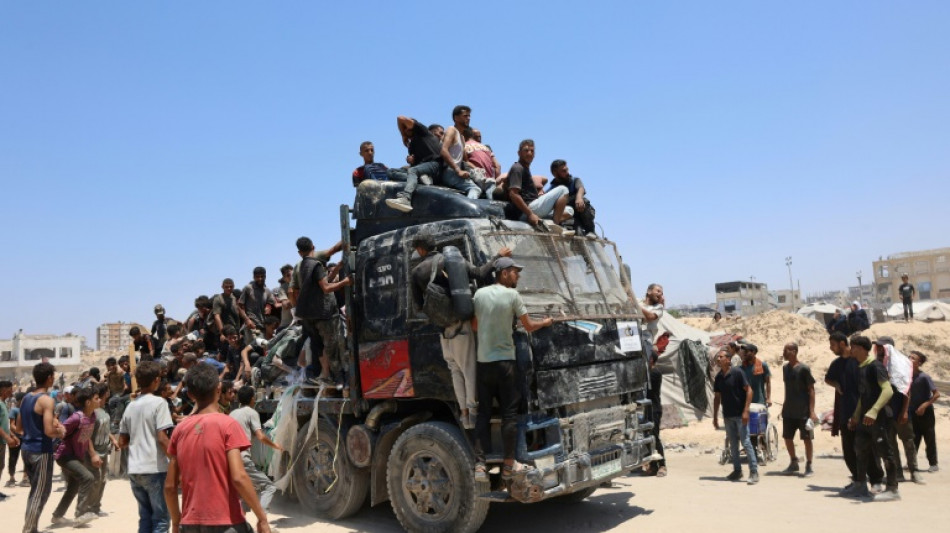
Why are Gazans not getting sorely needed aid? / Photo: Omar AL-QATTAA - AFP

 Texas Sports Betting Status: No Legal Options Amid Legislative Push for 2027 Referendum

 Geri Halliwell-Horner Embraces Queen Camilla at Commonwealth Writing Competition

 Meta Quest 3 and 3S Gain Access to Over 150 3D Movies

 Sarah Bajada Shares Message on Pregnancy Loss

 ALIX LASERS shareholders remove Michael Sobitsch as managing director in view of the circumstances

 Euroseas Q3 Net Profit Falls to $91.4 Million Amid Fleet Reduction
Gazans are in desperate need of essentials after more than 21 months of war, but efforts to get aid into the Palestinian territory -- and to its hungry residents -- face major obstacles.
UN agencies and aid organisations cite Israeli restrictions, safety issues and the establishment of a US- and Israeli-backed mechanism that has sidelined the humanitarian system in place.
Israel says international organisations have failed, and that the previous UN-led system had allowed Hamas militants to loot aid trucks.
On the ground, meanwhile, more than 100 aid and human rights groups warned this week that "mass starvation" was spreading.
- GHF: few sites, deadly incidents -
Israel's chosen aid distributor, the Gaza Humanitarian Foundation (GHF), began operations on May 26 after a more than two-month total aid blockade.
Now the main channel for distributing food to Gaza's more than two million people, GHF has faced chaos and deadly violence at its few distribution points.
The United Nations and aid groups have refused to work with GHF, saying it was created to serve Israeli military interests.
"They are not a humanitarian organisation... You don't deliver humanitarian aid in areas that have been completely flattened and militarised," said Arwa Damon, founder of INARA, a US-based NGO offering medical and mental health support to children.
She noted the GHF's site locations -- along two military corridors in southern and central Gaza -- rather than being spread out across the territory.
With only four GHG sites and huge crowds trying to reach them, there have been repeated reports of deadly fire near them.
According to UN figures, Israeli forces have killed some 800 Palestinian aid-seekers near GHF sites since late May.
Israel has rejected calls to restore the UN-led system, citing concerns that Hamas looted trucks and resold aid meant to be distributed free of charge.
- Aid organisations sidelined -
International aid groups say vast quantities of aid are stockpiled outside Gaza but require Israeli military clearance to enter.
Inside Gaza, coordination with the military is also essential, as fighting and air strikes rage on.
Damon accused Israel of preventing aid delivery by refusing to coordinate with NGOs to grant safe passage through combat zones.
"Getting that coordination approved is incredibly challenging," she told AFP.
"Not to mention Israel's lack of willingness to provide humanitarian organisations with a safe route to be able to ensure a secure pickup."
The UN agency for Palestinian refugees, UNRWA, said on Wednesday it had "thousands of trucks in neighbouring countries waiting to enter Gaza –- banned by Israeli authorities from entering since March".
- 'Encountered death' for flour -
Israel screens all goods entering Gaza, but COGAT, the Israeli defence ministry body overseeing civil affairs in the Palestinian territories, denies limiting the number of humanitarian trucks.
On Thursday it said "around 70 food trucks were unloaded at aid crossings, and over 150 were collected by the UN and international organisations from the Gazan side".
But more than 800 trucks remained uncollected, and Israel's military posted footage online of hundreds of trucks loaded with food aid "sitting idle inside Gaza".
UN agencies and international NGOs reject Israeli claims that they lack the capacity to distribute food.
They note that aid was distributed effectively in the past, including during the last ceasefire in the Israel-Hamas war that ended in March.
In Khan Yunis, in Gaza's south, resident Yousef Abu Shehla said this week he had "encountered death" to get his hands on a bag of flour for his family.
"We shall feed our children even if we die," he told AFP.
J.Oliveira--PC