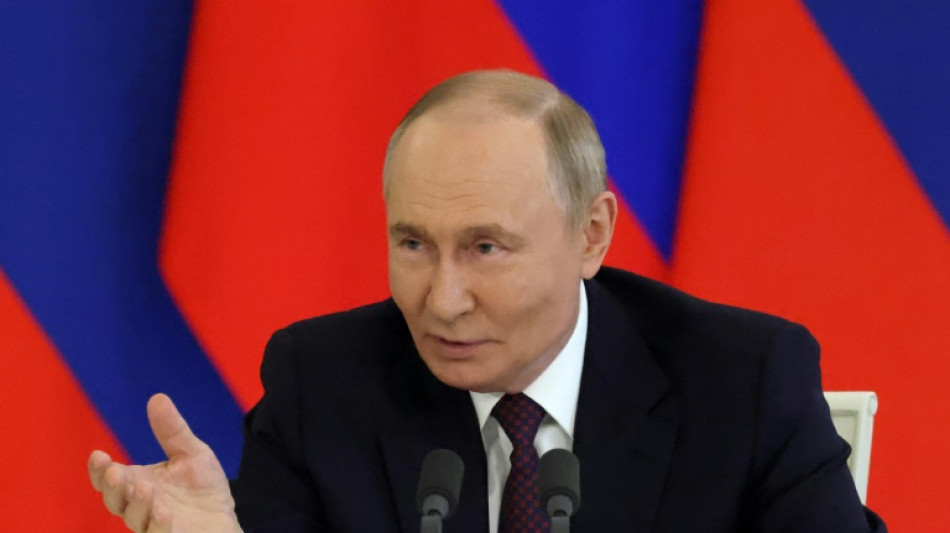
Putin decree allows Russia to increase greenhouse gas emissions / Photo: Evgenia Novozhenina - POOL/AFP/File

 Texas Sports Betting Status: No Legal Options Amid Legislative Push for 2027 Referendum

 Geri Halliwell-Horner Embraces Queen Camilla at Commonwealth Writing Competition

 Meta Quest 3 and 3S Gain Access to Over 150 3D Movies

 Sarah Bajada Shares Message on Pregnancy Loss

 ALIX LASERS shareholders remove Michael Sobitsch as managing director in view of the circumstances

 Euroseas Q3 Net Profit Falls to $91.4 Million Amid Fleet Reduction

 Daily Horoscope November 20, 2026: Astrological Predictions for All Signs

 Tosca's 2026 Sustainability Report Makes the Case for Packaging as Critical Supply Chain Infrastructure
Russian President Vladimir Putin on Wednesday signed a decree that would allow Russia to increase its greenhouse gas emissions by a fifth by 2035 compared with 2021 levels.
Russia, the world's fourth-largest emitter of planet-warming carbon dioxide gas, aims to achieve net zero emissions by 2060.
But activists say its current climate goals are woefully insufficient to combat global warming.
In the decree, Putin ordered his government to implement "by 2035 a reduction in greenhouse gas emissions to 65-67 percent relative to the 1990 level", taking into account the impact of Russia's vast forests that soak up carbon.
This would set Russia's maximum allowed emissions at around two billion tonnes of carbon dioxide equivalent by 2035 -- lower than the record of 3.1 billion tonnes in 1990 but around 22 percent higher than the 2021 figure of 1.7 billion, according to data provided by Russia to the United Nations.
Russia has cautioned against phasing out fossil fuels at previous climate summits.
Its economy is largely dependent on oil and gas exports and it has repeatedly set targets campaigners have described as unclear and unambitious.
Experts say the 1990 baseline is also misleading as Russia's greenhouse gas emissions plunged by more than half between 1990 and 2000, largely due to the collapse of industry following the break-up of the Soviet Union.
The Paris Agreement, which Russia has signed, aims to limit a rise in global warming to 1.5C above pre-industrial levels.
Russia is warming 2.5 times faster than the rest of the planet, according to the head of Russia's state meteorological service.
Experts from the United Nations Intergovernmental Panel on Climate Change have warned that there is a 50/50 chance the world will pass the 1.5C threshold in the early 2030s.
H.Portela--PC