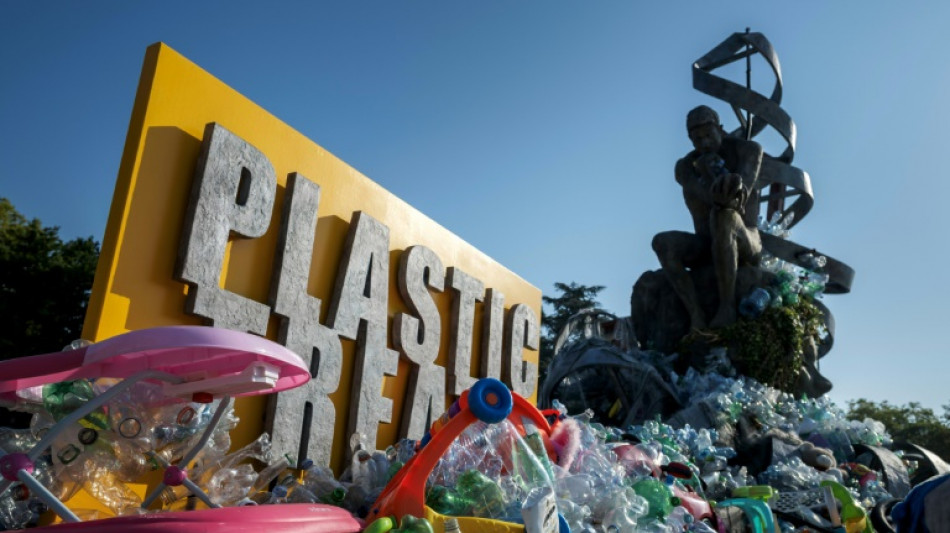
Deadlocked plastics treaty talks 'at cliff's edge' / Photo: Fabrice COFFRINI - AFP

 Geri Halliwell-Horner Embraces Queen Camilla at Commonwealth Writing Competition

 Meta Quest 3 and 3S Gain Access to Over 150 3D Movies

 Sarah Bajada Shares Message on Pregnancy Loss

 ALIX LASERS shareholders remove Michael Sobitsch as managing director in view of the circumstances

 Euroseas Q3 Net Profit Falls to $91.4 Million Amid Fleet Reduction

 Daily Horoscope November 20, 2026: Astrological Predictions for All Signs

 Tosca's 2026 Sustainability Report Makes the Case for Packaging as Critical Supply Chain Infrastructure

Negotiators from 184 countries remained riven Wednesday on how to curb plastic pollution, less than 36 hours before they were slated to deliver a binding global treaty.
Diplomats are "at the edge of a cliff," one official observer told AFP.
Dozens of ministers have arrived in Geneva to try to break the deadlock as the 10-day talks hurtle towards a close, but widely divergent positions have made the search for a so-called landing zone "very difficult", according to Danish Environment Minister Magnus Heunicke.
A new draft of the treaty text, streamlined by the talks chair, is expected later Wednesday, several sources told AFP. A plenary meeting to take stock of where things stand is scheduled for 7:00 pm (1700 GMT).
The debate continues to pit the so-called "Like-Minded Group" of chiefly oil-producing countries that refuse restrictions on the production of plastic -- a derivative of oil -- or certain chemicals thought to be harmful to health against a much larger "high ambition" bloc that favours such measures.
David Azoulay, director of the environmental health programme at the Center for International Environmental Law group, told AFP he expects the new summary text to be "very weak" and a "lowest common denominator", falling short of the treaty's purpose: resolving the global plastic pollution crisis.
"Negotiators are at the edge of a cliff," said Pamela Miller, co-chair of the International Pollutants Elimination Network (IPEN), which has official observer status.
The World Wide Fund for Nature's Eirik Lindebjerg fears last-minute compromises will result in a "bad deal".
WWF has identified "more than 150 countries in favour of a ban on certain plastics and toxic products, and 136 keen to strengthen the treaty over time," he told AFP.
Graham Forbes, head of the Greenpeace delegation, echoed this sentiment, telling AFP on Wednesday that "ministers must reject a weak treaty".
Other observers, however, suggested there was not enough attention given to the industrial transformations required in producing countries for the talks to succeed.
"Some are approaching the issue from the perspective of industrial policy, international trade and market access but are not being listened to, while on the other side they are talking about regulation, the environment and health," Aleksandar Rankovic from The Common Initiative think-tank, told AFP.
"It can't work."
C.Cassis--PC