'Never again': Indigenous Bolivians sour on socialism / Photo: MARTIN BERNETTI - AFP

 Huge crowds cheer Pope Leo along Champs-Elysees ahead of Paris mass

 Putellas wants to bring 'winning culture and mentality' to London City

 Rare Italian opera returns to Moscow after nearly 120-year hiatus

 Pope to celebrate giant Paris mass after 'peace' appeal

 Homes flooded, roads submerged: Bangkok declares disaster over heavy rains

 Ahead of Paris mass, pope urges life together in 'dignity and peace'

 Austria 'ghetto' language classes leave children to repeat school
 S.African women runners arm themselves after string of killings

 'I felt embarrassed': Japan eSports whizz-kid, 11, wins Games gold

 Indonesia fires threatens critically-endangered orangutan: IUCN

 Bangkok declares flood disaster across city

 'World records not enough': North Korea weightlifters target Olympic gold rush

 Iran proposes Hormuz plan, Trump reportedly refuses
 El Nino rewrites the menu in the world's top restaurants

 Pope to hold giant mass on Champs-Elysees

 TikTok to pay Alabama $100 mn under pre-trial settlement

 Internationals take 7-3 Presidents Cup lead after foursomes sweep

 Brazil team returns to Colombian site of doomed jet crash

 Mbappe injured as Zidane wins on France debut, Italy lose on Mancini return

 Senegal draw in Vieira debut, Nigeria survive scare as Cape Verde crash

 U2 performs surprise 50th anniversary gigs in Dublin

 Pope calls worshippers 'saints of France' after AI warning

 US court sides with Pentagon in Anthropic AI ban

 Wall Street stocks rise, greeting optimism over possible US-Iran deal

 NFL players chief raises concerns over pitch for Maracana game

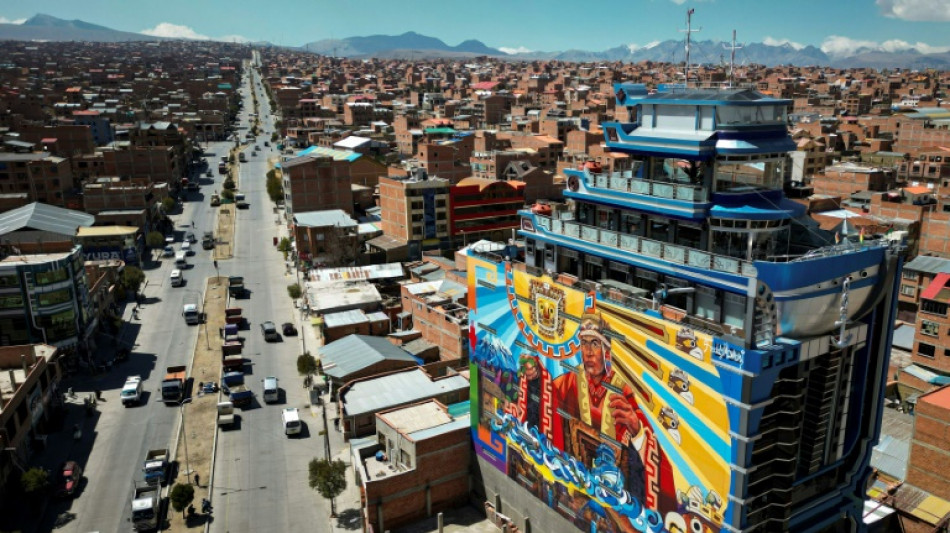
A giant cruise ship dominates the skyline in the city of El Alto in landlocked Bolivia, a symbol of the transformation of an Indigenous bastion keenly fought over in Sunday's presidential election.
The "Titanic," as the tallest building in the city is known, serves as the latest in a collection of uber-flamboyant neo-Andean "cholets" -- a mix of chalet and "chola" or Indigenous woman -- built by Bolivia's Aymara bourgeoisie over the past two decades.
Victor Choque Flores, a self-made 46-year-old businessman, forked out millions of dollars for his "ship in a sea of bricks," as he calls his futuristic 12-story palace which looms large over El Alto's red-brick homes.
"It's a bit like us," he said, adding that while rooted in the past, Indigenous Bolivians are "looking towards the future."
For many Aymara, that future no longer includes the ruling socialists, who emancipated the Indigenous majority over the past two decades.
For the first time since 2005, the political right is expected to triumph in presidential elections as Bolivians ditch the left over a deep economic crisis.
- Gratitude, frustration -
Nearly 20 years after one of South America's longest-serving presidents, Evo Morales, was elected on a promise of socialist revolution, the Andean country is running on empty.
Widespread shortages of dollars, fuel and basic foodstuffs have left some Bolivians worse off than before he took over.
Choque Flores still feels grateful to Morales, Bolivia's first Indigenous president, for throwing open the doors of power to the country's brown-skinned majority.
But El Alto, a flourishing merchant city, is also increasingly defined by its residents' desire to simply get ahead.
Accusing the socialists of multiple "failures," Choque Flores said he was ready to vote for "another political direction," without revealing which candidate.
- Gas War cauldron -
The fate of Bolivia's left is inextricably linked with El Alto.
Morales came to power in the wake of a bloody crackdown on a revolt in the city over gas exports, which led to over 60 deaths and the fall of a US-backed president in 2003.
In the years since, Morales repeatedly dispatched his supporters down the mountain from El Alto to the seat of government in La Paz to defend his causes.
But the winds of change are blowing on the streets of the Andean metropolis, where women in traditional bowler hats, flouncy "pollera" skirts and shawls hawk goods as gleaming cable cars ferry commuters overhead.
Across the million-strong city, walls are covered with leading center-right presidential candidate Samuel Doria Medina's promise to restore supplies of fuel and dollars in "100 dias carajo" (100 days goddammit).
In a sign of the importance of the Indigenous vote, Doria Medina, who is running neck-and-neck with right-wing ex-president Jorge Quiroga, staged his final campaign rally in El Alto on Wednesday.
Jonathan Vega, a 25-year-old chef who attended the gathering, said he was counting on Doria Medina to "restore stability."
A 72-year-old farmer invited to discuss the election at the local "San Gabriel" Aymara-language TV and radio station also backed change.
Arcenio Julio Tancara lambasted Morales's call for voters to spoil their ballot over the refusal by authorities to allow him to run for a fourth term.
"He has always called for unrest and for strikes and blockades.
"At first, we understood that it might be necessary, but since we've seen that it wasn't for a cause, but simply so that he'd be named leader."
- 'They disinfect themselves' -
Morales, who is wanted on charges of trafficking a minor, has sought to galvanize his base by warning that hard-won Indigenous rights are under threat if light-skinned politicians of European heritage take over.
It's a tactic that plays well with rural Aymara particularly.
"We don't want to go back to the 20th century," said Matilde Choque Apaza, the leader of an Indigenous and rural women's association, who wore a colorful "aguayo" hold-all knotted around her neck.
Opposition candidates, she said, "clasp (Indigenous) hands tightly" when on the campaign trail, but when they get into their cars or go home, "they disinfect themselves."
She backed the appeal made by Morales for a mass campaign of spoiled ballots to sap the election of legitimacy.
Polls show around 14 percent of voters are set to answer his call -- a far cry from the three outright majorities Morales secured during his 2006-2019 rule.
Santos Colque Quelca, a 38-year-old presenter at San Gabriel radio, said that growing numbers of listeners were swearing "never again with Evo or (current President Luis) Arce" and were switching their support to the "least bad" opposition candidate.
Pablo Mamani Ramirez, a sociologist at UMSA university in La Paz, said Morales' bid for "eternal" rule ran counter to Indigenous traditions.
"The logic of the Andean world is that power is rotated."
O.Salvador--PC