Under a drone canopy, Ukraine army medics rely on robots and luck / Photo: Genya SAVILOV - AFP

 Ahead of Paris mass, pope urges life together in 'dignity and peace'

 Austria 'ghetto' language classes leave children to repeat school
 S.African women runners arm themselves after string of killings
 'I felt embarrassed': Japan eSports whizz-kid, 11, wins Games gold
 Indonesia fires threatens critically-endangered orangutan: IUCN

 Bangkok declares flood disaster across city

 'World records not enough': North Korea weightlifters target Olympic gold rush

 Iran proposes Hormuz plan, Trump reportedly refuses
 El Nino rewrites the menu in the world's top restaurants
 Pope to hold giant mass on Champs-Elysees

 TikTok to pay Alabama $100 mn under pre-trial settlement

 Internationals take 7-3 Presidents Cup lead after foursomes sweep

 Brazil team returns to Colombian site of doomed jet crash

 Mbappe injured as Zidane wins on France debut, Italy lose on Mancini return

 Senegal draw in Vieira debut, Nigeria survive scare as Cape Verde crash
 U2 performs surprise 50th anniversary gigs in Dublin
 Pope calls worshippers 'saints of France' after AI warning

 US court sides with Pentagon in Anthropic AI ban
 Wall Street stocks rise, greeting optimism over possible US-Iran deal

 NFL players chief raises concerns over pitch for Maracana game

 Daytime Russian attacks kill seven in Kyiv
 Spotting AI writing: how reliable are the detectors?
 French youth await pope after AI 'paradise of machines' warning
 Man City found guilty of Premier League charges, set to appeal: reports
 Embolo follows Xhaka out of Swiss squad over fake Covid documents
When Magician, a Ukrainian serviceman, was remotely steering a robot hauling a wounded soldier away from the front line towards safety, the worst-case scenario played out on his monitor.
The 27-year-old, who asked AFP to identify him by his call sign in line with military protocol, was navigating the bot on a journey with life-or-death stakes when grey smoke appeared on his control screen. His machine had hit a mine.
The proliferation of cheap but deadly drones deployed by Russian and Ukrainian forces has irreversibly changed how the war is being waged -- including how frontline medics retrieve the wounded from the battlefield.
"For five minutes, that person's death was on my conscience," Magician told AFP.
He believed in that moment the mission -- and the soldier's life -- were lost.
The canopy of killer drones blanketing the skies over the front line is forcing military medics to find new ways to move wounded to field hospitals for treatment, including by robot.
At the beginning of Russia's full-scale invasion in early 2022, medics could rush onto the battlefield and carry hurt troops out by stretcher or vehicles.
Drones have made that almost impossible.
Military medic Olena Ivanenko recounted painful episodes when she was unable to reach wounded soldiers less than one kilometre (half-a-mile) away.
"I was hearing their voices on the radio and yet I couldn't do anything," she said.
- 'You're too far' -
The "kill zone," where drones make any movement potentially fatal, stretches for up to 10 kilometres (6 miles) behind the front line on the Ukrainian side, analysts say.
"When a brother or sister dies, it's already done. You can't bring them back, but when there is a chance to save someone and you can't do it because you're too far -- that's very tough," said Ivanenko, a medic with Ukraine's 412th regiment.
The excruciating helplessness has forced medics to get creative in their work.
Ivanenko said her unit often sends food or medication to stranded service members by aerial drone, even sending syringes filled with medicine and explaining remotely how to administer it.
Evacuation robots like Magician's are part of the solution, but only skilled operators can carry out delicate missions.
"It must be done verycarefully you shouldn't make any sudden movements," said Krop, a robot operator in the 5th brigade who also used his military call-sign.
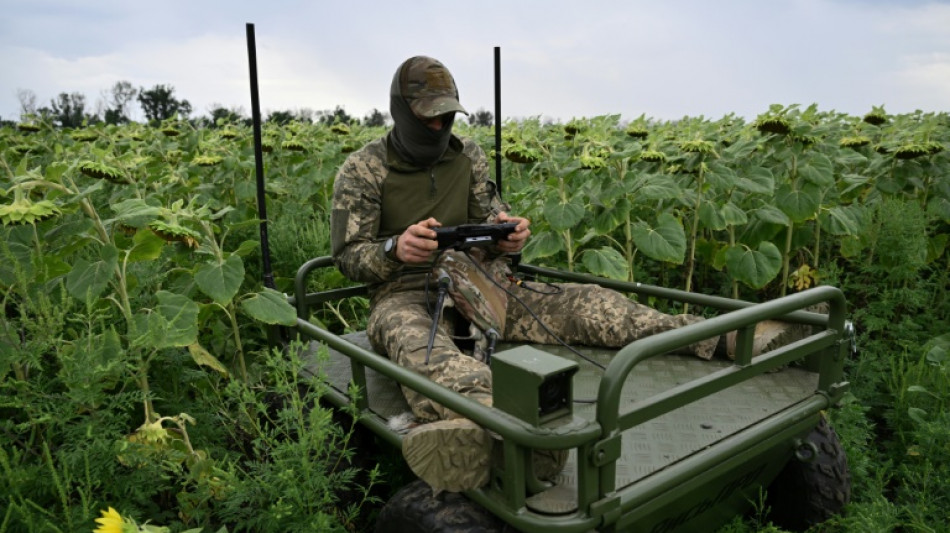
At a training ground in eastern Ukraine, he demonstrated to AFP the nimble movements the robots are capable of, steering it via a hand-held controller complete with a screen and triggers on the sides.
Krop sent the robot ploughing through a sunflower field, and spun the machine in one spot while another pilot held on to the platform for carrying the wounded.
- 'Shaking' -
Their attitudes shift on mission said Bot, a pilot in the 5th brigade.
"It's someone's life," the 24-year-old told AFP. "It's not just a game or a toy. We're not playing."
The robots are slow, which means Russian drones can easily locate and target them, that is if they don't hit mines.
The toll of failed evacuations -- of lives lost -- weighs heavily on the pilots.
"You get half-an-hour of self-flagellation, and then you think 'dammit, it was the bastards who killed them. I wasn't the one who shot them'," Magician said.
Magician thought all was lost when his bot carrying the wounded soldier hit the mine.
But staring at the monitor showing plumes of smoke billowing from the vehicle, he saw a figure crawling to safety and the team dispatched another robot.
"At that moment you're driving and your whole body is shaking -- except the fingers holding the joystick," Magician said.
The return journey lasted hours, including moments that were painful for the wounded soldier, over potholes, dips and bumps.
"I felt a little sorry for him. Fifteen kilometres in a shaking basket isn't very comfortable," Magician said.
"But I pulled him out."
E.Ramalho--PC