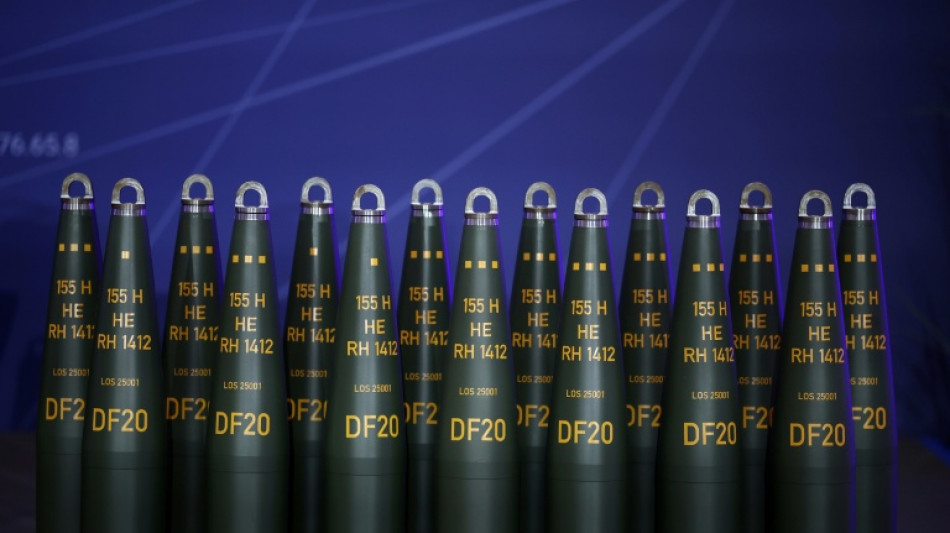
Defence giant Rheinmetall opens mega-plant as Europe rearms / Photo: Ronny HARTMANN - AFP

 Burnham Government Announces Neighbourhood Support Teams to Reduce Hospital Admissions

 KFF Health News Readers Weigh In on Healthcare Policy, Ethics, and Workforce Shortages

 16-Year-Old Founder Targets 'Cost Per Kill' With AI Missile Startup
 Elon Musk Promises Steering-Wheel-Free Tesla Model Y Amid Cybercab Sales Launch

 Tosca's 2026 Sustainability Report Makes the Case for Packaging as Critical Supply Chain Infrastructure

 Eisai's Dayvigo Shows Year-Long Efficacy Without Tolerance Ahead of Korean Launch
German weapons-maker Rheinmetall opened Europe's largest munitions plant on Wednesday, a move hailed as boosting Western defences by NATO chief Mark Rutte.
Taking up 30,000 square metres -- the size of five football pitches -- the factory in Unterluess in northern Germany will be able to produce 350,000 artillery shells a year by 2027.
"This is absolutely crucial for our own security and also to keep supporting Ukraine in its fight today and to deter any aggression in the future," Rutte said at an opening ceremony.
"We are being challenged" by China and Russia, he said, but added that Europe and the United States together are on course to "turn the tide on defence production".
Europe has moved to ramp up weapons production and military readiness following Russia's full-scale invasion of Ukraine in 2022, accelerating efforts as US President Donald Trump has urged Europe to take more responsibility for its own defence.
Artillery shell production across the continent is now six times greater than it was two years ago, Rutte said, and Germany earlier this year loosened strict debt rules so that it can borrow billions to pay for military equipment.
Speaking alongside Rutte at the ceremony, German Defence Minister Boris Pistorius said that Europe could not confront security challenges if it did not develop its industrial base to convert spending promises into concrete capabilities.
"The miliary and armed forces only work as well as the country behind them," he said. "We need to be successful because we are faced with a threat."
Washington was watching closely to see if Europe could deliver on its promises to increase spending, Pistorius added.
"NATO has to become more European so that it can stay transatlantic," he said. "This is the demand before which we stand as Europeans."
- 'Turning point' -
Praising Pistorius for his efforts, Rheinmetall chief Armin Papperger said that politicians taking defence increasingly seriously had helped ensure the plant could be built in as little as 14 months when it would ordinarily take two or three years.
"There has been a turning point here in Germany," he said.
The plant will help fill a record-breaking munitions order worth 8.5 billion euros ($9.3 billion at the time) placed by the German government in July 2024.
German Chancellor Friedrich Merz has vowed to build Europe's "strongest conventional army".
Defence spending is projected to reach to reach 162 billion euros in 2029, more than triple the defence budget compared to its level before the war in Ukraine.
Rheinmetall's Unterluess site already makes guns and munitions for the Leopard 2 tank, which has been used by the Ukrainian army.
Papperger also signed a 550-million-euro deal on stage with Romania's economy minister for a plant he said would probably be completed within the next 18 months.
Separately, Germany's cabinet signed off a draft law on Wednesday that aims to boost armed forces recruitment and includes provisions for compulsory military service if there are not enough volunteers.
About 182,000 soldiers currently serve in the armed forces. Pistorius has said that should rise to 260,000.
L.Torres--PC