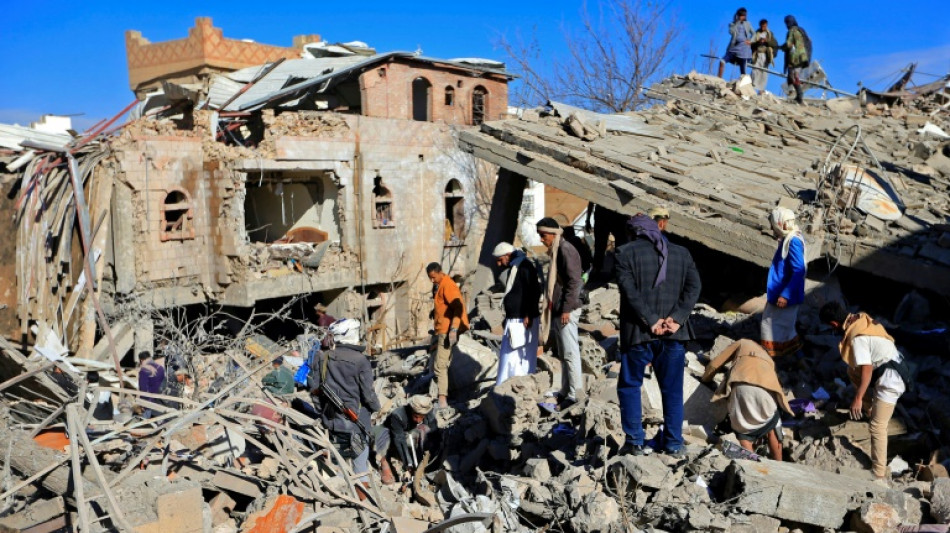
14 dead as coalition bombs Yemen after UAE attack

 Auger-Aliassime upset by Khachanov at US Open

 Hugging Face, the French start-up that became AI's warehouse

 World Cup winner Llorente retires from Spain team at 31

 Osaka squeezes into US Open third round

 Apple faces £2 bn lawsuit in UK over app privacy feature

 Former champ Swiatek eases into US Open third round

 DR Congo latest to promise moving Israel embassy to Jerusalem

 War criminal Mladic's body returns to Serbia with military honours

 Pierre Cardin museum brings designer's futurist style to Venice

 Slovenian rookie Omrzel triumphs as Mas extends Vuelta lead

 British, French leaders talk migrants, EU relations

 Heading for Ferrari's home race, Leclerc still dreams of world title
 Cafe at centre of Israel culture clash agrees to shut on Sabbath

 Spacecraft bound for Mercury begins 'tricky' arrival
 Initial expert report blames tanker for collision off Istanbul

 'Everyone a winner' with Barcola transfer, says PSG coach Luis Enrique

 Ukraine, India discuss Black Sea, food security on FM's 'historic' Kyiv visit

 Europe bids to be robot superpower like US, China

 US Fed official joins growing group open to rate hike if inflation rises

 Hugh Jackman in talks to buy stake in Norwich football club

 Yen surges on new intervention talk, oil prices climb
 US feminist icon Gloria Steinem dies aged 92
 France recorded 'hottest summer ever': environment minister

 'No plans to retire', says 'acting god' Malkovich

 Nigerian opposition lobbyist tapped for White House-linked role, firm says

The Saudi-led coalition killed 14 people in air strikes on Yemen's rebel-held capital, a medical source said Tuesday, after an attack by Huthi insurgents on the United Arab Emirates sent regional tensions soaring.
Sanaa residents were combing the rubble for survivors of the strikes that levelled two houses, hours after the Huthis had killed three people Monday in a drone and missile attack on the UAE capital Abu Dhabi.
Huthi Brigadier General Abdullah Qassem Al-Junaid, director of the rebels' air force academy, was killed along with family members, the rebels' Saba news agency said.
Coalition forces launched further strikes on Sanaa on Tuesday.
"The search is still going on for survivors in the rubble," said Akram al-Ahdal, a relative of several of the victims.
The UAE, part of the Saudi-led coalition fighting the Iran-backed rebels, had vowed a tough response to Monday's attack, the first deadly assault acknowledged inside its borders and claimed by the Yemeni insurgents.
The attack on the renowned Middle East safe haven of UAE, which opened a new front in the seven-year war, followed a surge in fighting in Yemen including battles between the rebels and UAE-trained troops.
Crude prices soared to seven-year highs partly because of the Abu Dhabi attacks, which exploded fuel tanks near storage facilities of oil giant ADNOC. The Huthis later warned UAE residents to avoid "vital installations".
Yemen, whose nearly seven-year-old war has killed hundreds of thousands, occupies a strategic position on the Red Sea, a vital conduit for oil from the resource-rich Gulf.
After the attacks, Saudi Arabia's de facto ruler, Crown Prince Mohammed bin Salman, and Abu Dhabi Crown Prince Mohamed bin Zayed agreed in a phone call to "jointly stand up to these acts of aggression", UAE state media said.
- 'No end in sight' -
The Abu Dhabi attack marked a new phase in the Yemen war and further reduced hopes of any resolution to the conflict, which has displaced millions in what was already the Arabian peninsula's poorest country.
The United States pledged to hold the Huthis accountable, while Britain, France and the European Union also condemned the assault.
The targeting of Abu Dhabi followed intense clashes in Yemen, including advances by the UAE-trained Giants Brigade, who drove the rebels out of Shabwa province.
The defeat dealt a blow to the Huthis' months-long campaign to capture neighbouring Marib, the government's last stronghold in the north.
Earlier this month, the Huthis hijacked the UAE-flagged Rwabee in the Red Sea, charging that it was carrying military equipment -- a claim disputed by the coalition and the UAE.
The ship's 11 international crew are being held captive.
Yemen's civil war began in 2014 when the Huthis seized the capital Sanaa, prompting Saudi-led forces to intervene to prop up the government the following year.
The conflict has been a catastrophe for millions of its citizens who have fled their homes, with many on the brink of famine in what the UN calls the world's worst humanitarian crisis.
The UN has estimated the war killed 377,000 people by the end of 2021, both directly and indirectly through hunger and disease.
"There is no end in sight for the Yemen war," Elisabeth Kendall, a researcher at the University of Oxford's Pembroke College, told AFP.
"Rather, the conflict is escalating and new fronts are opening up, both domestically and now regionally."
S.Caetano--PC