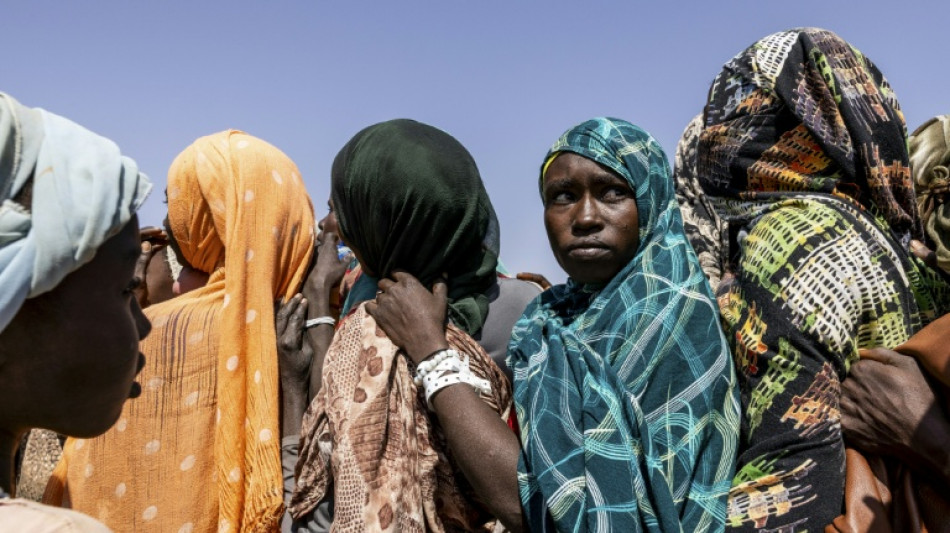
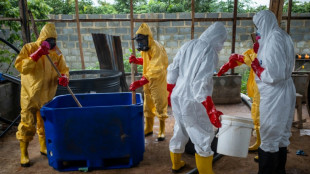
'Killed without knowing why': Sudanese exiles relive Darfur's past / Photo: Joris Bolomey - AFP

 Fury to face British rival Joshua in Cardiff on December 11

 Streamex Converts Interest Into Capital as GLDY Investment Strategy Secures $1M+ Institutional Allocation

 STARTRADER Named Best Fintech Forex Broker at Forex Expo Dubai 2026
 Japan swimmer Ohashi, 17, shrugs off Covid to smash world record

 Shin Ohashi: Junk food-loving teen and new world record-holder

 Greek PM urges 'courage' in talks with UK over Parthenon Marbles
 'I was drowning': Iran Nobel winner exposes pain of separation from children

 Israel's US envoy says son fighting for life

 Olympic champion Yulo completes gymnastics gold collection at Asian Games
 England cannot imitate Spain's success, says Gordon

 Hungary detects invasive spotted lanternfly for first time in EU

 Ο Alex Bodi και ο καθηγητής Δρ. Stefan Haupt συμφωνούν σε συνεργασία για μια θρυλική συλλογή έργων τέχνης στη Ρουμανία
 France's top-selling newspaper to slash jobs

 Tigray rebels in 'full-blown' war with govt

 Alex Bodi och prof. dr Stefan Haupt ingår samarbetsavtal om en legendarisk konstsamling i Rumänien

 อเล็กซ์ โบดี และศาสตราจารย์ ดร. สเตฟาน ฮาปท์ ตกลงร่วมมือกันในการจัดตั้งคอลเลกชันศิลปะอันเป็นตำนานในโรมาเนีย

 Alex Bodi a prof. dr. Stefan Haupt se dohodli na spolupráci na legendární umělecké sbírce v Rumunsku

 알렉스 보디와 슈테판 하우프트 교수, 루마니아의 전설적인 미술품 컬렉션을 위한 협력 합의

 BaazEX Enters the Asian Trading Market With a New Approach to Online Forex Trading.

 Asian markets fall on US-China jitters as leaders meet
 Thais hail teen rocker Nene for 'America's Got Talent' win

 Zverev, Agassi defend 'spectacular' Laver Cup
 Eel-powered Japan whizz-kid, 11, dominates in historic Games debut

 Madagascar's Gen Z 'betrayed' after ushering in new rule
 As Moscow steps up attacks, Kyiv residents brace for harsh winter
Decades after Darfur was the scene of some of the 21st century's worst atrocities, Sudanese exiles say the nightmare has returned as images of fresh bloodshed emerge from the region.
For the diaspora watching from afar, alleged crimes in El-Fasher -- the last army stronghold in Darfur before its fall to paramilitaries last month -- mirror the massacres that once shocked the world.
"Sometimes it's hard to believe it's happening again," said Abdullah Yasser Adam, a researcher from South Darfur's capital Nyala, who now lives in Cairo and uses a pseudonym for security reasons.
"People are being killed without knowing why. It feels like the end of the world."
Adam, 45, belongs to the Fur community, one of several non-Arab groups targeted between 2003 and 2008 in the western region when Omar al-Bashir's government armed Arab militias, the Janjaweed, to crush a rebellion.
He is among six million Sudanese living in exile, including four million who fled after war erupted in April 2023 between the army and the same fighters, now rebranded as the Rapid Support Forces.
Survivors of the RSF assault on El-Fasher described scenes Adam recognised instantly: summary executions, mass flight, and towns burned and emptied at gunpoint.
"Planes overhead, Janjaweed on camels and horses, vehicles on the ground," he said, recalling stories of survivors who staggered into Nyala in 2003.
"People were hunted like prey," he said. "They arrived on foot, many barefoot. Mothers carried children whose malnutrition you could see in their swollen bellies."
"Today, the attacks are the same," he added, "only with more advanced weapons."
- 'Same coin' -
The RSF is led by Mohamed Hamdan Daglo, known as Hemedti, who rose from camel trader to militia commander under Bashir.
Bashir's campaign in Darfur, framed as a counter-insurgency, became a devastating assault on non-Arab tribes demanding equality and political inclusion.
Sudanese-American poet Emtithal Mahmoud, who fled Darfur to the United States at four and returned in 2000 at age six, recalls seeing one of the early crackdowns in her hometown, El-Fasher.
"I remember us seeing the smoke rise from downtown," Mahmoud, 32, told AFP from Philadelphia.
"I hid underneath the bed that day with four other people. I could see the soldiers' boots coming in. And I saw our blood on their ankles," she said.
That war left 300,000 dead and 2.7 million displaced, according to the UN.
Bashir is wanted by the International Criminal Court on genocide charges.
Last week the UN Human Rights Council ordered investigators to probe recent alleged atrocities in El-Fasher.
After Bashir's fall in 2019, Hemedti recast himself as a statesman and army ally, analysts say, but disagreements over integrating the RSF into the military triggered the 2023 conflict.
For Mahmoud, the "Darfur genocide never ended".
"It became more complex politically, but the killing never stopped," she said.
Both sides, she argues, committed past atrocities.
The army "would carpet bomb our villages and the Janjaweed would" wait to kill survivors, she said.
"They would burn crops. They would throw bodies in wells. They would rape women and children."
Adam agreed that "they were two sides of the same coin."
Their roles may have shifted, but "the Sudanese people remain the victims," he said.
During the current war, the army faces accusations of indiscriminate air strikes and chemical weapons use, while the RSF is accused of executions, rape and looting.
- 'Worse than 2003' -
For Amar Salah Omar, a 34-year-old electrician from the Massalit tribe who has lived in Paris since 2016, foreign involvement has made today's war even deadlier.
The United Arab Emirates has been accused of giving the RSF weapons -- a claim it denies -- while analysts say the army is backed by Egypt, Saudi Arabia, Turkey, Russia and Iran.
"What's happening today is even worse than in 2003," Omar told AFP.
The RSF "didn't have as much power" back then, he said, but now "they are untouchable."
With El-Fasher's fall, the RSF controls all five Darfur state capitals, effectively slicing Sudan in two: the army in the north, east and centre, and the RSF ruling Darfur and parts of the south.
Nearly 100,000 people have fled El-Fasher, yet tens of thousands remain trapped in famine conditions after an 18-month siege.
Hospitals and markets have been shelled, and aid has been blocked. Similar patterns are emerging in the neighbouring Kordofan region.
Coman Saeed, a 33-year-old volunteer with Sudan's Emergency Response Rooms network, now exiled in Uganda, warns of a massacre "just like what took place in El-Fasher" if the RSF captures Dilling and Kadugli, two army-held cities in South Kordofan.
In Darfur itself, where the RSF has set up a parallel government, Omar remains in contact with friends in Nyala and other towns.
"They live in fear of being targeted," he said.
burs-maf/jfx
T.Vitorino--PC