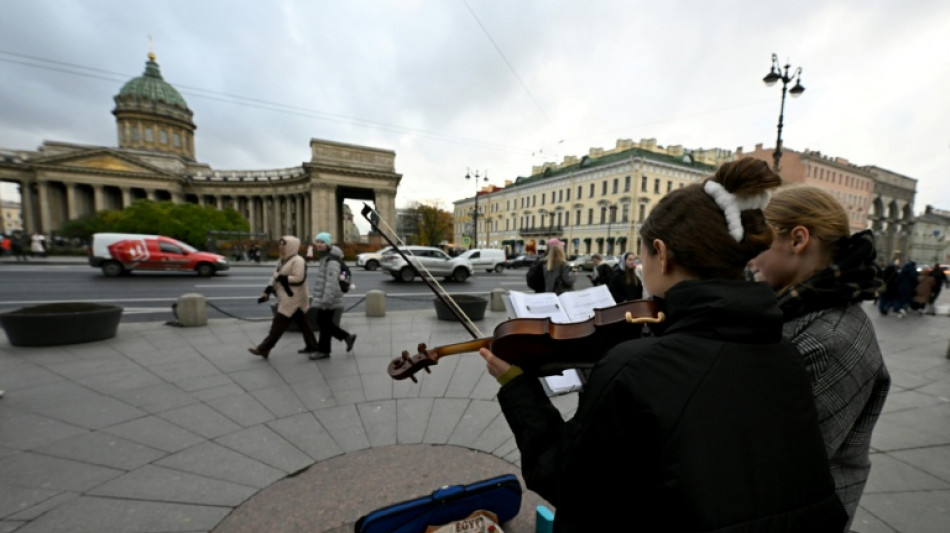
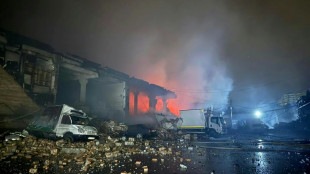
'Severely restricted': Russia's Saint Petersburg faces cultural crackdown / Photo: Olga MALTSEVA - AFP

 Fury to face British rival Joshua in Cardiff on December 11

 Streamex Converts Interest Into Capital as GLDY Investment Strategy Secures $1M+ Institutional Allocation

 STARTRADER Named Best Fintech Forex Broker at Forex Expo Dubai 2026
 Japan swimmer Ohashi, 17, shrugs off Covid to smash world record
 Shin Ohashi: Junk food-loving teen and new world record-holder
 Greek PM urges 'courage' in talks with UK over Parthenon Marbles
 'I was drowning': Iran Nobel winner exposes pain of separation from children

 Israel's US envoy says son fighting for life

 Olympic champion Yulo completes gymnastics gold collection at Asian Games
 England cannot imitate Spain's success, says Gordon
 Hungary detects invasive spotted lanternfly for first time in EU
 Ο Alex Bodi και ο καθηγητής Δρ. Stefan Haupt συμφωνούν σε συνεργασία για μια θρυλική συλλογή έργων τέχνης στη Ρουμανία
 France's top-selling newspaper to slash jobs
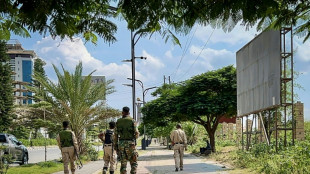 Tigray rebels in 'full-blown' war with govt

 Alex Bodi och prof. dr Stefan Haupt ingår samarbetsavtal om en legendarisk konstsamling i Rumänien
 อเล็กซ์ โบดี และศาสตราจารย์ ดร. สเตฟาน ฮาปท์ ตกลงร่วมมือกันในการจัดตั้งคอลเลกชันศิลปะอันเป็นตำนานในโรมาเนีย
 Alex Bodi a prof. dr. Stefan Haupt se dohodli na spolupráci na legendární umělecké sbírce v Rumunsku
 알렉스 보디와 슈테판 하우프트 교수, 루마니아의 전설적인 미술품 컬렉션을 위한 협력 합의

 BaazEX Enters the Asian Trading Market With a New Approach to Online Forex Trading.
 Asian markets fall on US-China jitters as leaders meet
 Thais hail teen rocker Nene for 'America's Got Talent' win
 Zverev, Agassi defend 'spectacular' Laver Cup
 Eel-powered Japan whizz-kid, 11, dominates in historic Games debut
 Madagascar's Gen Z 'betrayed' after ushering in new rule
 As Moscow steps up attacks, Kyiv residents brace for harsh winter

Russian bookseller Lyubov Belyatskaya sighed as she lamented the "climate of widespread anxiety" that has taken hold in her native Saint Petersburg amid the war in Ukraine.
Once dubbed Russia's "window to Europe", the city has long been the country's cultural capital, a hotbed of independent thinking, artistic expression and underground dissent.
But as authorities ratchet up repression, trying to stamp out any sign, no matter how small or subtle, of public opposition to the Kremlin or the Ukraine offensive, Belyatskaya said she senses the city retreating inwards.
"We can no longer write the way we used to, joke about certain things," she told AFP.
"Both our words and actions are severely restricted."
The effect is being seen on the shelves of her bookshop -- called "Vse Svobodny" or "Everyone is free" -- in the city centre.
"Every week we literally have to remove books for one reason or another," Belyatskaya said.
Since launching its offensive on Ukraine in February 2022, Russia has deployed a full legislative arsenal to silence anyone who criticises the campaign.
Those who breach wartime censorship face decade-long prison sentences.
Some authors -- like late opposition leader Alexei Navalny -- are completely banned.
Others -- those who are disliked by the Kremlin but not yet outlawed -- have to be sold with a giant label naming them as "foreign agents".
The Soviet-era term applies to the likes of Lyudmila Ulitskaya and Boris Akunin, prolific, now exiled, Russian writers.
- 'More liberated' -
The crackdown in Saint Petersburg -- President Vladimir Putin's hometown -- has a particular resonance.
The Tsarist-era capital has for decades been at the forefront of free thinking and dissent.
Nobel Prize-winner Joseph Brodsky was forced to emigrate in 1972 after years of persecution for his non-conformist poetry.
It was from Saint Petersburg that the protest rock anthem "Changes" -- by Kino, fronted by Viktor Tsoi -- emerged, encapsulating the pent-up frustration at the end of the Soviet Union.
And since 2022, the city's rock legends Boris Grebenshchikov and Yuri Shevchuk have repeatedly railed against the offensive in Ukraine.
"We consider ourselves to be freer here, more liberated, less subordinate to fear, including the fear of repression," local rights activist Dinar Idrisov told AFP.
"In reality, I don't think that's true."
There are signs that the screws are being tightened.
- Artists leaving -
Most recently, locals have been shaken by the case of Diana Loginova, an 18-year-old street musician in jail for the last month over pop-up performances of anti-war songs.
Known by her stage name Naoko, she has been sentenced to three consecutive short-term prison terms -- for disrupting public order, discrediting the Russian army and organising a mass gathering.
"To prosecute somebody for a song -- seriously?" said Serafim, a 21-year-old music student who had come to court, alongside 20 other young people, to support Loginova at a recent hearing.
Despite sympathy, some criticised her for drawing attention to the underground music scene.
"They knew they were endangering everyone", after they posted the videos online, said one singer from the city who spoke on condition of anonymity.
"The authorities ignored us, but now I know that many people have stopped going out" to perform, they added.
Pavel, a 17-year-old singer, was performing next to one of the city's canals.
"There is now a crackdown on musicians," he told AFP, saying authorities have started placing bureaucratic obstacles to hinder performances.
Platon Romanov, another bookseller who runs the independent Fahrenheit 451 store, said there was no point to trying to protest against the current situation.
"You just need to understand what times we live in. Singing songs by banned musicians on the street. Why? For what purpose? It's pointless, and obvious they will come and shut it down," he told AFP.
In such a climate, what are the prospects for a city that prided itself on its reputation as a counter-cultural hub and bastion of artistic freedom?
"Many many people, many artists, poets and musicians have left," said Romanov.
"Life has changed significantly."
T.Batista--PC