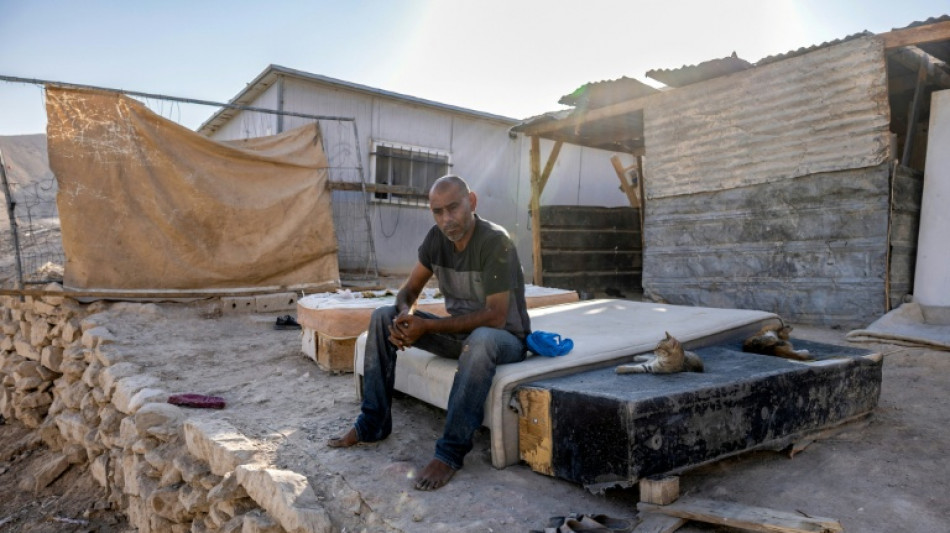
'Land without laws': Israeli settlers force Bedouins from West Bank community / Photo: Menahem Kahana - AFP

 Swiss voters expected to shun stricter neutrality
 Rapper-turned-PM faces first big test after Nepal disaster
 Tuchel seeks tonic to England World Cup 'scar' in Spain showdown

 'Helps me cope': Catholic baptisms rise among French youth

 Colombians in Santa Marta stay inside after violence wracks the city

 Iran airlines cancel flights as US sanctions hit

 Meta launches camera-free AI glasses amid privacy pushback

 Australian PM says OpenAI hacked government health website

 Xi arrives in US to personal Trump welcome

 Morocco elects new parliament amid social frustration, youth discontent

 Scheffler and Burns to face Im and Lee in Presidents Cup opener

 Crushing wins for Lyon and Barca in women's Champions League

 Rio breaks record for rainiest September amid powerful El Nino

 At UN, tech chiefs urge caution in AI development

 Russian strikes kill seven in Ukraine, Zelensky vows winter campaign

 Venezuelan shot by ICE needs urgent medical care, mother tells AFP

 Zelensky says Putin using fighters from 47 countries in Ukraine war

 Klopp calls on Germany to 'rise above ourselves' as new era begins

 Russian strikes kill seven in Ukraine as Russia vows no 'pause' to war

 ArcPoint Expands Globally with Institutional Intelligence Platform for Modern Investors

 Ronaldo focussing on 'present' ahead of Wales test

 Outgoing UN chief makes final climate push at New York summit

 Grief and pain flow at hearing for Canadian suicide poison vendor

 Ireland boss Hallgrimsson says timing of Israel remarks 'not clever'

 Weinstein resentenced to 15 years in prison for 2006 sex assault

As relentless harassment from Israeli settlers drove his brothers from their Bedouin community in the central occupied West Bank, Ahmed Kaabneh remained determined to stay on the land his family had lived on for generations.
But when a handful of young settlers constructed a shack around 100 metres above his home and started intimidating his children, 45-year-old Kaabneh said he had no choice but to flee too.
As with scores of Bedouin communities across the West Bank, the small cluster of wood and metal houses where Kaabneh's father and grandfather had lived now lies empty.
"It is very difficult... because you leave an area where you lived for 45 years. Not a day or two or three, but nearly a lifetime," Kaabneh told AFP at his family's new makeshift house in the rocky hills north of Jericho.
"But what can you do? They are the strong ones and we are the weak, and we have no power."
Israel has occupied the West Bank since 1967, and violence there has soared since the Gaza war erupted in October 2023 following Hamas's attack on Israel.
Some 3,200 Palestinians from dozens of Bedouin and herding communities have been forced from their homes by settler violence and movement restrictions since October 2023, the UN's humanitarian agency OCHA reported in October.
The United Nations said this October was the worst month for settler violence since it began recording incidents in 2006.
Almost none of the perpetrators have been held to account by the Israeli authorities.
- 'Terrifying' -
Kaabneh, four of his brothers and their families, now live together some 13 kilometres (eight miles) northeast of their original homes, which sat in the al-Hathrura area.
Outside his freshly constructed metal house, boys kicked a football while washing hung from the line. But Kaabneh said the area didn't feel like home.
"We are in a place we have never lived in before, and life here is hard," he said.
Alongside surging violence, the number of settler outposts has exploded in the West Bank.
While all Israeli settlements are illegal under international law, outposts are also prohibited under Israeli law. But many end up being legalised by the Israeli authorities.
AFP had visited Kaabneh in the al-Hathrura area weeks before he was forced to flee.
On the dirt road to his family's compound, caravans and an Israeli flag atop a hill marked an outpost established earlier this year -- one of several to have sprung up in the area.
On the other side of the track, in the valley, lay the wreckage of another Bedouin compound whose residents had recently fled.
While in Kaabneh's cluster of homes, AFP witnessed two settlers driving to the top of a hill to surveil the Bedouins below.
"The situation is terrifying," Kaabneh said at the time, with life becoming almost untenable because of daily harassment and shrinking grazing land.
Less than three weeks later, the homes were deserted.
Kaabneh said the settlers "would shout all night, throw stones, and walk through the middle of the houses."
"They didn't allow us to sleep at night, nor move freely during the day."
- 'Thrive on chaos' -
These days, only activists and the odd cat wander the remnants of Kaabneh's former life -- where upturned children's bikes and discarded shoes reveal the chaotic departure.
"We are here to keep an eye on the property... because a lot of places that are abandoned are usually looted by the settlements," said Sahar Kan-Tor, 29, an Israeli activist with the Israeli-Palestinian grassroots group Standing Together.
Meanwhile, settlers with a quadbike and digger were busy dismantling their hilltop shack and replacing it with a sofa and table.
"They thrive on chaos," Kan-Tor explained.
"It is, in a way, a land without laws. There (are) authorities roaming around, but nothing is enforced, or very rarely enforced."
A report by Israeli settlement watchdogs last December said settlers had used shepherding outposts to seize 14 percent of the West Bank in recent years.
NGOs Peace Now and Kerem Navot said settlers were acting "with the backing of the Israeli government and military".
Some members of Israel's right-wing government are settlers themselves, and far-right ministers have called for the West Bank's annexation.
Kan-Tor said he believed settlers were targeting this stretch of the West Bank because of its significance for a contiguous Palestinian state.
But Kaabneh said the threat of attacks loomed even in his new location in the east of the territory.
He said settlers had already driven along the track leading to his family's homes and watched them from the hill above.
"Even this area, which should be considered safe, is not truly safe," Kaabneh lamented.
"They pursue us everywhere."
A.Santos--PC