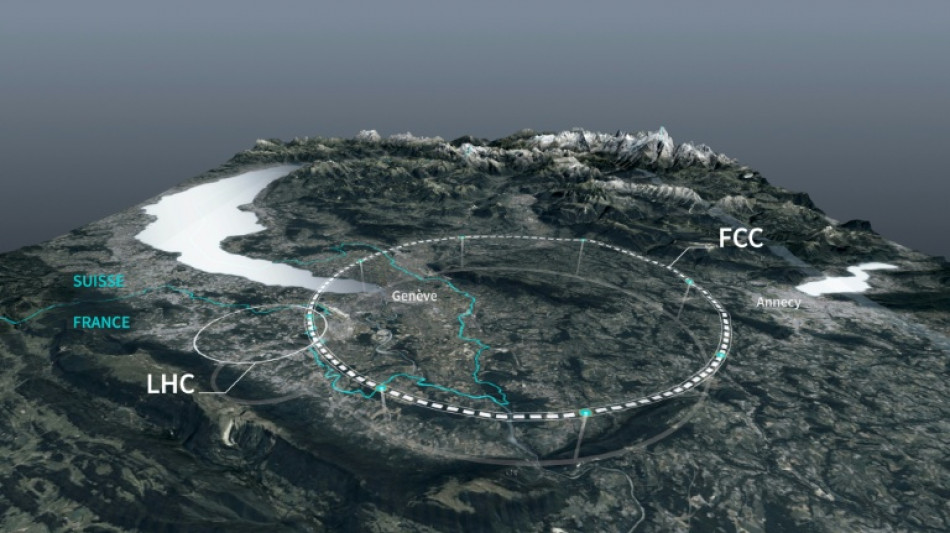
Private donors pledge $1 bn for CERN particle accelerator / Photo: HANDOUT - European Organization for Nuclear Research (CERN)/AFP/File

 Row engulfs Dolly Parton's estate as manager accuses nephew of making threats

 Mandela Digital Extends Early Access Programme to 11 February 2027 Following Strong Response

 US seeks 11th Presidents Cup win in a row over global foes

 McDonald's to boost franchisees as inflation weighs on consumers

 Trump invites Putin to G20 summit in Miami

 Archaelogical 'breakthrough' could confirm origins of Paris

 ILO financial crisis takes centre stage in leadership race

 Stocks dip, oil soars despite Trump hailing "productive" Iran talks

 China's Xi to get rare airport welcome from Trump

 Turkey reassures investors over investment fund crisis

 Saka says England still have 'scar' from World Cup semi-final loss
 アレックス・ボディ氏とシュテファン・ハウプト教授、ルーマニアの伝説的な美術コレクションをめぐり提携に合意
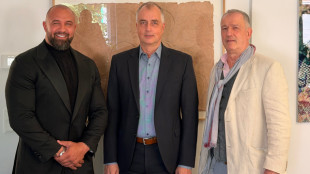 亞歷克斯·博迪與史蒂芬·豪普特教授就羅馬尼亞傳奇藝術收藏達成合作協議
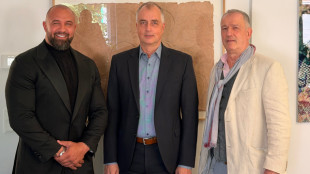
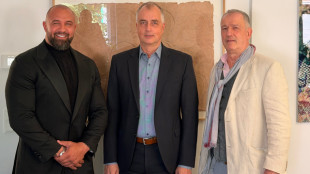 Алекс Боди и проф. д-р Стефан Хаупт договорились о сотрудничестве в рамках легендарной коллекции произведений искусства в Румынии
 French foreign minister says Palestinians 'must' hold polls
 Fresh Russian strikes on Ukraine's infrastructure kill seven

 Eriksen to return to Denmark after parting ways with Wolfsburg

 Brad Pitt says working with dog co-star was 'really moving'

 Golan will remain Syrian, vows President al-Sharaa at UN

 Blueberry Strengthens MENA Presence with CMA Category 5 License and Dubai Office Launch

 Russia probes bear attacks, as official says town under 'siege'

 Robertson tells Spurs to 'forget' past woes

 Italy police find 3 million euros stashed in mobster's house

 Renard versus Queiroz in AFCON qualifying blockbuster

 Former Mexico boss Aguirre returns to Spain with Valencia

Europe's physics lab CERN on Thursday said private donors had pledged $1 billion towards the construction of a new particle accelerator that would be by far the world's biggest.
In a first, private individuals and philanthropic foundations have backed a flagship research project at CERN, the European Organization for Nuclear Research, which seeks to unravel what the universe is made of and how it works.
The donors include the Breakthrough Prize Foundation of billionaire Silicon Valley investor Yuri Milner; the Eric and Wendy Schmidt Fund for Strategic Innovation of former Google chief executive Eric Schmidt; plus Italian Agnelli family heir John Elkann, and French telecoms tycoon Xavier Niel.
"It's the first time in history that private donors wish to partner with CERN to build an extraordinary research instrument that will allow humanity to take major steps forward in our understanding of fundamental physics," said CERN Director-General Fabiola Gianotti.
CERN's Large Hadron Collider (LHC) is currently the world's biggest particle accelerator, whizzing particles into each other at phenomenal speeds.
The 27-kilometre (16.8-mile) proton-smashing ring, running about 100 metres (330 feet) below France and Switzerland, has, among other things, been used to prove the existence of the Higgs boson.
Dubbed "the God particle", its discovery in 2012 broadened science's understanding of how particles acquire mass and earned physicists Peter Higgs and Francois Englert the 2013 Nobel Prize for Physics.
The LHC is expected to have fully run its course by around 2040, and CERN is considering building a far larger collider to allow scientists to keep pushing the boundaries of knowledge.
The planned Future Circular Collider (FCC) would be a ring with a circumference of 91 km and an average depth of 200 metres.
Scientists believe that ordinary matter -- such as stars, gases, dust, planets and everything on them -- accounts for just five percent of the universe.
The FCC will try to reveal what makes up the other 95 percent of the energy and matter in the universe -- so-called dark matter and dark energy, which scientists have yet to observe directly.
The gigantic project, estimated to cost around $17 billion, has not yet received the green light from CERN's 25 member states.
CERN, located on the outskirts of Geneva, is set to take a decision in 2028.
"The FCC is an instrument that could push the boundaries of human knowledge," Eric Schmidt in the statement.
"Beyond the science, the technologies emerging from this project could benefit society in profound ways, from medicine to computing to sustainable energy."
S. Pete Worden, chairman of the Breakthrough Prize Foundation, said the FCC would be "the most powerful scientific instrument in history, that can shed new light on the deepest questions humanity can ask".
T.Vitorino--PC