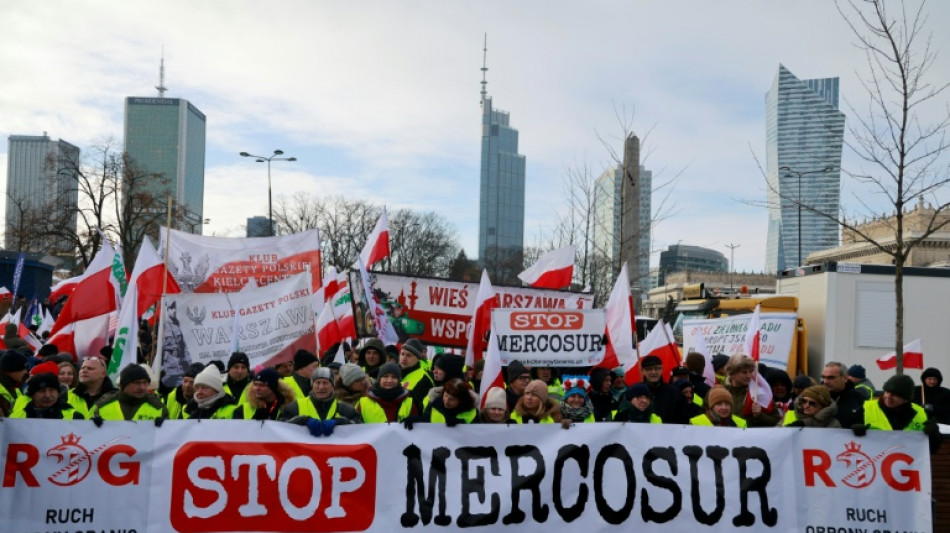
Polish farmers march against Mercosur trade deal / Photo: Wojtek RADWANSKI - AFP

 Devan Ekambaram and Susha’s 'Varuvaaiy' Makes History as First Tamil Song Nominated for a Grammy

 DiDi Advances Robotaxi Operations in China with New R2 Vehicle and Expanded Safety Infrastructure

 Freezz Italia Awarded ESA Contract for IRIS(2) Low-LEO Pre-Operational and De-Risk Activities

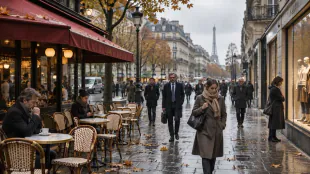 French Economy Shrinks 0.1% as Consumer Confidence Slumps

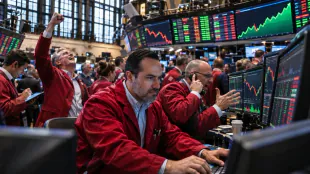 Wall Street Ends Turbulent Week Higher Despite Inflation and AI Jitters

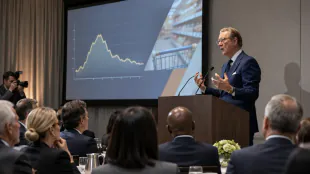 Kansas City Fed Chief Says Inflation Is Still Running Too Hot

 Oil Heads for Second Weekly Loss as Supply Surplus Emerges
Polish farmers descended on Warsaw on Friday to protest a European trade deal with the South American Mercosur bloc, marching just moments after it was accepted by a majority of EU nations in Brussels.
Over a thousand protestors gathered, some arriving on their tractors, to again denounce a deal many fear will lead to unfair competition in the bloc.
"This will kill our agriculture in Poland," said Janusz Sampolski, a farmer who came from a village just south of Gdansk on the Baltic coast, some 340 kilometres (210 miles) away.
"We will be dependent on supply chains from other countries," he told AFP, saying it could threaten Poland's food security "in the event of the threat of war".
Poland, along with France, Ireland, Austria, and Hungary, voted against the measure, but most of the 27 EU members approved it, diplomats told AFP.
Carrying flags and wearing yellow vests, the demonstrators marched toward Parliament and the chancellery of Prime Minister Donald Tusk.
Some protestors set off fireworks and lit off flares. Tractors, which several drove into the city, were not let into its limits.
Aside from economic concerns, farmers also warned of food quality and safety risks.
"Food will be coming to us... produced using pesticides that have been banned in the European Union," said Przemyslaw Zbroinski, another farmer from the Gdansk region.
"Some of the substances [have been banned] for nearly 30 years," he added.
The Mercosur deal has been in the works for over 25 years, with the European Commission arguing that it will bolster EU exports while fostering diplomatic ties.
But for Zbroinski, "It will definitely end with much harsher and larger strikes, and blockades of countries and capitals".
V.Dantas--PC