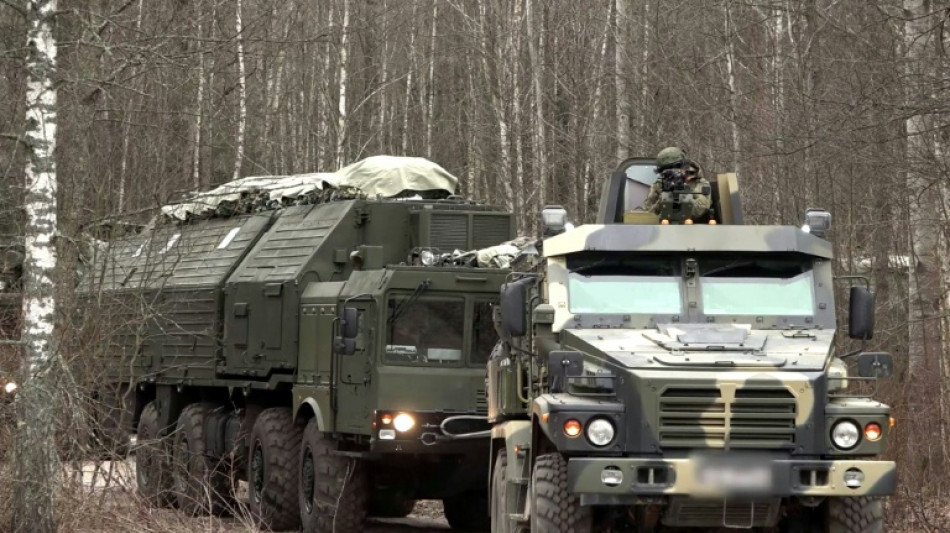
'Unhappy' Putin sends message to West with Ukraine strike on EU border / Photo: Handout - Russian Defence Ministry/AFP

 Google data centre sparks protests in Austria

 Shin Ohashi: Junk food-loving teen and Japan's next big swimming hope

 Stocks rise on AI buzz, drop in oil prices
 China's robot dancers limber up for America's Got Talent final

 Despite military might, Saudi struggles to crush the Houthis

 Trump to tout deals, defend Iran war in UN speech
 Sri Lanka to issue verdict in landmark Easter attack trial
 Macron says talks with Trump on Red Sea, Ukraine 'constructive'

 Green policies just good politics, says UK minister
 Bardot auction in Paris fetches nearly one million euros
 No timeline on Daniels injury return, says Commanders coach

 British Columbia sues OpenAI in US court over Canada school shooting

 French star Batum retires after 18-year NBA career
 Zidane leads first France training session

 Man shot by ICE agent in Texas detained with bullet inside him: lawyer

 California declares state of emergency ahead of El Nino

 South Africa arrests three more suspects, after nine women murdered

 Carse needs time away from England, says captain Brook

 NOWPayments Releases Cross-Chain Payout Data Revealing Key Performance Benchmarks Across TRON, BNB Chain, and Solana

 British Museum bans photos of Bayeux Tapestry as crowds linger

 COP31 host says AI climate footprint to be a summit priority

 Berlin's far-left vote winners reject anti-semitism charges

 Mancini eager for 'new adventure' on Italy return

 Mbappe says having Zidane as France coach 'like a film'

 Palmer, Rice out of England Nations League squad
Russia's Oreshnik missile attack in Ukraine near the EU border aims to intimidate Kyiv's Western allies and signals Vladimir Putin's displeasure at recent foreign policy setbacks including in Venezuela, analysts said Friday.
Days after European and US negotiators unveiled a post-war peacekeeping plan for Ukraine, Russia overnight Thursday to Friday targeted an infrastructure facility in the country's western region of Lviv with the Oreshnik nuclear-capable intermediate-range ballistic missile (IRBM).
It is thought to be only the second known combat use of the weapon.
While Moscow said the strike came in response to an alleged drone attack on a Putin residence in December, nearly four years after Russia's invasion of Ukraine, analysts said the move was designed to send a clear message to Western leaders and frighten ordinary Europeans.
"Vladimir Putin is using this to communicate with the West, because he could undoubtedly achieve the same operational effects without this missile," Cyrille Bret, a Russia expert at the Paris-based Montaigne Institute, told AFP.
"As Europeans are developing their air defence capabilities, this is a way of reminding them of their vulnerability," he added.
The Kremlin has touted the Oreshnik as a "state-of-the art" weapon, which travels at hypersonic speeds, can hit targets across Europe and cannot be intercepted.
In a call on Friday, the leaders of Britain, France and Germany said Russia's use of the missile was "escalatory and unacceptable", according to a UK government spokeswoman.
UK Prime Minister Keir Starmer said Russia was using "fabricated allegations to justify the attack", according to the spokeswoman. Ukraine has denied targeting Putin's residence.
Lviv mayor Andriy Sadovy said on Facebook the strike was "a new level of threat -- not only for Ukraine, but also for the security of Europe".
The missile, named after the Russian word for hazel tree, was first fired on the central Ukrainian city of Dnipro in 2024.
- 'Psychological weapon' -
The choice of a new target located around 70 kilometres (40 miles) from the border with the European Union was significant, observers said.
"It is much closer to the EU's borders," Etienne Marcuz, an associate fellow at the Foundation for Strategic Research, a French think tank, said on X.
"This should probably be seen as a message to European countries," he said, adding the result of the strike was "probably more psychological than operational".
Some observers saw the strike as Putin's attempt to reassert his authority following setbacks including Washington's capture of Venezuelan leader Nicolas Maduro, the seizure of a Russian-flagged vessel in the North Atlantic and fresh demonstrations in Iran challenging Moscow-allied authorities.
"It is a psychological weapon -- an instrument of Putin's cognitive war against Ukraine and the West -- rather than a weapon of mass physical destruction," wrote Mick Ryan, a retired major general from the Australian army and Ukraine war analyst.
He said the use of the Oreshnik was a "sign of a fearful, worried leader and not one that is confident and anticipating victory".
The move could not hide the fact that Russia had little power "to shape events or respond to military contingencies involving its allies and friends beyond its borders," he added.
Timothy Ash, an emerging market economist focused on Russia, struck a similar note, pointing to relatively limited damage on the ground after the missile strike.
"The Oreshnik is highly effective but also very high cost, and from a cost benefit analysis it makes zero sense for these to be deployed in Ukraine," he wrote.
"The deployment of the Oreshnik therefore seemed more a PR exercise, perhaps aimed at the Trump administration signalling that Russia is unhappy more broadly about the state of play in the world," he added.
While Russia calls the Oreshnik a hypersonic missile, Western defence analysts say it is not a revolutionary weapon.
"It is most likely NOT a hypersonic missile," said Marcuz, adding Europe has a means of intercepting IRBMs.
"The Oreshnik's multiple warheads could pose a problem, depending on when they are released," he added.
In December, Putin's ally, Belarusian President Alexander Lukashenko, said the weapon had been deployed in his country, which borders NATO's eastern flank.
F.Cardoso--PC