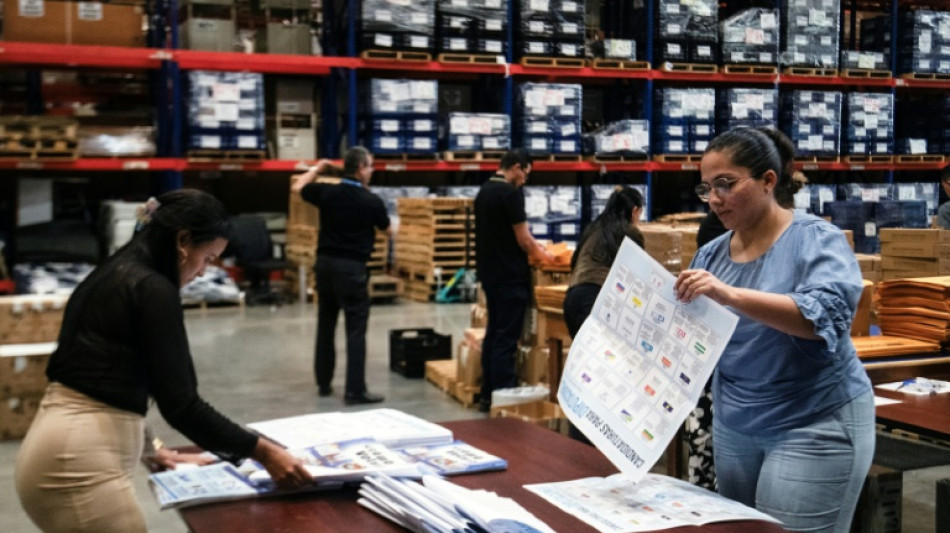
Costa Rica: Central America's democratic eco paradise / Photo: Ezequiel BECERRA - AFP

 Infantino proposes consulting federations to reform FIFA

 El Nino weather pattern enters record territory: scientist
 OpenAI calls for US to lead global effort on AI standards
 South African ostriches plucked alive for luxury fashion: report

 US networks halt Trump coverage in revolt over White House ban

 Paramount settles with US states to clear Warner Bros. mega-merger

 Climate crisis a job for world leaders, not just activists: UK FM

 US networks halt Trump coverage over White House ban
 French singer accuses Miley Cyrus of plagiarism

 EU fines Google 403 mn euros for location data breach

 'Best is yet to come,' says De la Fuente after Spain extension

 Why diesel prices are rising more than crude oil

 COP31 host says AI's climate footprint to be a summit priority

 Renewables hit record in 2025, but world must move faster: report
 US media outlets to sue Trump administration after White House ban
 Global stocks rally on lower oil prices, US-China hopes

 EU proposes energy rating for data centres

 Schoolgirl Yu scorches to second gold as doping case rocks Games

 Putin's party secures record score in Russia election

 Haupt Koleksiyonu: Paranın Biz İnsanlar Hakkında Anlattıkları

 Spanish PM says unregulated AI could be 'devastating'

 Yu, 13, smashes record again with second Asian Games gold

 Switzerland to play without Xhaka over fake Covid certificate

 From Korean Chipmakers to Leveraged Semiconductor ETFs: STARTRADER Launches 49 New 24/7 Stock and ETF CFDs

 Thai badminton player first doping case at Asian Games: testers

A favorite tourist destination for its stunning beaches and rich natural beauty, Costa Rica has recently seen its tranquility shattered by the impacts of drug trafficking.
Here are five things to know about the small Central American country of 5.2 million inhabitants, which goes to the polls Sunday to elect a new president and lawmakers.
- No military -
Despite is location at the heart of a violent and conflict-ridden region, Costa Rica has long clung on to a stable democracy since its only civil war, which lasted 44 days in 1948.
That year, it abolished its military -- a rarity in Latin America.
In the 1980s, when several other Central American countries were mired in civil wars, neutral Costa Rica acted as peace broker, earning then-president Oscar Arias Sanchez the Nobel Peace Prize in 1987.
In recent years, the country has seen an increase in organized crime. Drug trafficking has infiltrated even into spheres of the state, tarnishing Costa Rica's image with high-profile corruption cases.
Long considered one of the safest countries in Latin America, Costa Rica ended 2025 with a rate of 17 homicides per 100,000 inhabitants -- nearly triple the global average.
The country has a long tradition of welcoming asylum seekers and hosts hundreds of thousands of Nicaraguans who have fled repression across the border.
- Green paradise -
With its striking Pacific and Caribbean beaches, lush rainforests and imposing volcanoes, Costa Rica is considered a global leader for its environmental policies.
Nature reserves cover a quarter of Costa Rica's 51,000 square kilometers (19,700 square miles) -- territory that hosts six percent of the world's biodiversity, according to official figures.
Ninety-nine percent of its electricity generation comes from renewable sources, primarily water, geothermal, and wind.
- Happy people -
Costa Rica ranks in sixth place on the World Happiness Report, and its people are rated the happiest in Latin America.
The local expression "Pura vida!" (Pure life) has become a national motto -- an expression of optimism that is also used to greet people or give thanks.
The country's northern Nicoya Peninsula hosts one of the world's so-called "Blue Zones" -- places where people live exceptionally long, healthy lives.
- Rich but unequal -
Ecotourism is a key economic engine, with some 2.9 million people visiting Costa Rica in 2025, mainly from the United States, according to the tourism institute.
It is a member of the Organisation for Economic Co-operation and Development (OECD) group of high-income countries, with GDP growth of 3.6 percent forecast for 2026.
While poverty fell from 18 percent of the population in 2024 to 15.2 percent in 2025, Costa Rica is among the six most unequal Latin American countries on the Gini Index, and is the second most expensive after Uruguay.
- Human rights backsliding -
Roman Catholicism is Costa Rica's state religion, but the country has shown itself to be progressive on social and civil rights.
It was the first country in Central America to legalize same-sex marriage, in 2020.
Activists point to backsliding over the past four years of conservative government, during which Costa Rica restricted abortion to cases in which a woman's life is at risk. Previously it could also be performed if a pregnancy put a woman's health in peril.
The government has also eliminated sex education programs in schools.
Last year, Costa Rica agreed to receive 200 migrants deported by the United States under conditions decried by human rights groups.
H.Silva--PC