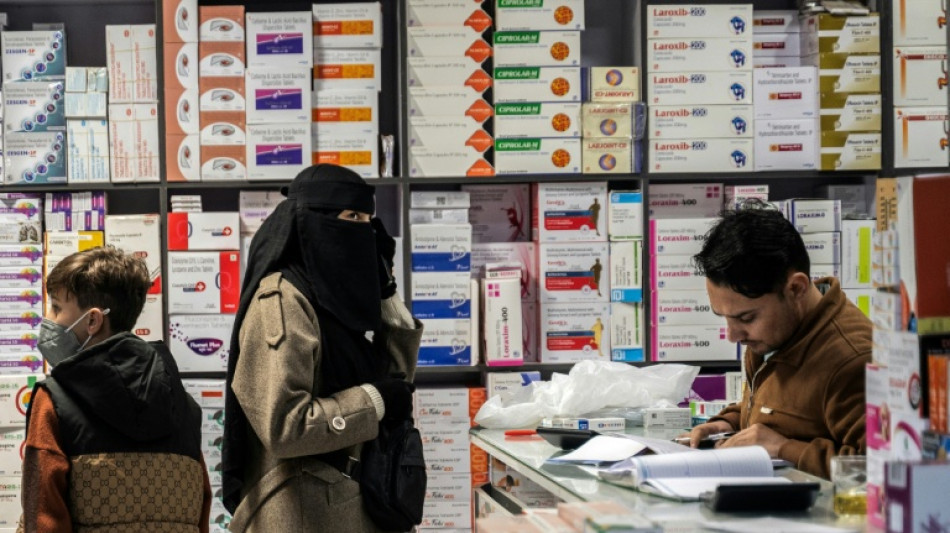
Bitter pill: Taliban govt shakes up Afghan medicine market / Photo: Wakil KOHSAR - AFP

 New Zealanders pick endangered black robin as Bird of the Year

 Asia stocks rise on AI, US-China trade talks optimism

 Malaysia's 'elephant whisperer' fights to save Borneo's endangered giants
 'I live in fear': 1.5 million Pakistani children sexually exploited online

 Cowboys beat Commanders, Vikings down Bears as star QBs injured

 Braves clinch division title as Red Sox reach MLB playoffs
 Bordeaux-Begles hammer Stade Francais despite Jalibert injury

 Milan and Juventus end blips with home wins
 Bridgeman wins PGA Biltmore title with sizzling 61

 Williams injured as Bears shut down by Vikings

 US warns of rapid escalation in Middle East war

 Germany's far-right AfD celebrates another state election win
 Russia vows revenge for election-day attacks as poll shows ruling party win

 Spaun late shows snatches PGA Championship win

 Conceicao strikes as Juventus beat Atalanta
 Britain, Zverev-inspired Germany, Spain complete Davis Cup finals

 Man Utd salvage Fulham draw as pressure mounts on Carrick

 Spanish civil war drama 'The Black Ball' wins at Toronto festival

 Germany's Merz shaken by far-right and far-left gains in state votes

 Macron welcomes Canada's Carney to French Atlantic territory
 Fiorentina frustrate Napoli with Serie A draw, Como upset

 Five-star Man City top Premier League after Sunderland thriller
 Ukrainian drones hit Moscow on last day of Russian elections
 Multi-Asset Trading Venue Monochrome Exchange Announces IEO of Its Native Token, $MCR
 South Korea break Japan hearts to win Asian Games basketball gold

Afghanistan's decision to overhaul its medicine market was meant to improve quality and boost domestic production, but industry specialists say the swift changes have led to a litany of problems.
The Taliban authorities announced in November that the decades-long dependency on medicine imports from Pakistan would soon end, a step taken after deadly border clashes with their neighbour.
After the ban came into effect this month, finance ministry spokesman Abdul Qayoom Naseer told AFP that the government urged all importers to find "alternative and legal" sources to replace Pakistani supplies.
Despite a three-month grace period to end existing contracts and clear customs, the shift presents a huge challenge for a country which had imported more than half its medicine from Pakistan.
"Some of the prices have increased, some of them are short (unavailable), it has created a lot of problems for people," said Mujeebullah Afzali, a pharmacist in the capital, Kabul.
Drugs now have to come from elsewhere, increasing transit time and transport costs, and adding logistical complexities.
The pharmacist said he had begun importing medicine through the Islam Qala crossing on the Iranian border, "which increased the transportation fee 10 to 15 percent".
Transport costs used to account for six to seven percent of total spending on medicine, but this has now risen to 25 to 30 percent, said a person directly involved in the pharmaceutical industry, speaking to AFP on condition of anonymity due to security concerns.
He estimated that the overall losses to business owners had already reached millions of dollars.
"If a medicine was short in the market before, a call was made to Pakistan, and the medicine was delivered in two to three days," he said.
Whether legally or not, it was "delivered quickly", he added.
- 'Fill the gap' -
The illicit trade in pharmaceuticals was a key driver for the overhaul, according to the health ministry.
"The biggest problem with Pakistani medicine was that we used to receive counterfeit and fake medicines," ministry spokesman Sharafat Zaman told AFP.
He acknowledged it will take some time to shift the market, saying that officials were working with Iran, India, Bangladesh, Uzbekistan, Turkey, China and Belarus to source medicine.
"India was second in the market, which means that now, through Indian medicines, we can cover the percentage needed," Zaman said.
And domestic production of 600 medicines has "solved the problems" of many patients, he said.
Afghanistan already produces a variety of serums including antibiotics, according to manufacturer Milli Shifa Pharmaceutical.
The company makes 100,000 bottles daily and "can double the capability" if demand merits, CEO Nasar Ahmad Taraki told AFP.
While Afghanistan has significantly expanded its pharmaceutical sector, domestic output still only meets a small fraction of the overall demand.
The industry source told AFP that the need to import raw materials, the high energy costs and limited infrastructure mean the country cannot be entirely self-sufficient in medicine production.
"If we are provided with the facilities, then we would be able to fill the gap created by Pakistan's situation," he said.
- Shortages and higher costs -
But reshaping an industry nationwide takes more than three months.
Some drugs made in Afghanistan have proven more expensive than those imported from Pakistan, which over the years have gained consumers' trust.
Some people believe that "if they use Pakistani medicine, they will be cured" -- but not if it came from India "or any other country", the industry source said.
Physicians, meanwhile, are also struggling, a healthcare provider in Kabul told AFP.
Doctors "must change prescriptions, find suitable alternatives, and spend additional time adjusting treatment plans", he said, requesting anonymity for security reasons.
The shake-up, which ultimately is meant to end reliance on Pakistan, is complicating care in the short term and could delay treatment, he warned.
"Patients face medicine shortages, frequent switches to alternative products, and sometimes higher costs."
S.Pimentel--PC