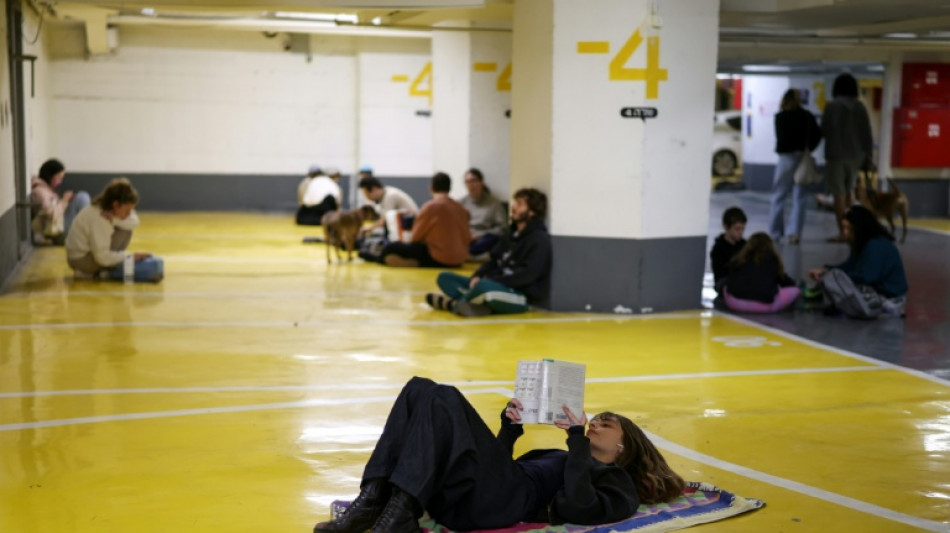
Israelis shelter underground as Iran fires missiles / Photo: Ilia YEFIMOVICH - AFP

 Putin's party set to retain power after Russia vote hit by cyberattacks, drones

 Germany's Merz under pressure after bruising state election losses

 Messi, Miami frustrated in 2-2 draw with San Diego
 Thousands march in France against 'licence to kill' draft law

 Forest fire threatens tourist town in Colombian Andes

 Torres on target again as PSG beat 10-man Marseille in Ligue 1

 Germany's Merz vows to stay course despite new election defeats

 Carrick demands Man Utd response after 'pathetic' jibes

 Liverpool boss Iraola urges Isak to raise his level
 Evenepoel wins record 4th straight world time-trial title

 France's Macron, Canada's Carney announce closer ties
 Carrick defends troubled Man Utd after Fulham escape

 Horror movie 'Resident Evil' tops N. American box office

 Germany's Merz vows to stay course despite new vote losses

 Man City outgun Sunderland despite Brobbey hat-trick, Man Utd rescue Fulham draw

 Mourinho blames ref committee for Real Madrid derby defeat

 Maresca craves a 1-0 win after eight-goal Man City thriller

 Atletico Madrid beat Real Madrid in tense derby clash

 Reusser retains world time-trial title

 Man City outgun Sunderland despite Brobbey hat-trick, Liverpool win at Bournemouth

 Top US, Chinese economic officials meet ahead of Trump-Xi summit
 Erdogan's LGBTQ crackdown 'first step of election campaign': activist

 Mass drone barrage on Moscow kills two

 82-year-old dies after beach fight in Greece over sun lounger

 US warns of rapid escalation in Mideast war

Across Israel, city streets stood deserted on Saturday as residents took cover in shelters, while the blasts from Iranian missiles being intercepted reverberated overhead.
It was the second time in under a year that Israelis were undertaking this grim wartime routine, having first fled Iranian missiles during a 12-day war between the arch-foes last June.
The United States and Israel launched a wave of strikes against military targets in Iran on Saturday, sparking a rapid Iranian retaliation towards Israel.
In the commercial hub of Tel Aviv, Orit Baisa, 42, rushed to an underground car park as soon as he heard the air raid sirens warning of an incoming missile barrage.
"We don't have a shelter, no safe room. The stairwell isn't a compliant secure room. This (car park) is the safest place there is," he said.
"If this (war) is going to last, then yes, sure, we'll go back to it, bring the tents, the mattresses, bring all the equipment and live here, like last time", he told AFP.
Andrea Siposova, who fled to the same car park, told AFP she had prepared for the shelter in case war broke out.
"We were already prepared with our emergency backpacks in case this happens. And yeah, so once we got the alert that there is a missile attack, we came to the shelter", said Siposova, a 31-year-old originally from Slovakia who now lives in Tel Aviv.
Roi Elba came to the shelter with his dog Gaia to wait out a missile salvo.
"It's the place to be when it's unsafe outside. Most of the buildings, most of the apartments in Tel Aviv, in the centre of Tel Aviv, don't have a safe room, shelter".
- Assault rifles and strollers -
Inside, some people had brought prams, others, who were reservists, their assault rifles while some began praying in a small group.
Several dogs were there, too, hunkering down with their owners.
Outside of the car park, white trails scarred the blue sky as Israel's air defence system launched into action to detonate Iranian missiles before they could land, an AFP journalist reported.
Further north on Israel's coast, a projectile lifted a large blast of water in Haifa Bay as it exploded in the Mediterranean Sea, water and smoke rising high above a nearby commercial ship, an AFP photojournalist reported.
After a projectile struck a building in the nearby city of Tirat Carmel, residents were evacuated, according to the same journalist.
Israel's first responders agency, Magen David Adom instructed its ambulances to use sirens as little as possible, so as to avoid people confusing the sound for that of air raid sirens, it said in a statement.
By mid-afternoon on Saturday, it had reported only one mild injury linked to missiles, a 50-year-old man injured by a blast in Israel's north.
All other national agencies also sprang into wartime mode, with the education ministry cancelling all classes and the aviation authority halting all flights in and out of the country.
In Jerusalem, the streets were mostly empty, with residents staying home or close to shelters.
There too, numerous blasts broke the stillness of the empty streets as barrages came one after the other, sometimes rattling windows as missiles detonated overhead.
- 'Trapped' -
In the nearby West Bank city of Ramallah, 15 kilometres north of Jerusalem, Palestinians mostly carried on with life as usual, with markets in full swing and conversations only occasionally interrupted by overhead blasts.
"There have been wars since our great-great-grandparents' time. Nothing concerns us. Our lives must continue as normal", Ghazala Arar, a resident of the nearby Jalazone camp, told AFP.
For most, the main inconvenience remained the Israeli military's closure of many of the hundreds of checkpoints that restrict movement in the Palestinian territory, locking some people out of their homes.
"I'm trying to go to Jenin, but all the checkpoints are closed. The attack happened in an instant -- we are trapped here", Rajwa Atatra, who had come to Ramallah from the northern city of Jenin to visit her brother, told AFP.
E.Borba--PC