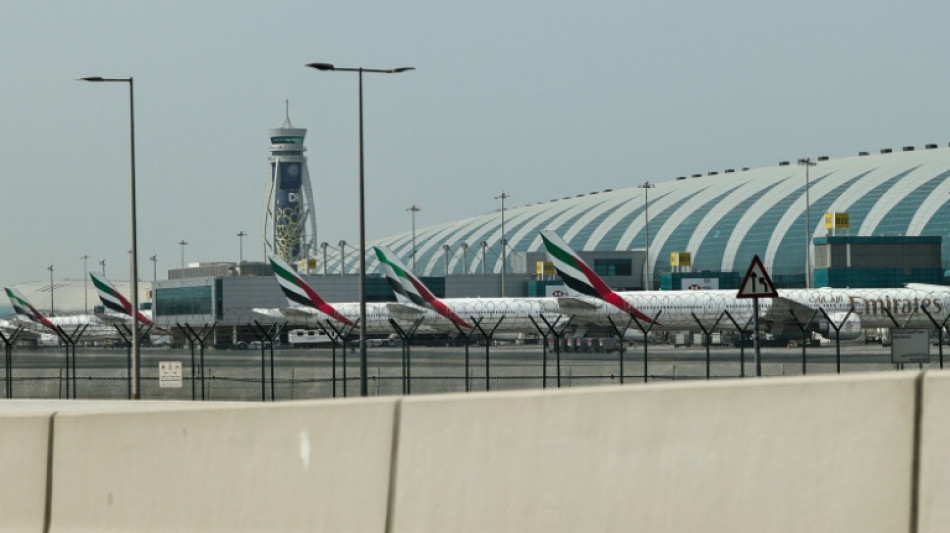
Key Gulf air hubs caught up in Iran conflict / Photo: Fadel SENNA - AFP

 Putin's party set to retain power after Russia vote hit by cyberattacks, drones

 Germany's Merz under pressure after bruising state election losses

 Messi, Miami frustrated in 2-2 draw with San Diego

 Thousands march in France against 'licence to kill' draft law

 Forest fire threatens tourist town in Colombian Andes

 Torres on target again as PSG beat 10-man Marseille in Ligue 1

 Germany's Merz vows to stay course despite new election defeats

 Carrick demands Man Utd response after 'pathetic' jibes

 Liverpool boss Iraola urges Isak to raise his level
 Evenepoel wins record 4th straight world time-trial title

 France's Macron, Canada's Carney announce closer ties

 Carrick defends troubled Man Utd after Fulham escape

 Horror movie 'Resident Evil' tops N. American box office

 Germany's Merz vows to stay course despite new vote losses

 Man City outgun Sunderland despite Brobbey hat-trick, Man Utd rescue Fulham draw

 Mourinho blames ref committee for Real Madrid derby defeat

 Maresca craves a 1-0 win after eight-goal Man City thriller

 Atletico Madrid beat Real Madrid in tense derby clash
 Reusser retains world time-trial title

 Man City outgun Sunderland despite Brobbey hat-trick, Liverpool win at Bournemouth

 Top US, Chinese economic officials meet ahead of Trump-Xi summit

 Erdogan's LGBTQ crackdown 'first step of election campaign': activist

 Mass drone barrage on Moscow kills two

 82-year-old dies after beach fight in Greece over sun lounger

 US warns of rapid escalation in Mideast war

Thriving thanks to their strategic geographical position, strong state backing and leading carriers, huge air hubs in the Gulf oil kingdoms have been shaken by the conflict over Iran.
Following US and Israel strikes on the Islamic Republic, Iran's retaliatory strikes have hit targets across the Gulf, forcing authorities to close airspace and stalling traffic at big hubs such as Dubai and Abu Dhabi.
"Gulf airspace closures are disrupting aviation corridors between Europe and Asia," wrote analysts from ING bank in a note on Monday.
Kathleen Brooks, research director at trading platform XTB, noted that the Middle East sees 18 percent of air freight.
This "will now be impacted and could cause some supply chain disruption," she wrote in a note.
"Airline stocks, hotels and holiday companies are all expected to see large declines in their share prices, as travel to the region remains closed."
Here are facts about the major role of the Gulf hubs in global air transport and what is at stake in the current disruptions.
- 'Unique region' for air links -
Dubai's main airport (DXB) ranks as the second-busiest worldwide, behind Atlanta in the United States, according to Airports Council International.
After handling 95 million passengers in 2025, it was targeting just under 100 million this year -- a tenfold increase over 30 years.
Also expanding rapidly, Doha's Hamad airport reported 54 million passengers last year, comparable to Frankfurt and Hong Kong.
The vast majority of travellers only stop for transfers. Beyond tourism and business traffic, diaspora populations such as Indians have helped fill aircraft.
"This is a very unique region in the geography that it represents," Stan Deal, then head of Boeing Commercial Airplanes, told CNBC in 2023.
"Within an eight-hour flight, you are able to get to 80 percent of the world's population, and we forecast over the next 20 years about 3,000 aircraft will be needed in this region."
- Competitive advantages -
Heavily supported by states with budgets overflowing with oil dollars, the Gulf hubs offer very competitive cost bases.
The states have fewer labour law restraints than in the West and total alignment between airlines and airport operators.
Emirates works hand in glove with Dubai airport to develop a global network of connections using its long‑haul Airbus A380s and Boeing 777s.
Qatar Airways and Etihad follow the same model.
Gulf hubs do not impose night curfews, allowing them to run 24 hours a day and streamline operations as much as possible.
Their competitive position has been further strengthened since 2022 by Russia's closure of its airspace to Western and Japanese carriers, while Gulf and Turkish airlines continue to overfly and serve the country.
- Gulf air growth -
The International Air Transport Association (IATA) had forecast that in 2026 airlines based in the Middle East would be the most profitable in the world.
Airbus said traffic between the Middle East and Asia would triple by 2042, and that between the Middle East and Europe to grow 2.2 times.
The Gulf states continue to expand infrastructure and place orders for aircraft by the hundreds with both Airbus and Boeing.
Dubai International, currently able to handle 120 million passengers a year, is to be bolstered by extensions to a peripheral airport -- aiming for 150 million passengers overall a year within 10 years, and 260 million in the longer term.
Seeking a share of this market, Saudi Arabia has launched a hub project in Riyadh designed to accommodate 120 million passengers a year by 2030, in tandem with the creation of a new airline, Riyadh Air.
O.Salvador--PC