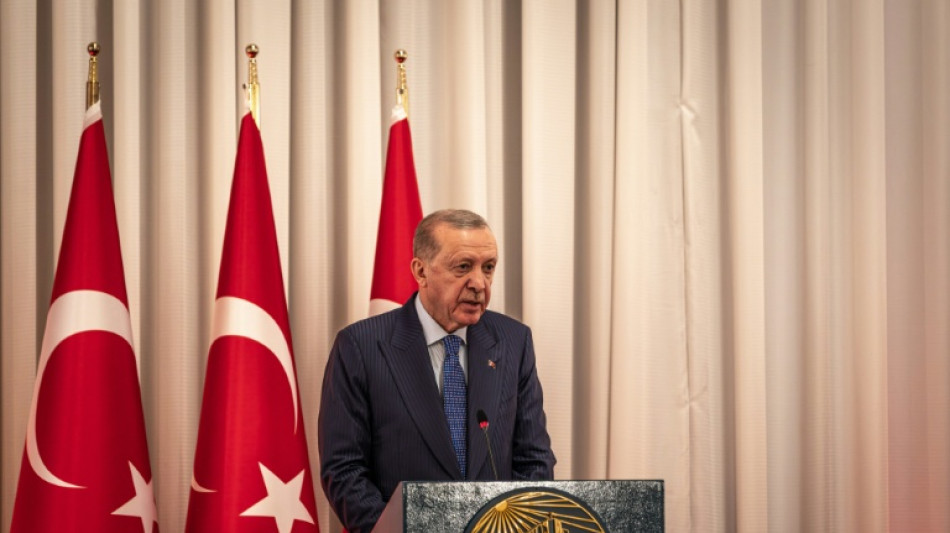
Turkey says missile launched from Iran destroyed by NATO / Photo: Marco Simoncelli - AFP

 China and Gabon Elevate Ties to 'Shared Future' Amid State Visit

 World Golf Awards 2026 to be Hosted at Egypt’s Madinaty Golf Club

 12 Billion Gallons of Raw Sewage Discharged into Chicago River Despite Deep Tunnel Infrastructure

 Edmund Richardson Wins Baillie Gifford Prize for 'Alexander' Biography

 BYD Drops Rotating Screens in New Models Due to Tech Limits
A ballistic missile launched from Iran and heading toward Turkish airspace via Iraq and Syria was destroyed by NATO air defence systems, Turkish officials said Wednesday.
The defence ministry said the it was "timely engaged and neutralised by NATO air-and-missile defence assets deployed in the eastern Mediterranean".
It did not specify the missile's intended target.
A Turkish official, speaking to AFP on condition of anonymity, said the missile had been "aimed at a base in Greek Cyprus but veered off course".
Officials said fragments that fell in the Dortyol district in southern Turkey, near the Syrian border, had been identified as pieces of the interceptor used to neutralise "the threat in the air".
No casualties were reported.
The incident drew condemnation from NATO.
"NATO stands firmly with all allies, including Turkiye, as Iran continues its indiscriminate attacks across the region," NATO spokeswoman Allison Hart said, using Turkey's official name.
"Our deterrence and defence posture remains strong across all domains, including when it comes to air and missile defence".
-'Wrong strategy'-
Turkey, a majority Sunni Muslim NATO member, shares a 500‑kilometre (315‑mile) border with Iran.
President Recep Tayyip Erdogan, who maintains good relations with US President Donald Trump despite his frequent criticism of Israel, has insisted that the US‑Israeli strikes on Saturday -- which sparked the war and prompted Tehran's retaliation -- were "illegal".
In an interview late Tuesday, Foreign Minister Hakan Fidan also criticised Iran's indiscriminate retaliatory strikes across Gulf states, calling them the "wrong strategy".
"The underlying strategy seems to be: 'If I am going to sink, I will take the region down with me'," Fidan added.
Following the missile incident, Ankara warned Tehran against steps that could widen the conflict.
Fidan told his Iranian counterpart in a phone call that "any steps that could lead to the spread of conflict should be avoided", a foreign ministry source said.
Analysts say the trajectory of the Iranian missile and its destruction by NATO systems further raises the stakes for a widening regional war, even if there is no clear evidence Iran intended to strike Turkey.
"Turkey will not want to become embroiled in the US-Israel attack on Iran, which it has criticised, but if Iran launches more missiles clearly aimed at targets on Turkish territory, Ankara will consider its own direct retaliation," said Hamish Kinnear of risk‑intelligence firm Verisk Maplecroft.
The defence ministry said "any steps necessary to defend our territory and airspace will be taken decisively and without hesitation".
"We reiterate that we reserve the right to respond to any hostile actions directed at our country," it added.
burs‑fo/jj
M.A.Vaz--PC