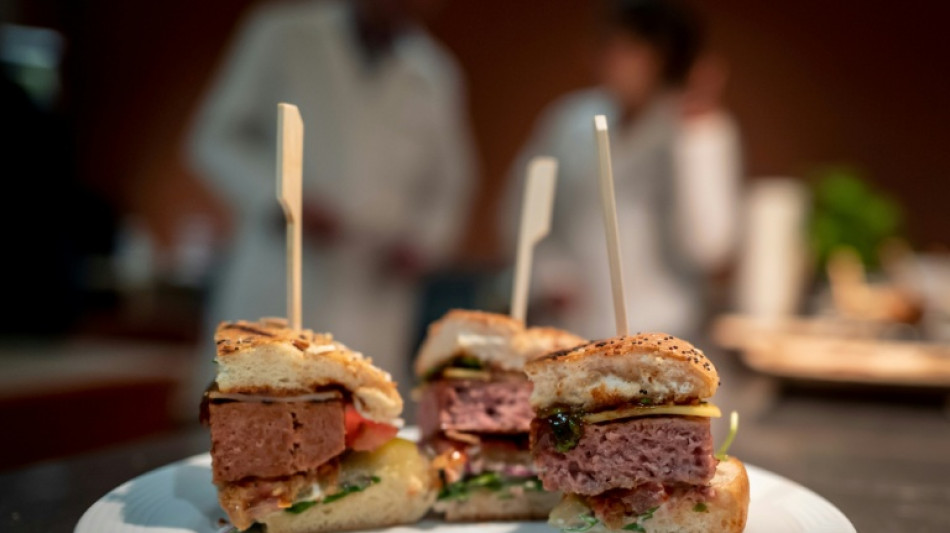
EU to ban plant-based 'bacon' but veggie 'burgers' survive chop / Photo: Fabrice COFFRINI - AFP

 China and Gabon Elevate Ties to 'Shared Future' Amid State Visit

 World Golf Awards 2026 to be Hosted at Egypt’s Madinaty Golf Club

 12 Billion Gallons of Raw Sewage Discharged into Chicago River Despite Deep Tunnel Infrastructure
 Edmund Richardson Wins Baillie Gifford Prize for 'Alexander' Biography

 BYD Drops Rotating Screens in New Models Due to Tech Limits
EU member states and lawmakers agreed Thursday to ban using meat-related terms such as "steak" and "bacon" to market plant-based foods -- but spared veggie "burgers" and "sausage".
The decision marks a win for Europe's livestock farmers, many of whom argue that plant-based foods which mimic meat are potentially misleading for consumers, threatening their already troubled sector.
Celine Imart, a cereal farmer and right-wing lawmaker from France who sponsored the plan hailed the deal as an "undeniable success".
It "recognises the value of livestock farmers' work and protects their products, fruits of unique know-how, against a form of unfair competition," she said.
The ban, which applies also to laboratory-grown or cell-based "meat", was agreed as part of a broad-ranging package of new measures to protect farmers, after months of wrangling, with critics questioning its usefulness.
Food retailers in Germany, Europe's largest market for plant-based alternative products, had spoken out against it, along with environmentalists and consumer advocates.
"Arguing that these meaty names create confusion amongst consumers is nonsense," said Agustin Reyna, director general of consumer organisation BEUC, adding most people agreed with the terms as long as products were clearly labelled vegetarian or vegan.
"The new rules will increase confusion and are simply not necessary".
Representatives for the EU's 27 member states and the European Parliament nevertheless decided to move ahead Thursday, after lawmakers endorsed the ban in October -- but with some exceptions.
"This agreement represents a meaningful step towards fairer and more resilient agricultural markets," said Maria Panayiotou, agriculture minister of Cyprus, which holds the EU's rotating presidency.
"Burger" and "sausage" survived the chop, as did "escalope".
"Veal", "pork", "chicken", "turkey", "duck" and "lamb" were less lucky -- as well as the generic label "meat".
The full list of banned terms also included "beef", "poultry", "goose", "mutton", "ovine", "goat", "drumstick", "tenderloin", "sirloin", "flank", "loin", "steak", "ribs", "shoulder", "shank", "chop", "wing", "breast", "liver", "thigh", "brisket", "ribeye", "T-bone" and "rump".
EU consumption of plant-based alternatives to meat products has grown five-fold since 2011, according to data from BEUC.
Concerns over animal welfare and greenhouse gas emissions by livestock farms as well as health arguments have fuelled the boom.
"Fortunately, the conservative word police have failed to ban the 'veggie burger'," said Anna Strolenberg, a lawmaker with the Greens group.
"Unfortunately, a number of other words still end up on the blacklist. That's a shame, Europe should be backing innovative entrepreneurs, not putting new obstacles in their way."
P.Queiroz--PC