Who rules the seas? Torpedoed Iran ship brings focus underwater / Photo: - - US Department of Defense/AFP

 Braves clinch division title as Red Sox reach MLB playoffs
 Bordeaux-Begles hammer Stade Francais despite Jalibert injury

 Milan and Juventus end blips with home wins
 Bridgeman wins PGA Biltmore title with sizzling 61

 Williams injured as Bears shut down by Vikings

 US warns of rapid escalation in Middle East war

 Germany's far-right AfD celebrates another state election win
 Russia vows revenge for election-day attacks as poll shows ruling party win

 Spaun late shows snatches PGA Championship win

 Conceicao strikes as Juventus beat Atalanta
 Britain, Zverev-inspired Germany, Spain complete Davis Cup finals

 Man Utd salvage Fulham draw as pressure mounts on Carrick

 Spanish civil war drama 'The Black Ball' wins at Toronto festival

 Germany's Merz shaken by far-right and far-left gains in state votes

 Macron welcomes Canada's Carney to French Atlantic territory

 Fiorentina frustrate Napoli with Serie A draw, Como upset

 Five-star Man City top Premier League after Sunderland thriller

 Ukrainian drones hit Moscow on last day of Russian elections

 Multi-Asset Trading Venue Monochrome Exchange Announces IEO of Its Native Token, $MCR
 South Korea break Japan hearts to win Asian Games basketball gold
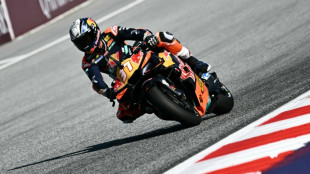 Acosta takes first victory at Austrian MotoGP
 PSG president Nasser al-Khelaifi under investigation in France for conflict of interest

 China swim sensation, 13, sets Games record after Japan win early
 Drones hit Moscow as Russians go to the polls

 New England boss Fleming says 'wrong' to ask Stokes to end retirement

A US submarine this week torpedoing an Iranian warship during the Middle East conflict raised the crucial question of who controls the seas during wartime.
The sinking of IRIS Dena on Wednesday in international waters off the coast of Sri Lanka killed at least 86 crew members, in what Iranian Foreign Minister Abbas Araghchi labelled an "atrocity".
It came after US-Israeli strikes on Iran on Saturday triggered war in the Middle East, with the Islamic republic launching retaliatory attacks across the region and beyond.
The US Navy had not torpedoed a ship since 1945.
Washington afterwards released what it said was periscope footage of the submarine firing on the ship, and an image of its hull almost vertical as it slipped below the surface.
The IRIS Dena "sank in less than 20 minutes", said Alessio Patalano, a professor at King's College London.
"It didn't stand a chance. The incident confirms the sophistication of the means of American undersea warfare."
Patalano said "submarine warfare has never gone away."
"It was just in the background because there hasn't been a confrontation between fleets since the 1980s," he added.
- 'Ultimate wartime weapon' -
The most recent confirmed wartime torpedo attack dates back to 1982, when the British submarine HMS Conqueror sank the Argentine cruiser Belgrano during the Falklands War.
In 2010, South Korea's Cheonan corvette was torpedoed -- an attack Seoul attributed to North Korea, but which Pyongyang denied.
A European military source specialising in submarines and speaking on condition of anonymity explained that a torpedo explodes underneath a ship rather than upon contact with it.
"It detonates a few metres below, creating a huge air bubble that lifts the vessel and breaks its main beam in two when it comes back down," the source said.
IRIS Dena's sonar range was probably too limited to have been able to detect the threat, they added.
The stealthy, invisible manoeuvres of a submarine, paired with its ability to fire torpedoes from dozens of kilometres away, make it "the ultimate wartime weapon", according to the source.
These capabilities can make a difference when surface combat between navies of similar standing is "symmetrical, with radars and missiles of roughly equivalent range".
Patalano said countries with a sophisticated underwater force enjoy an "objective advantage" in the event of a naval confrontation.
- 'We are everywhere' -
Another European military source, also speaking anonymously, said conducting the attack far from the conflict's epicentre was a "show of force aimed at major rivals" such as China and Russia.
"Attacking this ship in international waters... means: 'We, the Americans, dominate the air, the sea and the undersea. We are everywhere, able to find you and destroy you.'"
Experts suggest that while Russia has neglected the modernisation of its surface fleet -- signalled by its setbacks in the Black Sea throughout its war with Ukraine -- it has made a point of investing in its submarine fleet.
China has been developing its navy and submarines for years.
US submarine forces commander Vice Admiral Richard Seif told an American congressional committee this week that China's "formidable" next-generation submarines "challenge the US Navy's longstanding undersea dominance".
H.Silva--PC