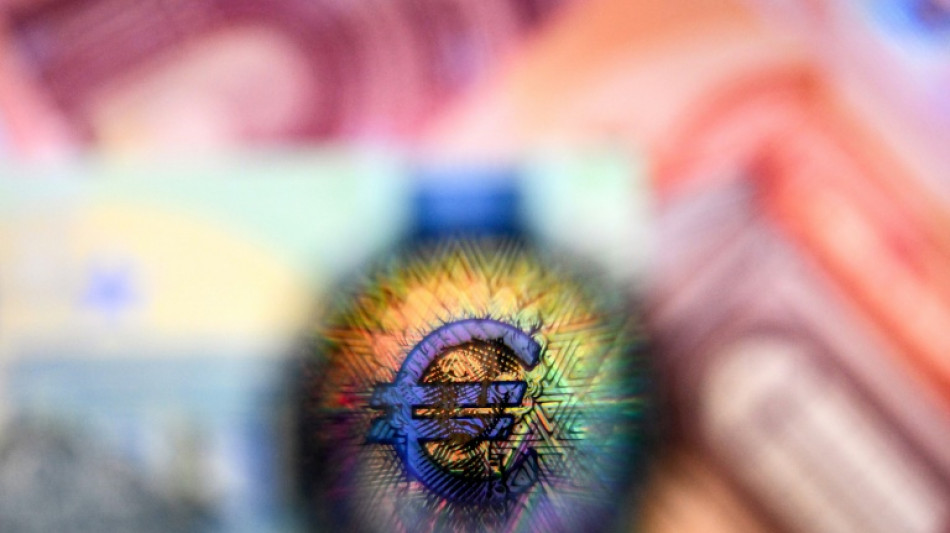
EU wants to tap citizens' savings. Easier said than done / Photo: Kirill KUDRYAVTSEV - AFP/File

 Tadej Pogacar Out of Vuelta a Espana with Broken Collarbone and Concussion
 Iceland votes 'No' to resuming EU talks

 Berlin Literary Guide: Book Launches, Festivals, and Readings Through August

 Nepal rescuers drill through debris towards trapped tunnel workers

 Manhunt in Switzerland after fatal rave shooting
 'No' camp seen winning Iceland's EU referendum

 Nepal flood survivors return to ruins to salvage memories

 Killing of Palestinian children and teens by Israel surges in West Bank

 Educators keep 9/11 memory alive for next generation, 25 years on

 Venezuelans view US oil deal with doubt, hope

 Gobena and Jepchirchir power to Sydney Marathon victories

 Iceland in suspense after close EU vote

 Wallabies hold on for victory in Argentina

 Juve notch second straight win, Fiorentina's centenary party falls flat

 Rybakina eases injury fears ahead of US Open

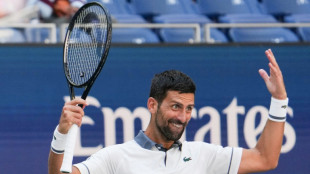 Djokovic kicks off latest Grand Slam quest under US Open lights

 'Sorry' De Zerbi won't panic after Spurs shambles

 UN, Nepal warn of climate threat after deadly floods

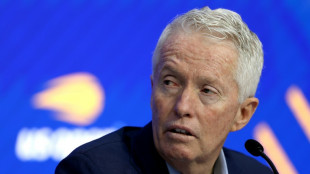 USTA boss says structure of new player council not yet set

 Tiny Elversberg stun Leverkusen on Bundesliga debut, Dortmund beat Hamburg

 India and China have not named two new border meeting sites

 Court orders JIPMER assessment of Durai Dayanidhi before money-laundering trial

 Chennai councillors unite across parties to demand ward development funds

 Tambaram civic groups seek action on eight long-pending issues

 Editorial questions Letitia James’ record as New York attorney general

The idea sounds simple: tap trillions of euros of EU citizens' savings to unlock capital for European companies through a more integrated financial market.
Getting over the finish line, however, has been complicated, with EU states unable to agree and the idea languishing for years.
More than a decade after the European Union first floated the idea of a deeper capital market, the issue has come roaring back into the spotlight -- and with it the type of concern that dogged previous efforts.
The renewed impetus stems from fears the EU is lagging dangerously behind the world's two biggest economies, the United States and China -- one of the topics set to dominate a summit of the bloc's leaders this week.
Some, including European Commission President Ursula von der Leyen, have raised the prospect of several EU states moving forward, leaving others behind, to establish a Savings and Investments Union.
A key element of such a union is centralising market supervision, an issue pitting the EU's six biggest economies against smaller countries.
France, Germany, Italy and three others say the move is necessary, but Luxembourg and Ireland have expressed reservations.
The topic will be discussed in depth when EU leaders meet Thursday.
But what really does the EU want, and can it be achieved?
- What is the plan? -
The idea first appeared as the "Capital Markets Union" when then-president of the commission Jean-Claude Juncker raised it in 2014.
Now the EU prefers the phrase "Savings and Investments Union" -- which combines the Capital Markets Union and the Banking Union.
Brussels wants to unify national financial markets to make investments flow more seamlessly across the EU.
The commission also wants markets to provide more attractive financial instruments to European citizens, who are more fearful of investing in stock markets than their American counterparts.
Currently, 10 trillion euros ($11.6 trillion) of EU citizens' savings are held as bank deposits, according to the bloc's executive, because people see it as safe.
The reform push is also about giving better access to money for businesses.
By harmonising financial markets and getting rid of the fragmentation that hinders pooling vast capital, there could be much bigger sums available for scale-ups and infrastructure, experts say.
"That is one of the key disadvantages the EU is facing compared to the US and China," said analyst Philipp Lausberg of the European Policy Centre think tank.
- Why is this a hot topic again? -
Europe needs money -- lots of it.
A landmark 2024 report estimated the EU's additional investment needs at 750 billion to 800 billion euros annually.
The EU needs to plough more money into its digital and green transitions as well as defence, faced with rising global instability.
Leaders are keen to move fast.
They agreed in February they wanted "to be done with phase one of the Savings and Investment Union, that includes the market integration, the supervision and the securitisation, by June", von der Leyen said.
Without "sufficient progress", she warned willing EU states would press on alone.
Under EU rules, at least nine countries could go full steam ahead on the project without others.
- Is it popular? -
In theory, member states all support the idea.
In practice, there are strong divisions over how it should look.
A group of countries known as "E6" -- France, Germany, Italy, Spain, the Netherlands and Poland -- want the Paris-based European Securities and Markets Authority to become the EU's supervisor of large stock exchanges.
Irish Finance Minister Simon Harris recommended "enhancing" its role instead.
The business community supports the Savings and Investments Union, including Europe's biggest organisation representing firms, BusinessEurope.
Others, while welcoming deeper financial markets, are more cautious.
Julia Symon, head of research and advocacy at NGO Finance Watch, said key barriers need to be removed if Europe wants a "regime comparable to the US, currently the main destination of EU private capital outflows".
This would mean "joint supervision, harmonised insolvency and greater tax coherence, which go far beyond what is currently proposed", she told AFP.
"The goal should not be to expand finance for its own sake, but to ensure that finance serves long-term economic resilience and productive investment."
L.Torres--PC