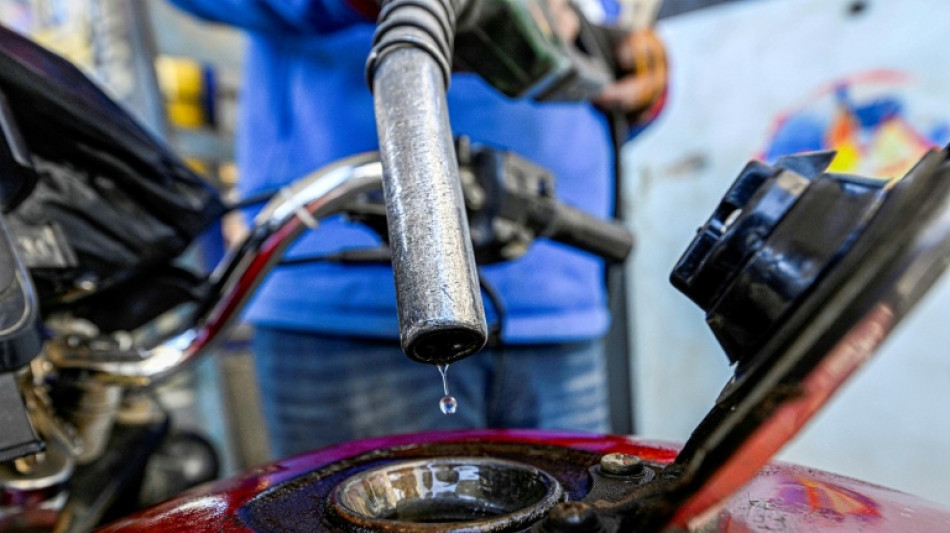
War fuels fears of new oil crisis / Photo: Khaled DESOUKI - AFP/File

 Vietnamese coffee farmers ride China's durian wave
 Venezuela says retains 'sovereignty' in US oil deal

 NASA's Roman telescope set to launch on cosmic mapping mission
 Data center backlash scrambles US midterm politics
 Emotional Federer inducted into tennis Hall of Fame

 Hovland takes solo lead as McIlroy surges at Tour Championship

 Djokovic 'prepared' for US Open bid for history

 Atletico down Sevilla to go top of La Liga

 US deports right-wing provocateur Milo Yiannopoulos

 Niger junta says it is back in control after soldiers' mutiny

 Erasmus calls Rennie barbs over Springbok scrumming 'nonsense'

 Lawrence's fifty leaves Pakistan facing record chase to level England series
 Netanyahu condemns settler attack in flashpoint West Bank village

 Munoz saves Iraola in Liverpool draw, big-spending Spurs lose again

 Newcastle condemn dismal Spurs to second successive defeat

 James Cleverly leaves shadow cabinet to seek London mayoralty

 Baladi Map app turns Lebanon’s local problems into a public record

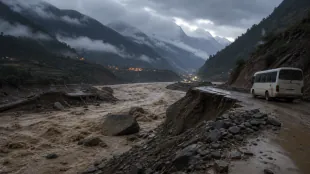
 Thirty-seven Mumbai pilgrims return after Nepal flood disruption

 Ankle ligament tear ends Neeraj Chopra’s 2026 season

 Five college football games that could shape the 2026 season

 New finds strengthen case for Bethsaida at Sea of Galilee site

 Felony assaults on older New Yorkers rise sharply, police data show

 Three Texas Tech softball players hurt in jet ski collision

 Tambaram civic groups seek action on eight long-pending issues

 Cyberabad civic body demolishes 19 unauthorised structures
Attacks on oil infrastructure in the Gulf region and soaring oil prices are raising the spectre of a new oil crisis, although economists say we’re not quite there just yet.
- What is an oil crisis? -
An oil shock is generally understood to mean a supply shortage that sparks a sharp rise in oil prices and consequently a negative impact on global economic growth, although there is no single definition.
The world is currently experiencing an energy price shock, but "it may be a bit too early to call it a true oil shock" such as those of 1973 or 1979, Helene Baudchon, deputy chief economist at BNP Paribas, told AFP in an interview.
"Supply constraints today are less severe" than some fifty years ago and remain concentrated around the Strait of Hormuz, through which one-fifth of global consumption of oil and liquefied natural gas typically passes.
Member states of the International Energy Agency have also decided to release 400 million barrels from their strategic reserves and the IEA says it is prepared to release more "if necessary."
Philippe Dauba-Pantanacce, global head of geopolitical analysis and senior economist with Standard Chartered Bank, notes that "hydrocarbon supply is much more geographically diverse than it was in the 1970s typically, electricity sources have also expanded with the renewables."
He added that "all of this is not to say that there won’t be consequences to the current oil supply shock, but there are many variables to take into consideration. We have revised our average for Brent to $85.50 for 2026, up from $70 before."
Additionally, global growth these days is less oil-intensive, requiring "four times less oil to generate one percentage point of GDP than in the 1970s," according to private bank Edmond de Rothschild.
- Three oil shocks -
OPEC imposes an embargo on Western countries deemed pro-Israel, triggering a price surge and a global oil crisis. In December, the price per barrel reaches $11.65, four times higher than in September. The price then quintuples a year later. The consequences for Western countries: higher prices at the pump, an inflationary spiral, recession -- and rising unemployment.
In August 2005 a barrel hits $70 after Hurricane Katrina hits oil industry infrastructure.
In January 2008, prices surpass the symbolic threshold of $100, then soar again to $147 in July for what was dubbed the third oil shock, triggered by a combination of factors: strikes in Venezuela, unrest in Nigeria, and the war in Iraq.
That period also brought rising demand from emerging economies. Speculators were also singled out as a contributing factor.
- Fears of a new shock -
During major geopolitical crises, the spectre of a new oil shock resurfaced, with the price per barrel incorporating a "geopolitical risk premium," to reflect the probability that a conflict will cause a drop in supply. The possibility of such a shock resurfaced after the start of the war in Ukraine in February 2022, when the price per barrel surpassed $100, and after the war in Gaza, following the Hamas attack on Israel on October 7, 2023.
The current war in the Middle East is causing "the most significant disruption" to oil supplies in history, according to the International Energy Agency. The two global benchmarks for crude, Brent and WTI, are hovering around $100 per barrel, a surge of 40 to 50 percent since the start of the war against Iran which the United States and Israel launched on February 28.
Edmond de Rothschild notes that "there are very few alternatives to the Strait of Hormuz" for regional supplies. Storage capacity in producing countries are also reaching saturation, forcing production cuts.
M.A.Vaz--PC