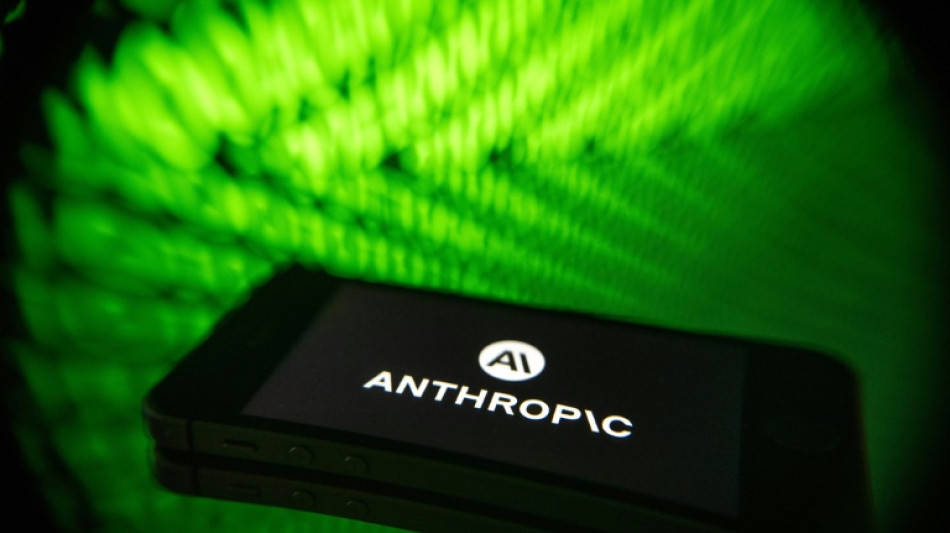
Anthropic calls for pause of global AI development
/ Photo: SEBASTIEN BOZON - AFP/File

 Zambia's vote marred by intimidation, counting pause: observers

 Marchand wins 200m butterfly for first Euros gold

 Fernandez booed by Chelsea fans in friendly win over Sociedad
 Fans line Welsh streets as Bonnie Tyler body's returns for funeral

 Tropical Storm Lala lashes Hawaii with heavy rain

 Lebanon reports 11 dead in strikes that Israel says targeted Hezbollah

 Crystal Palace sign Israel winger Khalaili

 Rescuers search for survivors as Indonesian quake death toll rises to 47

 Taliban govt supporters dance, take selfies in Kabul celebrations

 UK PM urges 'reflection' after Cambridge professor's death

 Rescuers search for survivors as Indonesian quake death toll rises to 40

 Earthquake rocks Spain's tourist jewel Granada

 Perez, Fiorini set world records in winning Euro race walk golds
 Lebanon says 9 dead in strikes as Israel says targeted Hezbollah

 World Cup winner Ferran Torres signs for Paris Saint-Germain

 Disney reveals 'X-Men' cast, slate of sequels at D23 fan event

 Star Cameroon goalkeeper Bihina faces Malawi's prolific Chawinga sisters in WAFCON final

 Mehidy claims Smith to keep Bangladesh on top in Australia Test

 Iran fires back at Trump's threat to declare Hormuz a US territory

 No monkey business: India 'whisperers' guard world championships

 Steady India 101-1 at lunch in first Sri Lanka Test

 Faced with historic drought, the Dutch rethink water management

 Pallister holds off Ledecky to win Pan Pacs 400m free title

 India's Modi woos youth with free coaching, AI training

 Mehidy half-century steers Bangladesh to big lead in Australia Test

Artificial intelligence company Anthropic suggested Thursday a global pause on building the most powerful AI systems as the latest models are beginning to show signs they could escape human control.
The San Francisco-based company, which makes the Claude family of AI models, said in a report that a worldwide slowdown in cutting-edge AI development would "likely be a good thing" -- but warned that if only one company stopped, rivals would simply race ahead.
"We believe it would be good for the world to have the option to slow or temporarily pause frontier AI development to enable societal structures and alignment research to keep up with the advance of the technology," it said.
Getting a real pause to work would mean multiple major AI companies in multiple countries -- most notably the US and China -- all agreeing to stop at the same time, under rules everyone could actually verify, Anthropic said.
"Without a global coordination mechanism, companies and governments will have to make difficult decisions about safety while under competitive and geopolitical pressures," it said.
The company has faced pushback from others in the industry -- and officials in the White House -- who say its focus on worst-case scenarios overstates the risks and amounts to a strategy for slowing rivals under the cover of safety concerns.
Still, the White House has acknowledged the power of the company's Mythos model -- which has not been made available to the general public due to its cybersecurity capabilities and is currently deployed only to a small number of vetted organizations.
The proposal would face an uphill battle in Washington and Silicon Valley, where US officials and tech executives have repeatedly argued that any slowdown in AI development risks handing China a decisive strategic edge in what many see as the defining technology race of the century.
US President Donald Trump, however, said he discussed the possibility of cooperating with China on AI safety issues during his recent visit to Beijing.
Trump also signed an executive order this week that allows the government 30 days to conduct a preliminary review of the most powerful US AI models before their release.
- 'Human role narrowing' -
Anthropic compared the problem to nuclear arms control treaties -- but said it would be even harder to get a handle on, since AI training is far easier to hide than a missile silo, and the temptation to quietly keep going would be enormous.
The company said it plans to bring together government officials, scientists, advocacy groups and competing AI firms in coming months to figure out how such a system could work.
The call for coordination comes alongside internal data showing that AI is already dramatically speeding up the development of AI itself, Anthropic said.
That acceleration creates a feedback loop that Anthropic warned could eventually lead to what researchers call "recursive self-improvement."
That's the idea of an AI system that becomes capable of essentially teaching itself to get smarter, without much human help.
"We are not there yet, and recursive self-improvement is not inevitable," the report said, while adding that it could arrive sooner than most governments and institutions are ready for.
"The evidence suggests that the human role is narrowing at each step in the AI development process," the company said.
A.Motta--PC