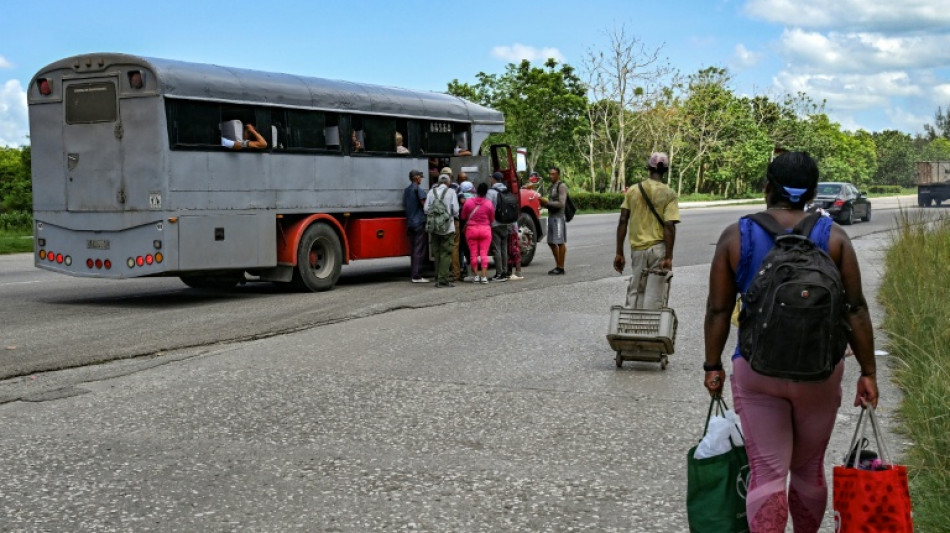
Cuba leader admits 'urgent changes' needed to overcome crisis / Photo: YAMIL LAGE - AFP

 Multi-Asset Trading Venue Monochrome Exchange Announces IEO of Its Native Token, $MCR
 South Korea break Japan hearts to win Asian Games basketball gold
 Acosta takes first victory at Austrian MotoGP
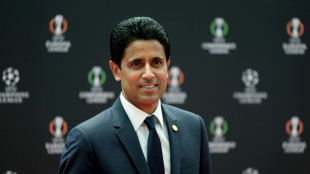 PSG president Nasser al-Khelaifi under investigation in France for conflict of interest

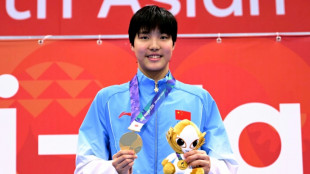 China swim sensation, 13, sets Games record after Japan win early
 Drones hit Moscow as Russians go to the polls

 New England boss Fleming says 'wrong' to ask Stokes to end retirement

 Germans vote in elections threatening fresh blow to Merz

 US fears rapid escalation in Mideast after Houthis attack Riyadh

 Japan triathlete Hojo wins first gold of Asian Games

 IOC president impressed by 'beautiful' Asian Games wooden huts

 First Asian Games gold goes to Japan as China's 13-year-old Yu lights up pool

 Data centre command hub keeps AI up and running

 Pope Leo in France: the issues on the table

 Packing for a pope: behind the scenes on foreign trips

 Republicans find transgender issues a powerful political weapon in midterm campaigning

 German state elections threaten new shock waves for Merz

 Chile's Bachelet quits race to be next UN chief

 Raphinha treble fires perfect Barca to win at Sevilla

 Thiam makes winning heptathlon return at Decastar meet

 Czechs beat USA to qualify for Davis Cup finals

 Dortmund sink Stuttgart to climb to Bundesliga summit

 Trump says will not tolerate attempts to slow AI growth

 'It has to stop': runners protest women's murders in S.Africa district

 Fire erupts near Riyadh airport as Houthis claim strikes

Cuba's communist model needs "urgent changes" to overcome a major crisis which cannot be solely blamed on a crippling US oil blockade, President Miguel Diaz-Canel said in his frankest admission yet of the need for radical reforms.
"The situation calls for urgent and necessary changes," Diaz-Canel told the Communist Party party's politburo in remarks broadcast on Thursday,
Diaz-Canel was speaking at a meeting called to fast-track reforms aimed at boosting the private sector and attracting more capital from millions of Cubans who have fled the crisis abroad.
The proposals are part of a desperate, eleventh-hour bid to stave off economic collapse in the face of unprecedented US pressure.
Diaz-Canel cited China and Vietnam as possible models for opening Cuba's economy to the world in order to "create economic wealth and distribute it equally."
Some of the reforms "will not have absolute consensus but cannot be postponed," Diaz-Canel stressed.
"When people's lives become this hard," the Communist Party and government had a responsibility to "change what needs to be changed" rather than try to explain away the crisis, he argued.
The oil blockade imposed by President Donald Trump in January has brought Cuba's already moribund economy to the brink of collapse, marked by power cuts sometimes lasting over 30 hours and shortages of food, fuel, drinking water and medicine.
While Havana's position has been to blame its woes on a more-than-six-decade US trade embargo and the blockade, Diaz-Canel admitted there were "obstacles that don't come from outside, nor the blockade."
He pointed to "slowness, bureaucracy and norms that impede those who want to produce" as well as "decisions that we have put off."
The reforms were approved by the Communist Party on Wednesday.
They also received the blessing of nonagenarian ex-president Raul Castro, widely seen as the power behind the throne, who described them as "the most beneficial to the revolution at this time."
They are expected to be approved by the National Assembly, which rubber-stamps legislation, in a vote later Thursday.
- 'Worse each day' -
It is unclear, however, whether the changes will satisfy Trump, who is pushing for a change in Cuba's leaders as well as its economic model.
Many disillusioned Cubans shrugged off the announcements as either too little too late or an outright "lie."
Some of the reforms announced were a rehash of earlier proposals, such as granting greater autonomy to state-owned enterprises, which account for roughly 80 percent of economic activity.
"It's a lie, we've been doing this for 67 years (since Fidel Castro's 1959 revolution) and it gets worse every day," Iris Montero Borges, a 58-year-old cleaner at state telecoms company Etecsa who had been without power at home for 12 hours, told AFP.
The country's small but growing business class welcomed the changes, however, while making clear they did not see them as a quick fix.
Private businesses, which can employ up to 100 people, were authorized in 2021 and have become an increasingly important part of the island's economy.
The reforms "offer hope, a chance that may or may not materialize," said Mario Gonzales, the 32-year-old manager of a restaurant in Havana's historic old town which was thronged with tourists a decade ago and now fills only a handful of tables for dinner
G.Teles--PC