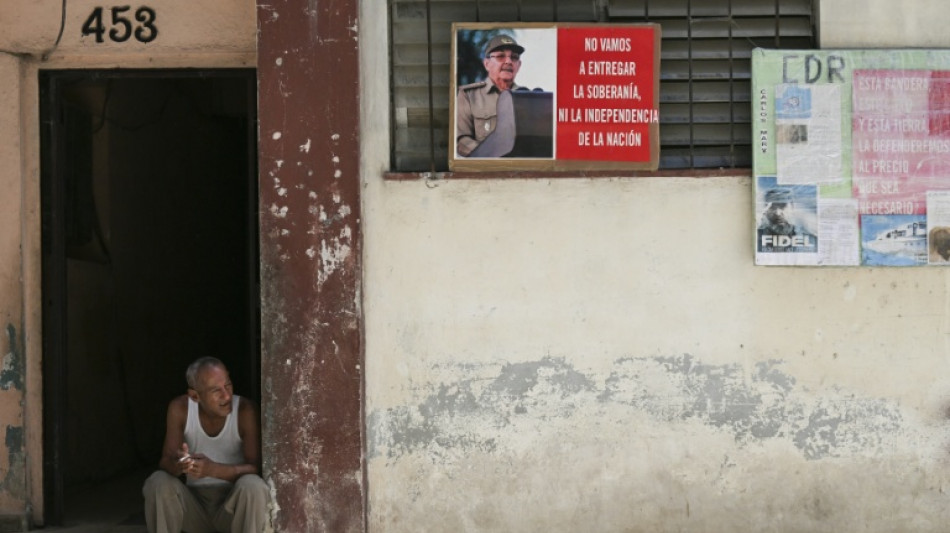
From private enterprise to property: Cuba's reforms unpacked / Photo: YAMIL LAGE - AFP

 US warns of rapid escalation in Mideast war

 Iran 'put hearts on the court' to win Asian Games basketball bronze

 School girl Yu helps China dominate in Asian Games swimming openers

 Myanmar win first Asian Games teqball gold as Spain great Puyol watches

 China's 13-year-old Yu scorches to first major gold at Asian Games

 Russians vote on last day of parliamentary elections

 Hong Kong pays final respects to former city leader Tung

 Typhoon put people off Asian Games opening ceremony, official says

 China's 13-year-old Yu cruises as Asian Games swimming begins

 AI 'warning shots' focus Beijing on national security risks

 Philippine tribe in limbo over US-led tech hub

 Leo XIV, first US pope transcends his restrained style

 Singer Ed Sheeran says Gaza situation 'unjustifiable' following controversy

 In 'Tenzing', a Sherpa mountaineer gets his due

 Ed Sheeran set to return to stage after Palestinian controversy

 Toulouse edge Vannes, Lyon beat Pau to take Top 14 summit

 Germans arrested for Louvre stunt in Mona Lisa hall

 Saudi-led coalition says Houthis fired ballistic missile at Riyadh

 France's debt climbs to highest since 1978: ministry

 McIlroy two shots off the lead at Wentworth after eagle on 18

 Martinez brace saves Inter in Serie A top-two clash with Roma

 Rosenior abused but guides Paris FC past old club Strasbourg

 Seven-try Lyon beat Pau, climb to Top 14 summit

 Brighton defeat a 'big lesson' against complacency for Arsenal, says Arteta

 Thousands protest inaction over climate crisis in Switzerland

Cuban lawmakers on Thursday adopted nearly 200 free-market reforms in a desperate bid to end a severe crisis and secure the end of a crippling US fuel blockade.
The 176 measures represent the biggest shake-up of the island's economic model since it began embracing communism six decades ago.
AFP looks at some of the standout measures:
- Private enterprise -
Small businesses of up to 100 people known as Mipymes were authorized in 2021 and have become an important part of the island's economy.
With the shelves of state-run shops glaringly empty and public transport drying up, Mipymes and the self-employed now dominate retail food sales and ferry people about -- by taxi, rickshaw and motorbike.
The reforms set out by Prime Minister Manuel Marrero go much further in promoting private enterprise.
Large companies, unlimited in size, will be authorized and Cubans will be allowed set up more than one company.
Foreign investors will no longer be required to form joint ventures with the state.
The government will cut red tape for business creation and allow private investors, both Cuban and foreign, to acquire shares in state companies.
State-owned enterprises will be transformed into commercial companies and the state salary scale scrapped in favor of company-level agreements.
- Energy -
Fuel supplies were a headache for Cuba long before US President Donald Trump cut off imports altogether by imposing a de-facto oil blockade.
To boost supplies, private and foreign investment will be allowed in the purchase and sale of fuel.
Tax breaks will be created for investment in renewable energy, such as solar panels, which have become ubiquitous during the energy crisis.
- Property -
While Cubans have since 2011 had the right to own a private home, many buildings remain state property.
The reforms would allow Cubans living on and off the island to buy state-owned property, "on a case-by-case basis" and to develop property in areas of high tourist potential.
- Banking -
Private investment in banking will be encouraged and citizens and companies will be allowed have accounts in foreign currency for the first time.
Remittances from Cubans abroad, a lifeline for many, will no longer be channeled exclusively through the state, and money changers will also be allowed operate privately.
- Land -
Land will remain in state hands but will be available for use in agro-fishing, forestry, agro-tourism and tobacco production under the usufruct -- the right to use and profit from another person's property -- for an indeterminate period.
P.Serra--PC