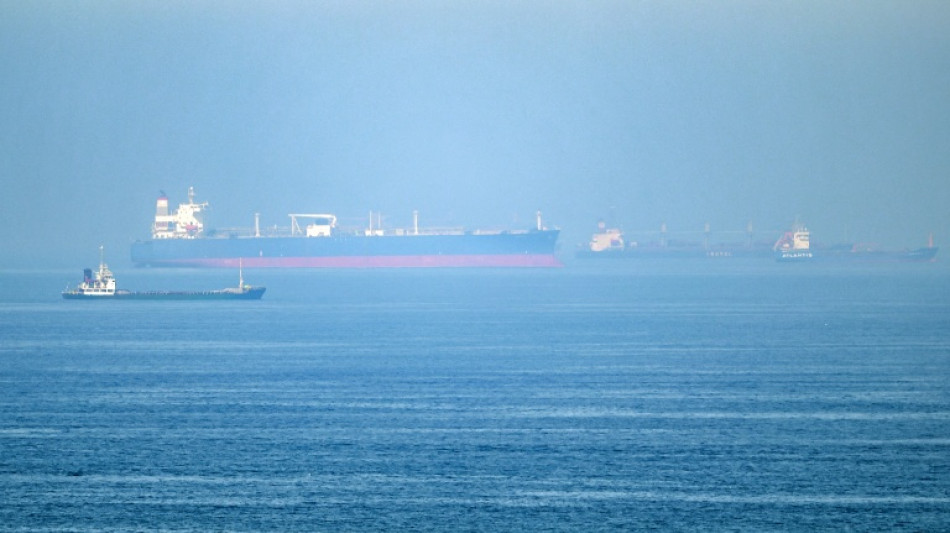
Hormuz: Traffic flows despite Iran's closure announcement / Photo: - - AFP

 Kospi Falls Below 5,000 as U.S. AI Regulation Fears Trigger Circuit Breaker

 Valsoft's TAG Software Group Enters the Content Operations Market with the Acquisition of Chalco

 South Korea Proposes Fourth Delay of Cryptocurrency Gains Tax to 2029

 ASIC Fines Mona Museum Owner's Company for Late Financial Report

 Business Leaders Criticize Productivity Commission Inquiry Scope

 SCANDIC FINANCE ने एलेक्स बोडी को समूह का उपाध्यक्ष नियुक्त किया
Maritime traffic in the Strait of Hormuz on Monday continued to flow at a faster pace than before the US-Iranian agreement on talks to end the Middle East war, according to tracking firms, despite Tehran's announcement of a renewed closure.
"The latest figures suggest a cautious but visible rebound in traffic following the MoU (memorandum of understanding between the United States and Iran), although the daily pattern remains volatile," Mihail Todorov of AXSMarine, a shipping data provider, told AFP.
As of 1530 GMT on Monday (late afternoon local time), the Kpler maritime tracking platform had already recorded 26 transits by commodity ships.
This level approached those of Thursday and Saturday, after the official signing of the agreement by US President Donald Trump and Iranian President Masoud Pezeshkian, when traffic was around 30 transits per day.
Including container ships, at least 26 commercial vessels had already transited the strait by Monday morning, according to AXSMarine navigation data.
Traffic on Saturday hit the highest levels since the start of the war, with AXSMarine recording 38 transits by commercial vessels, including 32 by commodity ships, according to Kpler.
Both records could be broken on Monday, once the day's figures are consolidated.
The Strait of Hormuz, which Iran closed at the start of the war, reopened last week, after the US-Iranian agreement was reached.
But Tehran announced on Saturday that it had closed the strategic waterway again in response to Israeli attacks in Lebanon.
Since then, Tehran and Washington have agreed on mechanisms to end the fighting in Lebanon and secure the strait, through which a fifth of the world's oil normally passes.
Both agreed to establish a line of communication "to avoid incidents and miscommunication with the aim of safe passage for commercial vessels through the Strait of Hormuz", according to Qatari and Pakistani mediators.
"Despite uncertainty surrounding the US–Iran talks, the Strait of Hormuz remained operational over the weekend," Nikos Pothitakis, press officer at Kpler, wrote on X on Monday.
He added that some ships had resumed sailing with their transponders turned off.
S.Caetano--PC