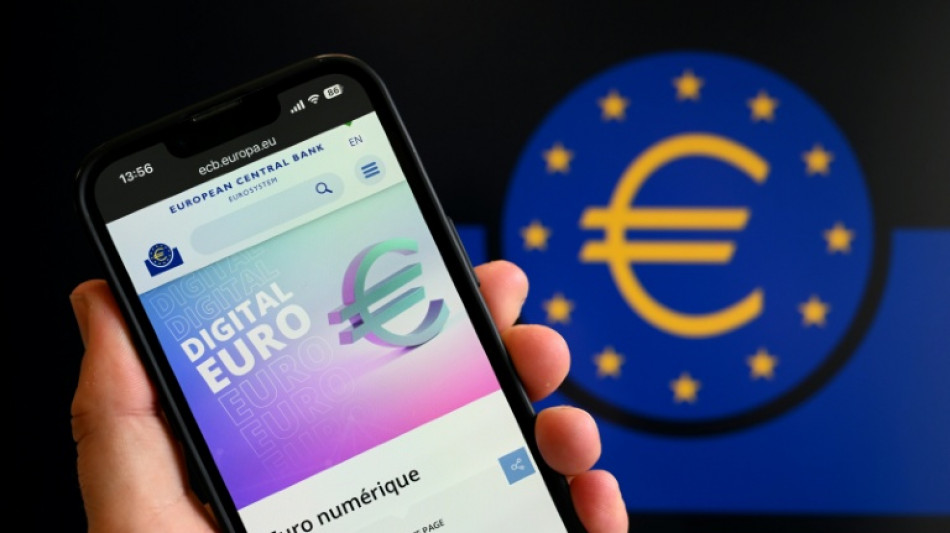
EU bets on digital euro to cut US tech addiction / Photo: Nicolas TUCAT - AFP/File

 Colombia declares three days mourning for quake victims

 44 lives lost after ferry capsizes on Zimbabwe's Lake Kariba

 WallStreetPR Releases Report on China’s Gold Purchases and African Mining Investment

 Former Chinese premier Zhu Rongji dies aged 97

 Markets steady awaiting US inflation data

 WHO says Trump vaccine shake-up goes against evidence

 Eclipse chasers flock to Spain for 'breathtaking' experience

 'To make the civilians leave': Russia pummels Ukraine's petrol stations
 Japan brushes off Australian PM's melon drama

 Rod Stewart cancels tour dates after heart surgery

 How Britain's mapmakers track climate change

 Australian delivery drivers win 'world-leading' pay rise

 Meta meets its own 'tobacco' moment in court

 Art or medicine? Japan's cosmetic tattoo artists in limbo

 Rybakina ousts Osaka to book Toronto semi-final against Gauff
 Colombia rescuers find woman alive as quake death toll passes 240

 Charges dropped against Bondi Beach attack hero
 Parched and desperate for rain, Kazakhstan turns to cloud-seeding
 The perfect storm that turbocharged Venezuela's twin quakes
 2.4 million girls banned from Afghan schools since Taliban return: UNESCO

 Colombians dig through rubble as quake death toll surpasses 240

 Karbon-X and Core Energy Sign Letter of Intent to Explore Commercial EV Charging Infrastructure in South America
 What to know about the total solar eclipse

 Tentoglou claims fourth Euro long jump title, injured Jacobs falters

 All Blacks knew Nonu would perform solo Haka - coach Rennie

The EU believes a digital euro is the answer to cutting its addiction to US payment systems like Visa and Mastercard as well as Apple Pay and Google Pay as the bloc seeks to favour European firms over others.
Brussels hopes it could provide an alternative local option for any payments in shops or online since people could easily pay, just like other systems, using a card, an app or via their banking app.
The European Union will move one step closer on Tuesday to creating a digital euro when EU lawmakers hold a long-awaited vote on the virtual currency.
The European Central Bank first suggested the digital euro in 2020 because Europe lacked its own system before the EU executive made its formal proposal.
The digital euro cannot be created without the rules underpinning the project being approved by the EU capitals and the European Parliament.
What is the digital euro?
Don't confuse it with your cash in the bank. When you use your bank card, Apple or Google Pay, you pay with physical money that exists in your account.
Instead, your digital euros would be in a separate virtual wallet.
The ECB hopes the digital euro will be available to citizens in 2029 if the EU negotiators greenlight the rules by the end of the year.
If that timeline sticks, the ECB is ready to launch a pilot programme in mid-2027 to test how it would work in practice.
Some say that is too long, but "banks and merchants need time to prepare so they can roll it out smoothly and at scale", Alessandro Giovannini, advisor to the digital euro director at the ECB told AFP.
How will it work?
Digital euros will have the same value as cash and banknotes.
Any user would need to create an account with a bank or a public institution like a post office, and transfer money into it from another account or via a cash deposit.
Users can then pay with digital euros in shops, online and between individuals using different methods including card, app or phone.
Officials stress the system would protect people's privacy, with no possibility to identify who made transactions, and an offline mode that would be as confidential as using cash.
"It wouldn't replace anything. Cash would still be available, and people could use existing private payment methods," the ECB's Giovannini said.
The digital euro would give more choice and let consumers "preserve their freedom to choose how to pay as daily life becomes more digital", he added.
Why does the EU want a digital euro?
Payment systems are "not neutral" but "instruments of power", centrist EU lawmaker Gilles Boyer said in a statement.
"We, Europeans, have had many wake-up calls about our dependence on the US. We're fully awake now, but we're not always acting," he said, adding Tuesday's vote would make "a sovereign, pan-European payment solution a reality".
EU officials often point to Washington's 2025 sanctions against International Criminal Court judges to illustrate the grip of US firms. French judge Nicolas Guillou has described how he lost access to his Visa card.
The digital euro is "a chance to end a dependence we have lived with for too long".
According to the ECB, nearly two-thirds of card payments in the euro area are handled by non-European companies -- mostly Visa and Mastercard.
And 13 out of 21 eurozone countries have no national card scheme for day-to-day payments in shops or online stores.
Who doesn't want it?
Banks. The main reason for their reticence is the cost.
Adapting the banking system to the digital euro will cost 18 billion euros ($20 billion), a report in April by the European Banking Federation said.
But the ECB insists it will cost the banking sector between four and 5.8 billion euros in investment costs.
Banks also fear the effects on their financial stability because if customers convert their money into digital euros, bank deposits would plummet.
The ECB says there is no risk.
"Thanks to its design that prevents large deposit outflows, the digital euro wouldn't cause these risks -- even in extreme and unlikely crisis situations," Giovannini said.
European banks also fear reduced demand for their online services and worry the digital euro is a rival to the pan-European payment system Wero.
A.Seabra--PC