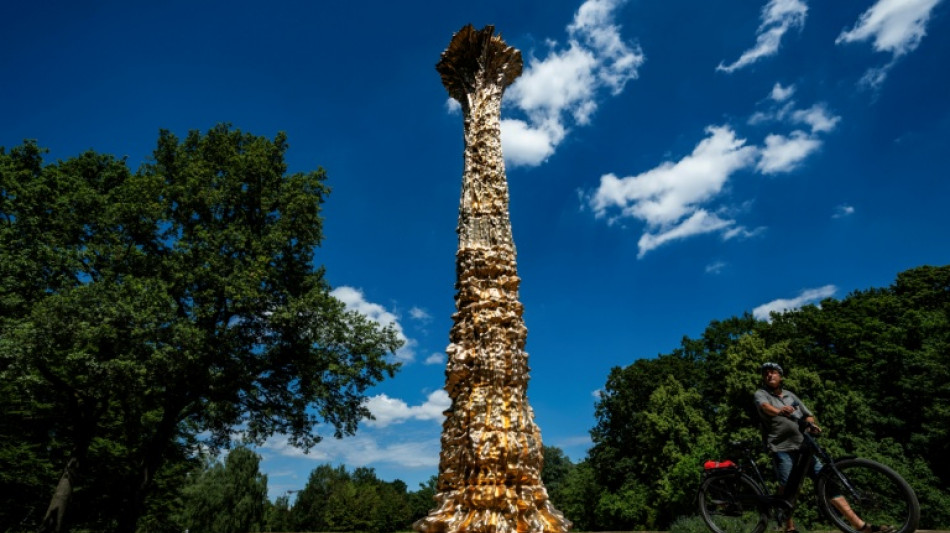
Berlin unveils monument to Jehovah's Witnesses murdered by Nazis / Photo: John MACDOUGALL - AFP

 How Britain's mapmakers track climate change

 Australian delivery drivers win 'world-leading' pay rise

 Meta meets its own 'tobacco' moment in court

 Art or medicine? Japan's cosmetic tattoo artists in limbo
 Rybakina ousts Osaka to book Toronto semi-final against Gauff

 Colombia rescuers find woman alive as quake death toll passes 240

 Charges dropped against Bondi Beach attack hero

 Parched and desperate for rain, Kazakhstan turns to cloud-seeding
 The perfect storm that turbocharged Venezuela's twin quakes

 2.4 million girls banned from Afghan schools since Taliban return: UNESCO
 Colombians dig through rubble as quake death toll surpasses 240

 New Zealand's ruling party meets to decide PM Luxon's fate

 Total solar eclipse to spellbind Europe

 Jodar, Nakashima to make Masters semis debuts in Montreal

 Chilean veteran Sanchez signs with MLS club Montreal

 Cristiano Ronaldo marries long-term partner Georgina Rodriguez

 Oil prices higher, stocks mixed ahead of inflation report
 Jacobs into 100m final with eye on third title
 Eight-try New Zealand cruise to tour victory over Sharks

 Trump's secret plane swap triggers questions and confusion
 California calls Paramount's threat to leave state 'blackmail'

 PSG 'want to win everything', says Luis Enrique

 Barred from elections, Russia's anti-war party vows to fight on
 Jaissle states Newcastle ambition but urges patience

 NBA star Cooper Flagg trading card a slam dunk for lucky buyer
Germany on Wednesday unveiled a monument to Jehovah's Witnesses persecuted and murdered by the Nazis -- a group that experts say has been historically overlooked in commemorations of the Holocaust.
Around 700 people attended the unveiling of the memorial, a bronze column reminiscent of a tree trunk, in Berlin's central Tiergarten park.
The German capital already has four major memorials dedicated to groups persecuted by the Nazis -- Jews, homosexuals, the Sinti and Roma community, and victims of the Third Reich's "euthanasia" programme targeting people with mental and physical disabilities.
"This is not a monument for an institution... it is not about judging a religious community. It is about bowing before the victims of National Socialism," said Julia Kloeckner, the president of the German parliament.
Germany voted to build a monument to Jehovah's Witnesses under the previous government of chancellor Olaf Scholz in 2023.
The religious minority, which traces its roots to early Christianity and promotes conservative moral values, has been present in Germany since the 19th century.
Today, there are around 180,000 Jehovah's Witnesses in the country, compared with around 25,000 in the 1930s.
They "unanimously and consistently resisted National Socialism on the basis of their faith", Wolfgang Benz, an independent historian specialising in the Nazi period, told AFP.
Jehovah's Witnesses refused to perform the Hitler salute, to swear an oath to the "Fuehrer" and to join the army or Nazi organisations.
- Purple flowers -
When Hitler came to power in 1933, the community was banned in Germany.
Around 14,000 Jehovah's Witnesses –- at least 10,700 Germans and 2,700 from European countries occupied by Germany -- were persecuted by the Nazis, mostly in the form of imprisonment.
Around 4,200 were sent to concentration camps and 1,700 were murdered, according to the Arnold Liebster Foundation, a German NGO founded by Jehovah's Witnesses.
Several members of the crowd on Wednesday had purple flowers pinned to their clothing -- a nod to the purple triangles Jehovah's Witnesses were forced to wear in the camps.
Jehovah's Witnesses were accused of being communists and stigmatised as a "Jewish sect", according to Benz.
The Catholic and Protestant churches turned a blind eye, urging their own adherents "not to get involved in political matters", the historian said.
After the war, Jehovah's Witnesses were also banned in communist East Germany from 1950 until reunification in 1990.
East Germany was hostile to them because they are "a very hermetic community and have their headquarters in America", said Benz, adding that their experience during the war was "ignored" for decades.
- Remembrance culture -
Cecilia Yankey, a 59‑year‑old administrative assistant who converted recently, told AFP she had "learned a lot" about her community at the unveiling of the memorial.
"I didn't know how the persecution had unfolded," she said.
Germany has seen several campaigns for more recognition for groups persecuted by the Nazis, including trade unionists, communists and people labelled "asocial" -- a term used to describe those considered outside the ideal "national community".
Remembrance of the Nazis' atrocities and the theme "never again" have for decades been a central feature of German politics and society as the country seeks to atone for its dark past.
But concerns are growing amid a rise in support for the far-right Alternative for Germany (AfD), which emerged as the second-biggest party in the federal elections in 2025.
Bjoern Hoecke, the AfD leader in Thuringia state, has called the central Holocaust memorial in Berlin a "memorial of shame".
Germany's culture of remembrance must be defended against the rise of the AfD, Benz said, but he added that Germany must also "fight our own arrogance and hubris, the idea that we are now world champions in commemoration and remembrance".
Remembering the crimes of the Nazis can be "arduous", said Kloeckner, from Chancellor Friedrich Merz's conservative CDU, but doing so "reveals the democratic freedom of our society".
Yankey said that "I think it's good that we keep trying to remember these events in Germany" despite the "major shift to the right".
N.Esteves--PC