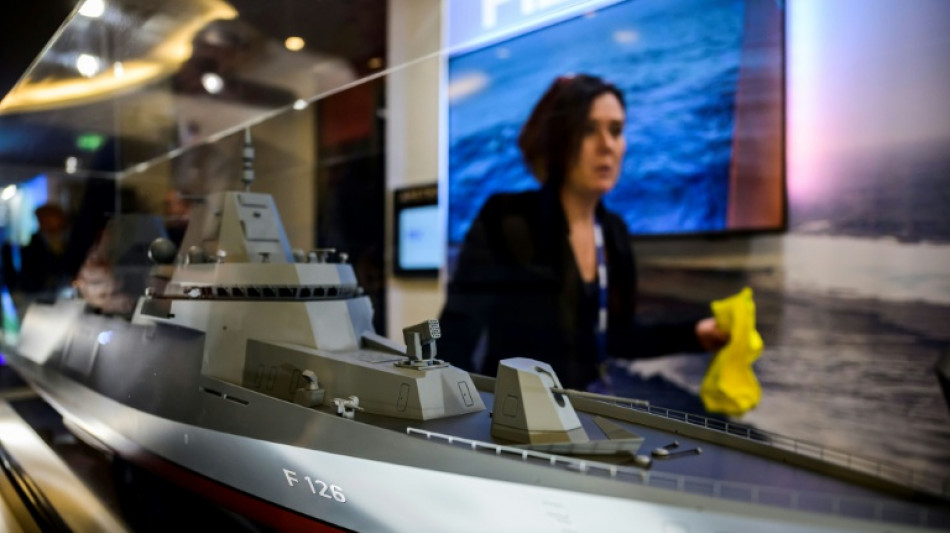
Germany sinks troubled warship project in blow to naval ambitions / Photo: John MACDOUGALL - AFP

 How Britain's mapmakers track climate change

 Australian delivery drivers win 'world-leading' pay rise

 Meta meets its own 'tobacco' moment in court

 Art or medicine? Japan's cosmetic tattoo artists in limbo

 Rybakina ousts Osaka to book Toronto semi-final against Gauff
 Colombia rescuers find woman alive as quake death toll passes 240

 Charges dropped against Bondi Beach attack hero

 Parched and desperate for rain, Kazakhstan turns to cloud-seeding
 The perfect storm that turbocharged Venezuela's twin quakes
 2.4 million girls banned from Afghan schools since Taliban return: UNESCO

 Colombians dig through rubble as quake death toll surpasses 240

 New Zealand's ruling party meets to decide PM Luxon's fate

 Total solar eclipse to spellbind Europe

 Jodar, Nakashima to make Masters semis debuts in Montreal

 Chilean veteran Sanchez signs with MLS club Montreal

 Cristiano Ronaldo marries long-term partner Georgina Rodriguez

 Oil prices higher, stocks mixed ahead of inflation report

 Jacobs into 100m final with eye on third title

 Eight-try New Zealand cruise to tour victory over Sharks

 Trump's secret plane swap triggers questions and confusion

 California calls Paramount's threat to leave state 'blackmail'

 PSG 'want to win everything', says Luis Enrique

 Barred from elections, Russia's anti-war party vows to fight on

 Jaissle states Newcastle ambition but urges patience

 NBA star Cooper Flagg trading card a slam dunk for lucky buyer

Germany on Wednesday pulled the plug on its largest naval order in decades after the mammoth warship project suffered lengthy delays, a setback for the country's ambitions to overhaul its military.
The multi-billion-euro project to build six next-generation frigates specialised in anti-submarine warfare was being abandoned in favour of purchasing eight smaller warships, Defence Minister Boris Pistorius said.
"Continuing the project would have involved a significant loss of time, disproportionately high costs, and also considerable risks," Pistorius said.
Germany had already spent 2.3 billion euros ($2.6 billion) on the troubled project to construct the F126 frigates, which was awarded in 2020 to Dutch shipyard Damen Naval, he conceded.
But he added: "Better a hard stop than a permanent limbo. We cannot afford that, neither financially nor in terms of time."
While the programme had long been in trouble, the announcement nevertheless came as a shock as German defence giant Rheinmetall had been widely expected to take over as lead contractor and complete the frigates.
Rheinmetall's shares dived some 20 percent in Frankfurt following the news.
The move is a setback for the EU's most populous country at a time it was seeking to rapidly build up its long-neglected armed forces to bolster its role in NATO and deter a hostile Russia.
Anti-submarine warfare has become a key focus for European NATO members following suspected Russian submarine manoeuvres near vital undersea cables and pipelines in the Baltic Sea and the Atlantic.
- All at sea -
Germany ordered four F126 submarine hunters in 2020 from Damen Naval, with the price set at 10 billion euros (then $11.2 billion), with the deal later expanded to include two more vessels.
The first was set to be delivered in 2028, with all due to be operational by 2033, according to the defence ministry.
But the project was beset by repeated delays, with the delivery of the first vessel pushed back to 2032.
"The navy would not have been able to provide the capabilities it has pledged to NATO in time," Pistorius said.
The Financial Times reported there were myriad problems in the complex project, in particular cultural clashes between the Dutch shipyard and German military procurement officials.
Damen struggled with officials' demands for submissions to be on paper as well as for documentation to be in German, the paper reported in April, citing industry sources.
- Procurement perils -
Rheinmetall CEO Armin Papperger told reporters in May that the defence giant, which has seen stellar growth as Europe rearms, was in talks with Berlin to take over the project, fuelling expectations of an imminent deal.
But the government ultimately concluded that handing over the work to NVL, a shipyard acquired by Rheinmetall in March, would be too costly, the defence ministry said.
Carrying on would have led to an estimated bill of over 18 billion euros, including money already spent as well as 15.2 billion euros for NVL to take it on.
It would have also meant the government forgoing a contractual right to sue Damen Navel for damages, the ministry added.
Pistorius said the government would seek to claw back some of the money spent on the doomed project but conceded there was "little prospect of success".
Instead of the F126s, Berlin will instead order eight smaller vessels of a type long in service from rival German contractor TKMS.
Under the plan, the government will pay 6.3 billion euros for four MEKO A-2000 frigates with an option to purchase another four for about 5.3 billion euros.
TKMS shares were up 16 percent following the news.
The saga throws a spotlight on the challenges for Germany's massive military build up, in particular slow and complex procurement processes.
Berlin has earmarked hundreds of billions of euros for rearmament over the coming decade, exempting most defence spending from strict constitutional borrowing limits.
X.Matos--PC