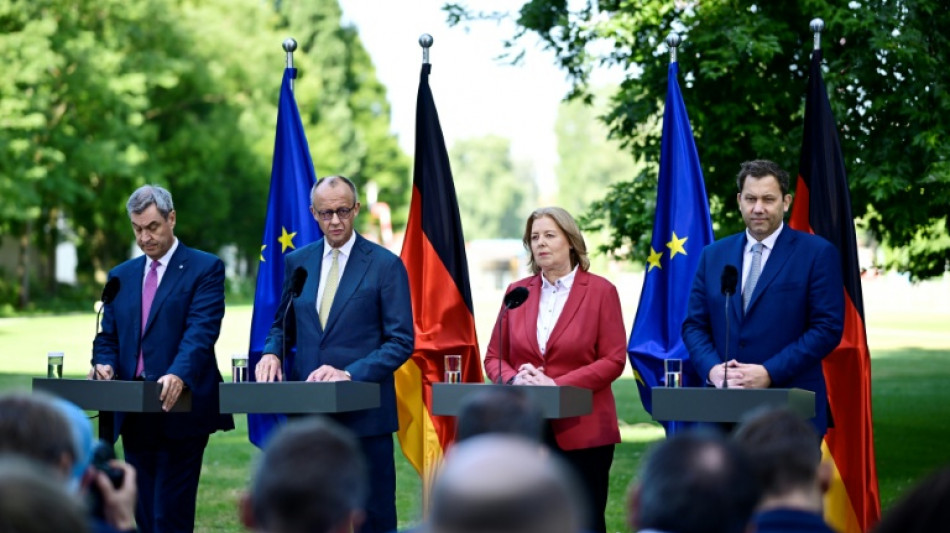
German ruling coalition agrees on major reform package / Photo: Tobias SCHWARZ - AFP

 US warns of rapid escalation in Mideast war

 Iran 'put hearts on the court' to win Asian Games basketball bronze

 School girl Yu helps China dominate in Asian Games swimming openers

 Myanmar win first Asian Games teqball gold as Spain great Puyol watches

 China's 13-year-old Yu scorches to first major gold at Asian Games

 Russians vote on last day of parliamentary elections

 Hong Kong pays final respects to former city leader Tung

 Typhoon put people off Asian Games opening ceremony, official says

 China's 13-year-old Yu cruises as Asian Games swimming begins

 AI 'warning shots' focus Beijing on national security risks

 Philippine tribe in limbo over US-led tech hub

 Leo XIV, first US pope transcends his restrained style

 Singer Ed Sheeran says Gaza situation 'unjustifiable' following controversy

 In 'Tenzing', a Sherpa mountaineer gets his due

 Ed Sheeran set to return to stage after Palestinian controversy

 Toulouse edge Vannes, Lyon beat Pau to take Top 14 summit

 Germans arrested for Louvre stunt in Mona Lisa hall

 Saudi-led coalition says Houthis fired ballistic missile at Riyadh

 France's debt climbs to highest since 1978: ministry

 McIlroy two shots off the lead at Wentworth after eagle on 18

 Martinez brace saves Inter in Serie A top-two clash with Roma

 Rosenior abused but guides Paris FC past old club Strasbourg

 Seven-try Lyon beat Pau, climb to Top 14 summit

 Brighton defeat a 'big lesson' against complacency for Arsenal, says Arteta

 Thousands protest inaction over climate crisis in Switzerland

Germany's ruling coalition has agreed on sweeping tax, labour and pension reforms, Chancellor Friedrich Merz said Thursday, a breakthrough aimed at reviving the struggling economy and countering the rise of the far right.
"We are working to increase the flexibility of our businesses," Merz told a Berlin press conference after lengthy talks between his centre-right CDU/CSU alliance and their coalition partners the centre-left SPD.
"We are working to cut red tape. We are working to protect our welfare state, and we are working to ease the burden on employees and companies by lowering taxes," said Merz, who had promised a "great leap forward" for German growth.
The package includes income tax cuts worth 10 billion euros ($11.4bn), to be financed by higher taxes on those earning more than 250,000 euros a year. And changes to the pension system will eventually see the retirement age rise past 67.
"The highest earners in this country will take on a larger share" of the tax burden, said Finance Minister and Vice Chancellor Lars Klingbeil of the SPD. "That is fair, so that our country can move forward."
The tax relief would mean an average family is about 600 euros better off per year, the parties said.
The coalition also agreed to reduce corporate reporting obligations that companies see as burdensome, and to scrap the right of employees to get a sick note by telephone with the aim of reducing worker absentee days in Germany.
It will also be possible to employ people on temporary contracts for up to four years.
Business organisations welcomed the plans, but trade union IG Metall said the labour reforms were "an attack on workers' rights".
- 'Under pressure' -
The coalition parties -- in power since May last year in Europe's biggest economy -- had been struggling for months to agree on a series of thorny issues.
The government is also keen to show it can get to grips with the country's problems and to diminish the appeal of the far-right Alternative for Germany (AfD), which has been topping national opinion polls for months.
Key regional elections will be held in September in formerly communist eastern Germany, which could produce the first-ever AfD-led state government. That would be unprecedented in post-war Germany and would underline Merz's dire approval ratings.
"We are doing everything we can to overcome our country's structural weakness when it comes to economic growth," Merz said, admitting that "we are under pressure from many sides".
Germany's export-led industry was long the engine of its economic success but has been hit hard by rising energy and labour costs. Tough Chinese competition and US President Donald Trump's erratic tariff blitz have only heightened the pressure.
In a part of the package which was seen as aimed at China, the coalition said the government would press for tougher action at the EU level against "unfair competition" as well as stricter rules on foreign investment in "strategic sectors and critical infrastructure".
Marion Muehlberger, senior economist at Deutsche Bank, said Thursday's announcement represented "one of (Germany's) biggest reform packages in decades" and showed the government's "ability to agree on important structural reforms".
She said that the package "should bode well for sentiment and dovetails with our forecast that growth will pick up in the second half of the year".
Holger Schmieding from Berenberg cautioned that "none of the many reforms... will be ground-breaking on its own".
"But on top of the major pension reform proposal which the government had already endorsed ten days ago, the reform deal can make a real difference," he said. "If implemented, Germany can become a better place to invest and create jobs again."
Marcel Fratzscher, president of the DIW institute, offered a more downbeat assessment, telling the Rheinische Post daily that the reforms did not represent "a great success but rather a symbolic package".
A.P.Maia--PC