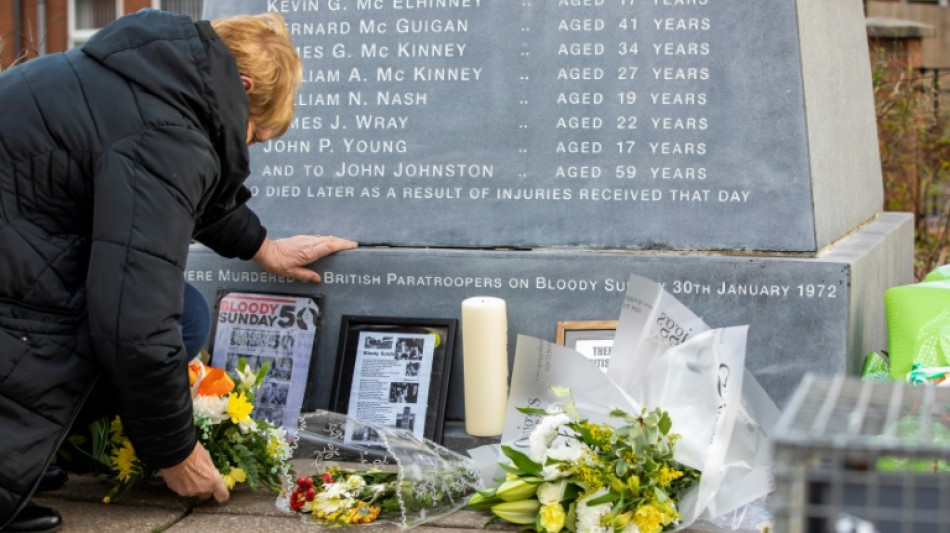
Catholic majority set to raise unification pressure in N.Ireland / Photo: PAUL FAITH - AFP

 Middletown High School Football Team Ends Legal Battle After Playoff Forfeit

 Canada Signals Openness to Chinese Automakers if US Trade Talks Fail

 US Mortgage Rate Falls for Fourth Week but Remains Above 7%

 US Jobless Claims Rise to 200,000 but Layoffs Remain Historically Low

 Euro-Area Growth Slows to 0.4% While Employment Stalls

 US Wholesale Inflation Eases Monthly but Hits a Four-Year Annual High

 India's Wholesale Inflation Jumps to 12.29% as Fuel Costs Surge

 Japan's Economy Edges Into Contraction as Costly Oil Weighs on Demand

 Kuwait and Egypt Sign Eight Agreements to Expand Strategic Partnership

 OBI Pharma Signs Collaboration and License Agreement with Novartis

The results of the 2021 census in Northern Ireland are due on Thursday, with expectations of a Catholic majority in the UK-run province for the first time in its history.
The region, which was plagued by decades of sectarian violence beginning in the 1960s, was carved out 101 years ago with an in-built Protestant majority designed to ensure power to pro-UK unionists.
Calls for equal civil and political rights among pro-Ireland Catholics were an early flashpoint for violence in the period of conflict known as "The Troubles", which killed 3,500 and ended with a 1998 peace deal.
The last Northern Ireland census in 2011 showed 45 percent of the population identified as Catholic, with 48 percent saying they were from a Protestant or other Christian background.
The 2001 census showed a 53-percent Protestant majority with 44 percent of the population identifying as Catholic.
If trends continue as expected, census figures showing a Catholic majority will add urgency to calls from nationalists for a referendum, known as a border poll, on the unification of Northern Ireland and the Republic of Ireland.
Elections to the regional assembly at Stormont in May were won for the first time in the province’s history by Sinn Fein, formerly the political wing of the paramilitary Irish Republican Army (IRA).
The party has also dominated recent opinion polls south of the border, putting Sinn Fein on course to hold the balance of power in both Belfast and Dublin following scheduled elections to the Irish parliament in 2025.
- Border poll? -
Unionist politicians have attempted to downplay the link between the census and a so-called border poll on continued British sovereignty of Northern Ireland.
Under the terms of the 1998 Good Friday Agreement, the UK Northern Ireland secretary should organise the vote "if at any time it appears likely to him that a majority of those voting would express a wish that Northern Ireland should cease to be part of the United Kingdom."
The largest unionist party, the Democratic Unionist Party (DUP), has refused to re-enter power-sharing with Sinn Fein following the May elections over their bitter opposition to post-Brexit trading rules.
They claim checks on goods from England, Scotland and Wales -- designed to protect the European single market because of the open border between Northern Ireland and EU member Ireland -- putting the province's place in the wider UK under threat.
UK Prime Minister Liz Truss's new government has threatened to rip up the agreement between Brussels and London, known as the Northern Ireland Protocol, failing concessions from the EU.
However, Truss's new Northern Ireland Secretary Chris Heaton-Harris has also urged the DUP to return to Stormont ahead of an October 28 deadline, at which point fresh elections must be called within 12 weeks.
Heaton-Harris has refused to rule out the possibility of an election before Christmas in a bid to increase the pressure on the DUP.
M.A.Vaz--PC

