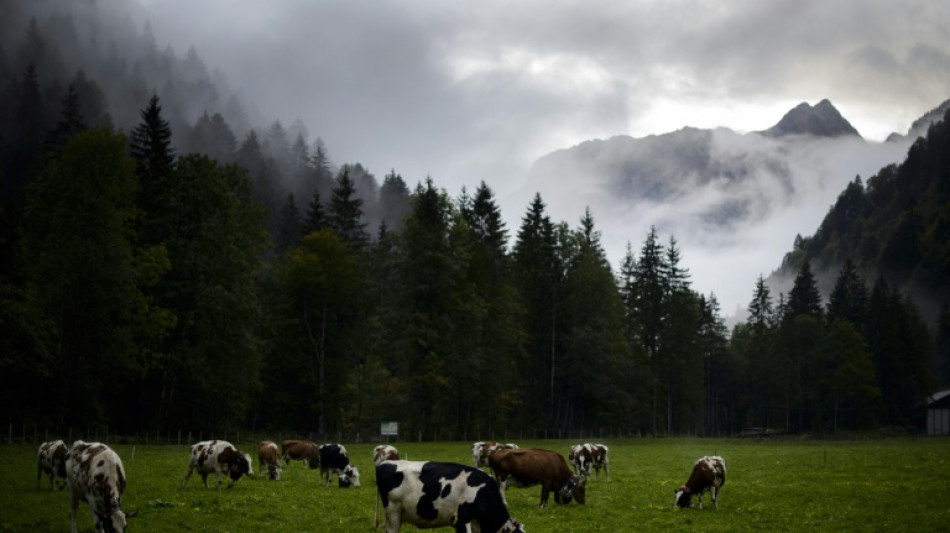
Swiss mull banning factory farms / Photo: FABRICE COFFRINI - AFP/File

 Middletown High School Football Team Ends Legal Battle After Playoff Forfeit

 Canada Signals Openness to Chinese Automakers if US Trade Talks Fail

 US Mortgage Rate Falls for Fourth Week but Remains Above 7%

 US Jobless Claims Rise to 200,000 but Layoffs Remain Historically Low

 Euro-Area Growth Slows to 0.4% While Employment Stalls

 US Wholesale Inflation Eases Monthly but Hits a Four-Year Annual High

 India's Wholesale Inflation Jumps to 12.29% as Fuel Costs Surge

 Japan's Economy Edges Into Contraction as Costly Oil Weighs on Demand

 Kuwait and Egypt Sign Eight Agreements to Expand Strategic Partnership

 OBI Pharma Signs Collaboration and License Agreement with Novartis

The Swiss will vote Sunday on whether to ban intensive livestock farming in the largely rural country, which already has some of the world's strictest animal welfare laws.
The animal rights and welfare organisations behind the initiative want to make protecting the dignity of farm animals like cattle, chickens or pigs a constitutional requirement.
Their proposal, which received more than the 100,000 signatures needed to put any issue to a popular vote under Switzerland's famous direct democracy system, would essentially eradicate all factory farming.
"We believe animal agriculture is one of the defining problems of our time," animal welfare group Sentience, which presented the initiative, says on its website.
It points to the "immense suffering experienced by animals on factory farms," but also to scientific studies showing that "industrial animal husbandry is disastrous for the environment and detrimental to our health".
If accepted, the initiative -- which has the backing of left-leaning parties, Greenpeace and other environmental organisations -- would impose stricter minimum requirements for animal-friendly housing and care, access to outdoors, and slaughtering practices.
It would also significantly shrink the maximum number of animals per pen.
- Price hikes -
The government and parliament oppose the initiative, insisting that Switzerland already has strict animal welfare laws defining how much living space each animal should have.
The initiative "goes too far," Swiss Health Minister Alain Berset told reporters in June, maintaining that the government for the past quarter century had been promoting "respectful animal husbandry".
According to the current laws, farms cannot keep more than 1,500 fattening pigs, 27,000 broiler chickens or 300 calves, basically ruling out the kinds of massive factory farms seen in other countries.
"There is no factory farming in Switzerland," insisted Marcel Dettling, a farmer and parliamentarian with the populist right-wing Swiss People's Party.
Pointing out that limits in neighbouring Germany for instance can be 100 times higher, he told Swissinfo.ch that the initiative would only serve to hike prices.
Sentience campaign manager Philipp Ryf, however, said that when you have 27,000 chickens crammed into a pen and only 12 percent of farm animals ever go outside, "we do think that is factory farming".
He acknowledged to AFP that the law in Switzerland "is quite strong compared to other countries", but added: "We don't necessarily think that's a good metric."
"We want to look at what we are doing... We think we could be doing more."
The government has also warned that if the initiative passes, prices would swell, and has cautioned it could also impact relations with trading partners.
This is because the requirements would also apply to the import of animals and animal products, which the government says would force Switzerland to violate its World Trade Organization obligations and to renegotiate trade agreements.
The Swiss would also have to invest large amounts in costly inspections of foreign farms, it argues.
- 'Misconception' -
Such arguments appear to have convinced a growing number of Swiss.
While early polls indicated that a slim majority was in favour of the initiative, the latest gfs.bern poll last week saw the "no" camp take the lead, with 52 percent of those questioned opposed to the move.
The farmers themselves appear particularly sceptical.
The latest poll showed 62 percent of those questioned in rural areas rejecting the proposal, while 53 percent of city-dwellers surveyed said they would vote in favour.
Ryf said the strong opposition in rural areas was largely due to a well-funded campaign by the initiative's opponents that had spread the "misconception" it would be bad for farmers.
"We regret that, because we do believe that our initiative will be good for farmers," he said, pointing out that it would provide them support and 25 years to implement the changes.
While Switzerland's largest farmers association is staunchly opposed to the initiative, many of those running smaller farms support it.
David Rotzler, who has a small, diverse livestock farm in Sonvilier in northern Switzerland, told the Journal du Jura daily that "animal welfare does not depend on the size of the farm, but on the farmer".
But, he said, it is certainly "easier to care for animals when you are smaller".
G.M.Castelo--PC

