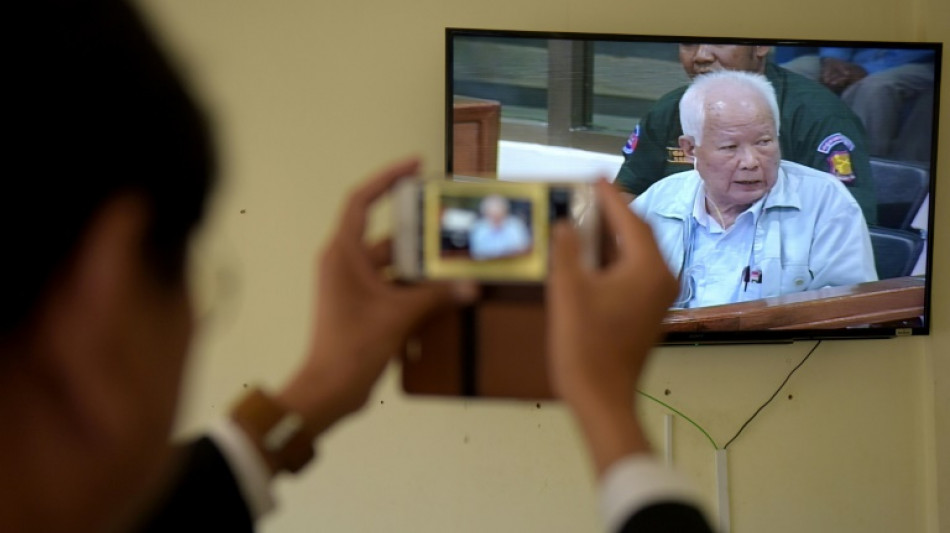
Cambodia Khmer Rouge court upholds conviction in final ruling / Photo: TANG CHHIN Sothy - AFP/File

 Middletown High School Football Team Ends Legal Battle After Playoff Forfeit

 Canada Signals Openness to Chinese Automakers if US Trade Talks Fail

 US Mortgage Rate Falls for Fourth Week but Remains Above 7%

 US Jobless Claims Rise to 200,000 but Layoffs Remain Historically Low

 Euro-Area Growth Slows to 0.4% While Employment Stalls

 US Wholesale Inflation Eases Monthly but Hits a Four-Year Annual High

 India's Wholesale Inflation Jumps to 12.29% as Fuel Costs Surge

 Japan's Economy Edges Into Contraction as Costly Oil Weighs on Demand

 Kuwait and Egypt Sign Eight Agreements to Expand Strategic Partnership

 OBI Pharma Signs Collaboration and License Agreement with Novartis

Cambodia's UN-backed Khmer Rouge war crimes court gave its final verdict Thursday, upholding the genocide conviction and life sentence imposed on the regime's last surviving leader.
The tribunal was ruling on an appeal by Khieu Samphan, head of state for the murderous communist regime which wiped out a quarter of the Cambodian population in less than four years in the 1970s.
It is the last verdict that will be issued by the tribunal, which has cost more than $330 million and prosecuted only five Khmer Rouge leaders, two of whom died during proceedings.
"The Supreme Court chamber finds no merit in Khieu Samphan's arguments regarding genocide and rejects them," Chief Judge Kong Srim said in the lengthy ruling.
The court also upheld the 2018 convictions against the 91-year-old for multiple crimes against humanity -- including murder, torture and enslavement -- on the basis of a "joint criminal enterprise", even if he did not personally take part in all crimes.
But it reversed convictions on several specific murder and persecution charges.
The hybrid court, with both Cambodian and international judges, was set up to try the senior leaders of the genocidal ultra-Maoist regime, which wiped out some two million people through starvation, torture, forced labour and mass executions during its 1975-79 rule.
Regime chief Pol Pot, known as "Brother Number One", never faced justice, dying in 1998 before the court was set up.
The genocide conviction relates to the persecution of ethnic-minority Vietnamese, seen by the Khmer Rouge as treacherous enemies within.
The chief judge said the charges related to "some of the most heinous events" during the Khmer Rouge's blood-soaked rule.
- Justice -
The frail Khieu Samphan sat hunched in a wheelchair in the dock, listening intently to the lengthy ruling through headphones.
Some 500 people packed into the courtroom to hear the verdict, including Khmer Rouge survivors, Buddhist monks, diplomats and government officials.
"I want justice for all victims because we suffered so much. The Pol Pot regime was so brutal," survivor You Soeun, 67, told AFP.
Alongside Khieu Samphan in the 2018 case, "Brother Number Two" Nuon Chea was also sentenced to life for genocide and other crimes, including forced marriages and rapes.
Nuon Chea died in 2019.
Both men were given life sentences by the court in 2014 for crimes against humanity in another case related to the violent forced evacuation of Phnom Penh in April 1975, when Khmer Rouge troops drove the population of the capital into rural labour camps.
The only other person convicted by the special court was Kaing Guek Eav, better known as Duch, head of the notorious S-21 torture interrogation centre where about 18,000 people were murdered.
Like Nuon Chea, Duch also died several years after being convicted.
While the tribunal, formally known as the Extraordinary Chambers in the Courts of Cambodia (ECCC), has secured few convictions, experts say it has done valuable work in promoting national reconciliation.
In earlier appeal hearings, Khieu Samphan's lawyers accused the tribunal of taking a "selective approach" to testimony and of using legal criteria that he could not have known when the alleged crimes took place more than 40 years ago.
J.Pereira--PC

