
World markets plunge on growing recession fears / Photo: KAREN BLEIER - AFP

 US Retail Sales and Fed Minutes Set Up a Critical Test for Consumers

 MotorTrend’s Top Hybrid Vehicle Picks for 2026

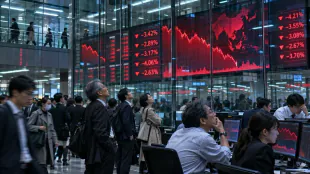 Asian Markets Slide as AI Concerns Hit Chip Stocks

 Brazil Faces Debt and Inflation Test as Lula Prepares Fourth Term
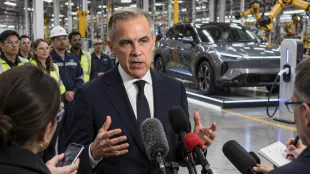
 Canada Expands Asian Trade Push as US Negotiations Resume

 Jennie Earns Two Grammy Nominations as Major K-pop Agencies Boycott New Asian Pop Category

 Italy Raises 2026 Growth View but Warns Energy Will Keep Inflation High

 UK Economy Grows 0.7% in Third Quarter as Services Lead Expansion

 India's Retail Inflation Reaches 6.09% as Food Prices Accelerate

 China's October Activity Data Reveal a Weak Start to the Fourth Quarter

 Critics Demand Stronger Action from Jeffries and Schumer Following Democratic Wave

 Grand Theft Auto VI: Inside the Decade-Long Development of a Billion-Dollar Cultural Phenomenon

 Maldon Sea Salt Uses Imported German Rock Salt in Production Process
Stock markets tumbled, the pound crashed against the dollar and oil prices slumped Friday on growing recession fears after central banks this week ramped up interest rates to fight decades-high inflation.
With price rises showing no solid sign of letting up, monetary policymakers have been forced to go on the offensive, warning that short-term hits to economies are less painful than the long-term effects of not acting.
The Federal Reserve's decision Wednesday to lift borrowing costs by 0.75 percentage points for a third successive meeting was followed by a warning that more big rises were in the pipeline and that rates would likely come down only in 2024.
That came along with similar moves by banks in several other countries including Britain, Sweden, Norway, Switzerland, the Philippines and Indonesia -- all pointing to a dark outlook for markets.
"We see this new even-higher-for-longer rate path as associated with a substantially higher likelihood of a hard landing, and so not just unambiguously hawkish but unambiguously bad for risk," said Krishna Guha, vice-chair of Evercore ISI.
In a sign that recession expectations are rising, the 10-year US Treasury yield jumped to 3.7 percent, its highest level in a decade, while on Wall Street the S&P 500 has sunk to its weakest level since June and just above its 2022 lows.
The UK 10-year yield struck at an 11-year high at 3.84 percent Friday.
The pound slumped to $1.1021, the lowest level since 1985, even as the UK government unveiled a tax-cutting budget aimed at driving growth.
In the eurozone, recession fears deepened as data showed its economic activity fell once again in September.
The S&P eurozone PMI dropped to 48.2 in September -- with a score under 50 representing economic contraction.
"A eurozone recession is on the cards as companies report worsening business conditions and intensifying price pressures linked to soaring energy costs," said Chris Williamson, chief business economist at S&P Global Market Intelligence.
He added that falling UK business activity this month indicates that the British economy is likely already in recession.
Traders were keeping a close eye also on developments following the Japanese finance ministry's intervention to support the yen, after it hit a new 24-year low of 146 against the dollar.
The first such intervention since 1998 helped strengthen the yen to just above 140.
But analysts warned the move was unlikely to have much long-term impact and the yen remained vulnerable owing to the Bank of Japan's refusal to tighten policy -- citing a need to boost the economy.
Recession fears also caused oil prices to fall by more than three percent.
- Key figures at around 1115 GMT -
London - FTSE 100: DOWN 2.4 percent at 6,984.85 points
Frankfurt - DAX: DOWN 2.6 percent at 12,201.91
Paris - CAC 40: DOWN 2.4 percent at 5,777.00
EURO STOXX 50: DOWN 2.6 percent at 3,337.10
Hong Kong - Hang Seng Index: DOWN 1.2 percent at 17,933.27 (close)
Shanghai - Composite: DOWN 0.7 percent at 3,088.77 (close)
Tokyo - Nikkei 225: Closed for a holiday
New York - Dow: DOWN 0.4 percent at 30,076.68 (close)
Pound/dollar: DOWN at $1.1059 from $1.1252 Thursday
Euro/dollar: DOWN at $0.9760 from $0.9839
Euro/pound: UP at 88.27 pence from 87.40 pence
Dollar/yen: UP at 142.90 yen from 142.35 yen
West Texas Intermediate: DOWN 3.4 percent at $80.68 per barrel
Brent North Sea crude: DOWN 3.2 percent at $87.56 per barrel
burs-bcp/rfj/lth
B.Godinho--PC