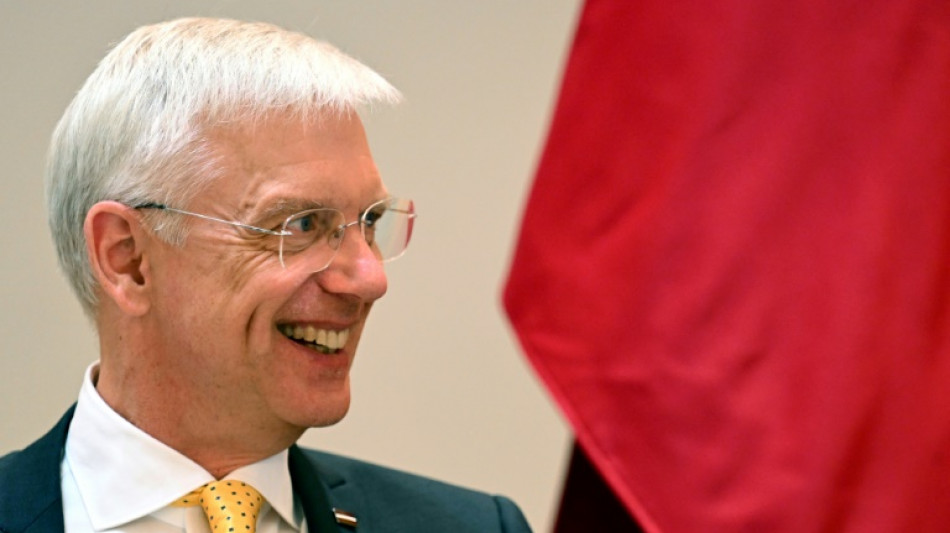
Centrists set to win as Latvia holds elections / Photo: GABRIEL BOUYS - AFP/File

 RBI Grants Paytm In-Principle Approval to Revive Wallet Business

 China's Factory Activity Contracts as Export Orders Weaken

 US Retail Sales and Fed Minutes Set Up a Critical Test for Consumers

 MotorTrend’s Top Hybrid Vehicle Picks for 2026

 Asian Markets Slide as AI Concerns Hit Chip Stocks

 Brazil Faces Debt and Inflation Test as Lula Prepares Fourth Term

 Canada Expands Asian Trade Push as US Negotiations Resume

 Jennie Earns Two Grammy Nominations as Major K-pop Agencies Boycott New Asian Pop Category

 Italy Raises 2026 Growth View but Warns Energy Will Keep Inflation High

 UK Economy Grows 0.7% in Third Quarter as Services Lead Expansion

 India's Retail Inflation Reaches 6.09% as Food Prices Accelerate

 China's October Activity Data Reveal a Weak Start to the Fourth Quarter

 Critics Demand Stronger Action from Jeffries and Schumer Following Democratic Wave

 Grand Theft Auto VI: Inside the Decade-Long Development of a Billion-Dollar Cultural Phenomenon
Latvians headed to the polls on Saturday in the shadow of neighbouring Russia's invasion of Ukraine, with victory expected for centrist parties that have vowed to continue backing Kyiv.
Opinion polls ahead of the general election have shown a weakening of populists, conservatives and the social-democratic party Harmony which usually has strong support from Latvia's large Russian-speaking minority.
Political expert Marcis Krastins said Prime Minister Krisjanis Karins was "most likely" to win, depending on how many smaller parties supporting him get past the five percent threshold for entering parliament.
"Russians invading Ukraine helps Karins to secure voters in Latvia because in such times people tend to rally around the flag," Krastins said.
Karins's New Unity Party topped one recent opinion poll with 13.3 percent.
Harmony, which has come first in recent elections but has lacked enough allies to govern the Baltic state, got 5.1 percent.
Ahead of the election, President Egils Levits warned voters against backing politicians in the Russian-speaking community who "hesitated to clearly state who is the aggressor and who is the victim at the outset of the Russian invasion".
Referring to the energy crisis and economic difficulties, he warned against populists saying he was "highly sceptical of political parties and figures promising to get us out of this mess quickly and easily.
"I do not trust those who offer simple, and most often useless, solutions to extraordinarily complex problems," he said in a statement.
Dominated over the centuries by Teutonic knights, Swedes, Poles, then Russians, Latvia gained independence in 1918 before finding itself under Soviet occupation in 1944-1990.
Today, the Russian-speaking minority makes up around 30 percent of the population of 1.8 million.
Polling stations opened at 0400 GMT and close at 1700 GMT.
- Fears over Russian expansionism -
Along with inhabitants of nearby Poland and their Baltic neighbours Lithuania and Estonia, many Latvians are worried about Russia's expansionist plans and feel their country is vulnerable even though it is an EU and NATO member.
The outgoing government has shown strong support for Ukraine, hiked defence spending and worked towards greater energy security.
The Harmony party, which scored 20 percent at the last election in 2018, has been on a path of gradual decline since then in part because of a series of corruption scandals.
Harmony has condemned Russia's invasion but has been less vocal about accusations that Russian forces are carrying out human rights atrocities.
The Russian-speaking electorate has turned to two new parties -- one that is openly pro-Kremlin and another favourable to Russia but less staunchly so.
Some Russian speakers in Ukraine say Latvian attitudes towards them have deteriorated since the war started and feel their linguistic and cultural identity is being challenged.
"In Latvia, Russian-speakers are in a way collateral victims of the war," said Miroslavs Mitrofanovs, co-chairman of the Latvian Russian Union party.
P.Queiroz--PC

